Seeking Sydney is a podcast that travels to the landscapes and landmarks of Sydney, adding the people and their stories. This episode, Episode 10, is the final episode. The whole series is now available in your podcast subscription, on the Spineless Wonders website, in Apple podcasts or Spotify or iHeart!
I’m starting this post with special mention and thanks to Bronwyn Mehan, Spineless Wonders; Martin Gallagher, Echidna Audio: sound design; Zoe Hercus: publicity; Bettina Kaiser: logo & artwork; Peter Barley: extra voices and extra above-and-beyond support. I really couldn’t have done it without you.
All the people whose interviews I’ve used in this episode are acknowledged below, but I would also like to add thanks to the many people who suggested interviews and helped me to contact interviewees. Thanks to the people who I nearly interviewed, but where the timing just didn’t work. Thanks also to the people who declined to be interviewed – most of you were very kind (and far too self-effacing) in your refusals. The letter of rejection from Paul Keating, with its official letterhead, I will treasure forever.
Finally, to the person who many friends recommended and tried to contact for me, thank you for your one-line email – ‘I’m too busy’. It has given my household much amusement, and a personal by-word for not doing something.
Once this blog is written I’m off to do something very important. I’m too busy for this.
The final episode
In this, the final episode of Seeking Sydney series 1, we’re wrapping it all up. We go west to the Hawkesbury River and talk more about survival and adaptation. And I include what the people I’ve interviewed have had to say about Sydney. It’s really surprisingly sweet.
I started this series on the east coast of Sydney and wandered a route that took us from Bondi to La Perouse. I jumped from Bondi to Watson’s Bay and from there up to Darlinghurst and Kings Cross. The next two episodes took us west into the CBD, from Surry Hills down to the harbour, and then further west into Glebe and Leichhardt. The Parramatta River carried us down to Parramatta and the story of Nah Doong took us on to Penrith. Now we’re at the Hawkesbury River, or Dyarubbin.
I could also say I travelled from Eora country into Darug.
The Hawkesbury officially starts where the Grose and Nepean Rivers meet, north of Penrith, nearly at Richmond. Jakelin Troy defines ‘the Sydney language’ as being spoken by a tribe that lived across an area from the coast to the Hawkesbury and Nepean Rivers to the north and west, and as far south as Appin. The Hawkesbury was the western boundary of the original colony of Sydney – the County of Cumberland. Permanent settlement wasn’t authorised outside the County of Cumberland until 1820.
The first interview of this episode is with Grace Karskens. Her research into the convicts who went to the Hawkesbury shows that they came from rural areas of England, and she’s convinced that they were farmers. The land was rich, and they were successful in producing enough grain by 1796 to support the colony.
But that rich soil out around the Hawkesbury is Aboriginal land. Those convict farmers paved the way for an influx of colonisers, and – despite fighting hard for their land – the Darug and Darkinjung people were eventually driven off.
It’s land that has continued to be possessed and dispossessed, as Bette Mifsud relates. Her family arrived in Sydney from Malta in 1954 and established their first market garden there. They went on to establish three more market gardens, each time being forced off when the land was rezoned for housing. And, as Bette says, ‘you can’t compete with that kind of money and power.’
The British colonisers were not of one mind in their attitude to the Aboriginal people. Some of them, like Richard Windeyer – a barrister who arrived in Sydney in 1835 – were determined to expose and address the dispossessions and cruelty suffered by the Aboriginal population. He convened the Select Committee on the Condition of the Aborigines in 1845. The committee’s report was published in 1847, but by then Windeyer was dead, and unable to continue his work.
Grace Karskens and Paul Irish are both historians of early Sydney, and they agree that you have to acknowledge the dead but also the living – the survivors. As Paul Irish says:
‘Aboriginal people were smashed by that early impact of the arrival of Europeans – of violence, dispossession of lands and resources, disease, which was a particularly stark thing that happened in Sydney. But there were survivors and they regrouped and they regrouped and continued to live, as much as they could, in ways that they could determine themselves. They also adapted to their new situations and made a way of life that included interacting with the colony. If we stop the story soon after Europeans arrive, it makes it really impossible to see that continuity.’ [interview 30 August 2024]
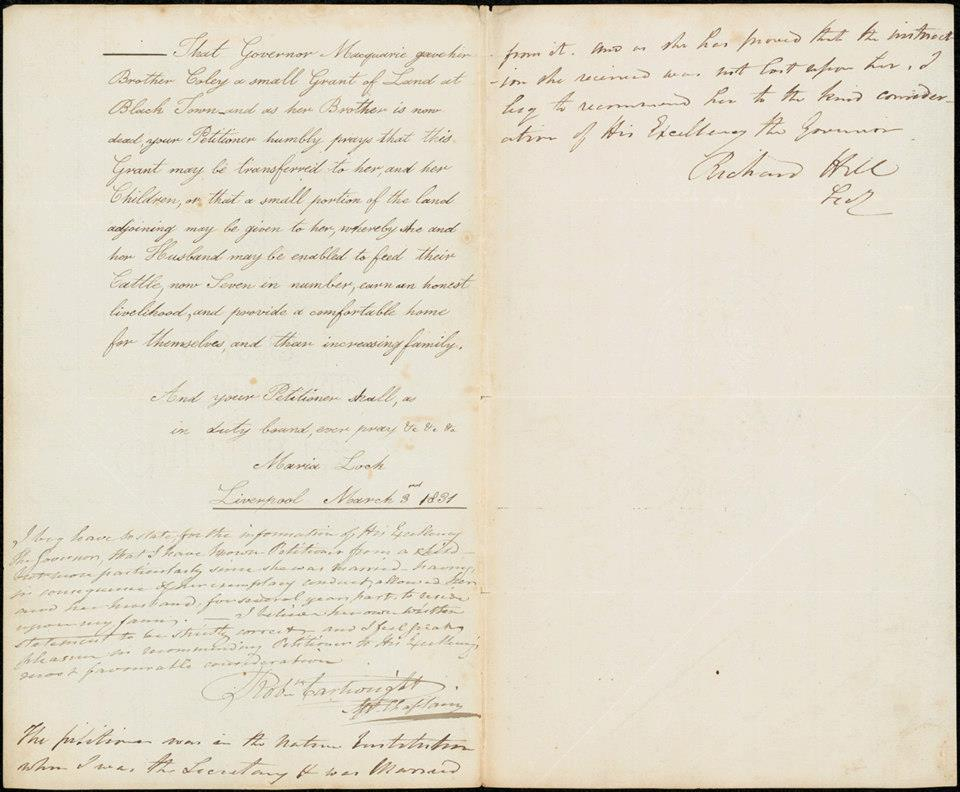
In 2017 Grace Karskens made a discovery that has given Darug people back a missing link in their culture and language – a list of 177 of their Dyarubbin place names. They were collected by a Presbyterian minister, Reverend John McGarvie, in 1829 and they remained hidden in his journal until Grace unearthed them nearly 200 years later. You can see reproductions of the lists here. You can hear Grace’s description of that discovery, still excited by its meaning, in this episode of Seeking Sydney, or you can read it here. Darug and Darkinjung language was still being spoken in the early 20th century and an early anthropologist, RH Matthews, wrote down some of its words and grammar, but the list of place names brings a whole culture back to life.
Language, and the names of people and places are so important to our identity. Jing Han tells how early Chinese immigrants to Australia were misunderstood, giving rise to a surname that’s not really a surname. Bette Mifsud tells how her parents maintained their Maltese dialect in Australia, but when they went back to Malta after 25 years they found that it had virtually died out. In her Masters of Fine Arts thesis on migration Bette described history as ‘a collection of layered elements – a sedimentation of theory, ideas, fiction, emotion and memory. Whilst a story is being told, other stories are being written and others still being retold again, but differently.’ For me, this sums it up perfectly.
I finish episode 10 with the ‘stories of Sydney’ that the people I interviewed told me. They range from appreciation of its environmental beauty to the variety of its urban landscapes, and how it’s viewed by its artists. Matthew Doyle had a memory of performing woggan-ma-gule, the morning ceremony, in the Royal Botanic Gardens, and Julie Gibson had a memory of body surfing at Cronulla (here she is).
You’ll have to listen to the episode to hear me give architect John Richardson the final word. His delivery is immaculate.
Acknowledgements
Interviewees for episode 10: my thanks to you all
Grace Karskens, Emeritus Professor of Australian History at the University of New South Wales. Her books include The Rocks: Life in Early Sydney (1997), The Colony: A History of Early Sydney (2009) and People of the River: Lost Worlds of Early Australia (2020).
Paul Irish, historian and archaeologist, author of Hidden in Plain View
Felicity Castagna, on Instagram at @Felicity Castagna
Deborah Lennis, Cultural Advisor Inner West Council
John Richardson, Sydney architect
Bette Mifsud, a first-generation Maltese-Australian visual artist who grew up on family market-gardens in North Western Sydney during the 1960s and ‘70s, and now lives on Dharug and Gundungurra lands in the Blue Mountains. Website: https://www.bette-mifsud.com/#/ Instagram: https://www.instagram.com/bette.mifsud/
Matthew Doyle, Aboriginal Performing Artist, Muruwari/ Yuwalaraay nations. Instagram: @Wuruniri
Jing Han, a leading intercultural communication expert and director of the Institute for Australian and Asian Arts and Culture at Western Sydney University. Instagram: jinghan2020
Wendy Bacon, https://www.wendybacon.com/
Steven Penning, Sydney employment lawyer specialising in workplace relations and safety
Joss Bell, resident of Daceyville
Julie Gibson, revolutionary, activist, organiser, philosopher, filmmaker, photographer, Glebe resident for 30 years. Bodysurfer, student, computer programmer, mother, teacher, friend, kayaker, walker, ping pong player, cyclist, technical writer. Farmer and Landcare activist.
References
Jakelin Troy’s definition of the Sydney Language is from Troy, J. The Sydney Language. Produced with the assistance of the Australian Dictionaries project and AIATSIS, Canberra 1993, p8.
The description of the Australian Aborigines Progressive Association is from: Heather Goodall and Allison Cadzow. Rivers and resilience: Aboriginal people on Sydney’s Georges River. UNSW Press, 2009, p144.
NSW Legislative Council Votes and Proceedings, 1846. ‘Replies to a circular letter from the Select Committee on the Aborigines’. Microfilm, p554.
The description of the next Select Committee in the Legislative Council to consider the Aboriginal people – the 1849 inquiry into the Protectorate and the Aborigines – as ‘a body strongly weighted in favour of the pastoralists’ is from: Heather Goodall. Invasion to Embassy: Land in Aboriginal Politics in New South Wales 1770-1972. Allen & Unwin in association with Black Books. 1996, p53.
 Kathy Prokhovnik