• Home
  • Welcome
  • Latest post
  • Sydney snaps
  • Tapitallee tales
  • Climate urgency
  • At the farm
  • About

Kathy Prokhovnik

~ Seeking Sydney and more

Kathy Prokhovnik

Category Archives: Seeking Sydney

Seeking Sydney, Episode 10: Survival and adaptation

Featured

Posted by kathyprokhovnik in Seeking Sydney

≈ 4 Comments

Seeking Sydney is a podcast that travels to the landscapes and landmarks of Sydney, adding the people and their stories. This episode, Episode 10, is the final episode. The whole series is now available in your podcast subscription, on the Spineless Wonders website, in Apple podcasts or Spotify or iHeart!

I’m starting this post with special mention and thanks to Bronwyn Mehan, Spineless Wonders; Martin Gallagher, Echidna Audio: sound design; Zoe Hercus: publicity; Bettina Kaiser: logo & artwork; Peter Barley: extra voices and extra above-and-beyond support. I really couldn’t have done it without you.

All the people whose interviews I’ve used in this episode are acknowledged below, but I would also like to add thanks to the many people who suggested interviews and helped me to contact interviewees. Thanks to the people who I nearly interviewed, but where the timing just didn’t work. Thanks also to the people who declined to be interviewed – most of you were very kind (and far too self-effacing) in your refusals. The letter of rejection from Paul Keating, with its official letterhead, I will treasure forever.

Finally, to the person who many friends recommended and tried to contact for me, thank you for your one-line email – ‘I’m too busy’. It has given my household much amusement, and a personal by-word for not doing something.

Once this blog is written I’m off to do something very important. I’m too busy for this.

The final episode

In this, the final episode of Seeking Sydney series 1, we’re wrapping it all up. We go west to the Hawkesbury River and talk more about survival and adaptation. And I include what the people I’ve interviewed have had to say about Sydney. It’s really surprisingly sweet.

I started this series on the east coast of Sydney and wandered a route that took us from Bondi to La Perouse. I jumped from Bondi to Watson’s Bay and from there up to Darlinghurst and Kings Cross. The next two episodes took us west into the CBD, from Surry Hills down to the harbour, and then further west into Glebe and Leichhardt. The Parramatta River carried us down to Parramatta and the story of Nah Doong took us on to Penrith. Now we’re at the Hawkesbury River, or Dyarubbin.

I could also say I travelled from Eora country into Darug.

The Hawkesbury officially starts where the Grose and Nepean Rivers meet, north of Penrith, nearly at Richmond. Jakelin Troy defines ‘the Sydney language’ as being spoken by a tribe that lived across an area from the coast to the Hawkesbury and Nepean Rivers to the north and west, and as far south as Appin. The Hawkesbury was the western boundary of the original colony of Sydney – the County of Cumberland. Permanent settlement wasn’t authorised outside the County of Cumberland until 1820.

The first interview of this episode is with Grace Karskens. Her research into the convicts who went to the Hawkesbury shows that they came from rural areas of England, and she’s convinced that they were farmers. The land was rich, and they were successful in producing enough grain by 1796 to support the colony.

But that rich soil out around the Hawkesbury is Aboriginal land. Those convict farmers paved the way for an influx of colonisers, and – despite fighting hard for their land – the Darug and Darkinjung people were eventually driven off.

It’s land that has continued to be possessed and dispossessed, as Bette Mifsud relates. Her family arrived in Sydney from Malta in 1954 and established their first market garden there. They went on to establish three more market gardens, each time being forced off when the land was rezoned for housing. And, as Bette says, ‘you can’t compete with that kind of money and power.’

The British colonisers were not of one mind in their attitude to the Aboriginal people. Some of them, like Richard Windeyer – a barrister who arrived in Sydney in 1835 – were determined to expose and address the dispossessions and cruelty suffered by the Aboriginal population. He convened the Select Committee on the Condition of the Aborigines in 1845. The committee’s report was published in 1847, but by then Windeyer was dead, and unable to continue his work.

Grace Karskens and Paul Irish are both historians of early Sydney, and they agree that you have to acknowledge the dead but also the living – the survivors. As Paul Irish says:

‘Aboriginal people were smashed by that early impact of the arrival of Europeans – of violence, dispossession of lands and resources, disease, which was a particularly stark thing that happened in Sydney. But there were survivors and they regrouped and they regrouped and continued to live, as much as they could, in ways that they could determine themselves. They also adapted to their new situations and made a way of life that included interacting with the colony. If we stop the story soon after Europeans arrive, it makes it really impossible to see that continuity.’ [interview 30 August 2024]

In 2017 Grace Karskens made a discovery that has given Darug people back a missing link in their culture and language – a list of 177 of their Dyarubbin place names. They were collected by a Presbyterian minister, Reverend John McGarvie, in 1829 and they remained hidden in his journal until Grace unearthed them nearly 200 years later. You can see reproductions of the lists here. You can hear Grace’s description of that discovery, still excited by its meaning, in this episode of Seeking Sydney, or you can read it here. Darug and Darkinjung language was still being spoken in the early 20th century and an early anthropologist, RH Matthews, wrote down some of its words and grammar, but the list of place names brings a whole culture back to life.

Language, and the names of people and places are so important to our identity. Jing Han tells how early Chinese immigrants to Australia were misunderstood, giving rise to a surname that’s not really a surname. Bette Mifsud tells how her parents maintained their Maltese dialect in Australia, but when they went back to Malta after 25 years they found that it had virtually died out. In her Masters of Fine Arts thesis on migration Bette described history as ‘a collection of layered elements – a sedimentation of theory, ideas, fiction, emotion and memory. Whilst a story is being told, other stories are being written and others still being retold again, but differently.’ For me, this sums it up perfectly.

I finish episode 10 with the ‘stories of Sydney’ that the people I interviewed told me. They range from appreciation of its environmental beauty to the variety of its urban landscapes, and how it’s viewed by its artists. Matthew Doyle had a memory of performing woggan-ma-gule, the morning ceremony, in the Royal Botanic Gardens, and Julie Gibson had a memory of body surfing at Cronulla (here she is).

You’ll have to listen to the episode to hear me give architect John Richardson the final word. His delivery is immaculate.

Acknowledgements

Interviewees for episode 10: my thanks to you all

Grace Karskens, Emeritus Professor of Australian History at the University of New South Wales. Her books include The Rocks: Life in Early Sydney (1997), The Colony: A History of Early Sydney (2009) and People of the River: Lost Worlds of Early Australia (2020). 

Paul Irish, historian and archaeologist, author of Hidden in Plain View

Felicity Castagna, on Instagram at @Felicity Castagna 

Deborah Lennis, Cultural Advisor Inner West Council

John Richardson, Sydney architect

Bette Mifsud, a first-generation Maltese-Australian visual artist who grew up on family market-gardens in North Western Sydney during the 1960s and ‘70s, and now lives on Dharug and Gundungurra lands in the Blue Mountains. Website: https://www.bette-mifsud.com/#/ Instagram: https://www.instagram.com/bette.mifsud/ 

Matthew Doyle, Aboriginal Performing Artist, Muruwari/ Yuwalaraay nations. Instagram: @Wuruniri

Jing Han, a leading intercultural communication expert and director of the Institute for Australian and Asian Arts and Culture at Western Sydney University. Instagram: jinghan2020

Wendy Bacon, https://www.wendybacon.com/

Steven Penning, Sydney employment lawyer specialising in workplace relations and safety

Joss Bell, resident of Daceyville

Julie Gibson, revolutionary, activist, organiser, philosopher, filmmaker, photographer, Glebe resident for 30 years. Bodysurfer, student, computer programmer, mother, teacher, friend, kayaker, walker, ping pong player, cyclist, technical writer. Farmer and Landcare activist.

References

Jakelin Troy’s definition of the Sydney Language is from Troy, J. The Sydney Language. Produced with the assistance of the Australian Dictionaries project and AIATSIS, Canberra 1993, p8.

The description of the Australian Aborigines Progressive Association is from: Heather Goodall and Allison Cadzow. Rivers and resilience: Aboriginal people on Sydney’s Georges River. UNSW Press, 2009, p144.

NSW Legislative Council Votes and Proceedings, 1846. ‘Replies to a circular letter from the Select Committee on the Aborigines’. Microfilm, p554.

The description of the next Select Committee in the Legislative Council to consider the Aboriginal people – the 1849 inquiry into the Protectorate and the Aborigines – as ‘a body strongly weighted in favour of the pastoralists’ is from: Heather Goodall. Invasion to Embassy: Land in Aboriginal Politics in New South Wales 1770-1972. Allen & Unwin in association with Black Books. 1996, p53.

Share this:

  • Click to share on X (Opens in new window) X
  • Click to share on Facebook (Opens in new window) Facebook
Like Loading...

Seeking Sydney, Episode 9: Time travel

Featured

Posted by kathyprokhovnik in Seeking Sydney

≈ Leave a comment

Tags

Maria Lock, Mousqueda, Nah Doong, Parramatta

Seeking Sydney is a podcast that travels to the landscapes and landmarks of Sydney, adding the people and their stories. I will publish one episode every month for ten months. Episode 9 is now available in your podcast subscription, on the Spineless Wonders website, in Apple podcasts or Spotify or iHeart!

I call this episode ‘Time travel’ because we all time travel sometimes. We’re time travelling when we walk down a street and realise that a house that we’ve always looked at, is gone. We can still see every detail of it, but what is actually in front of us is a wire fence barricading off a piece of empty land.

Felicity Castagna sees how the streets and surrounds of Parramatta tell stories of their past and present inhabitants. She sees the migrant stories in the grand columns and staircases, and the stories of aspiration and hope in the fibro and red brick cottages.

Parramatta was established as part of the colony soon after the settlement at Sydney Cove. The soil at Parramatta was better than Sydney’s, and Governor Phillip was keen to make it the colony’s focus. But, as Naomi Parry Duncan says, the move out to Parramatta,

“was a military invasion. It wasn’t like Sydney Cove where it had been reasonably friendly, a beachhead settlement. Aboriginal people were like, oh yeah, these guys, well they don’t seem to be going very far. They don’t seem to know what they’re doing. So, yeah, it’s fine. We can hang around with them. We can enjoy their company. But once they went out to Parramatta and started to gobble up the land and push the people away from their lagoons and their rivers, and the places where they caught eel, the places of ceremony, the important places. Once they did that, then it was like, hang on a minute. And so war was the result. But they were outgunned. Literally.”

Naomi has been researching one of the people who fought in that war, the warrior Mousqueda [also Musquito], probably an Eora man, for 20 years. She tells his story vividly, giving us a sense of the people and dilemmas of that time. Mousqueda was arrested in 1805, but the war in the wider frontier beyond Parramatta continued. The Appin massacre of at least 14 Aboriginal men, women and children in April 1816, ordered by Governor Macquarie, marks the beginning of the final stage of that war.

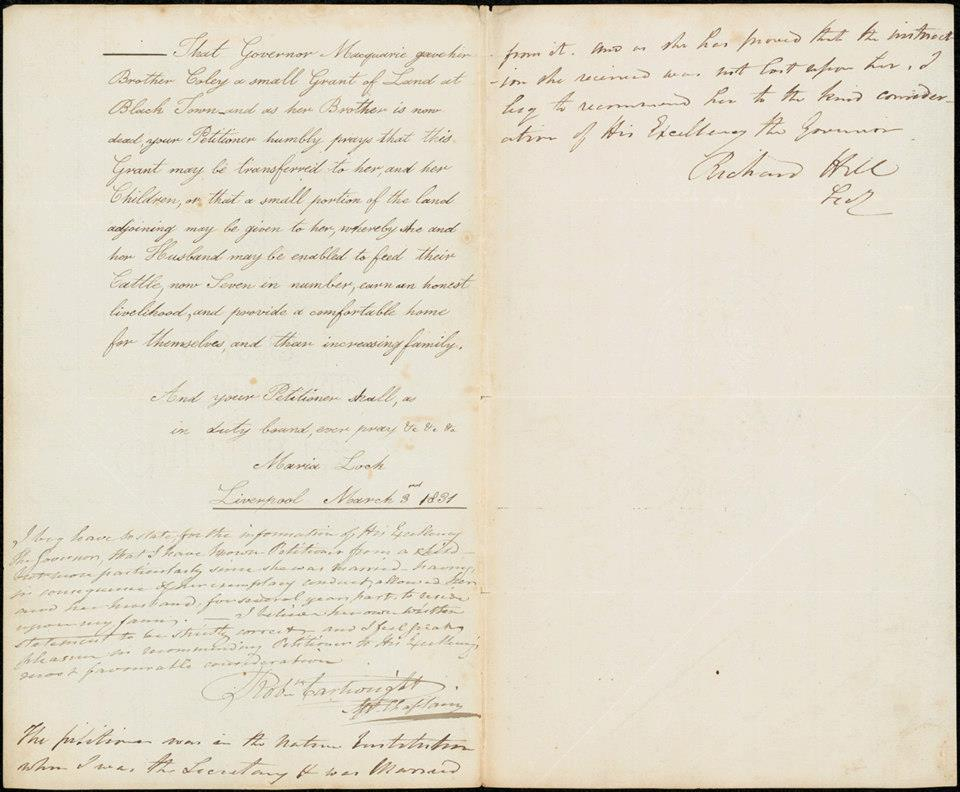
Macquarie arrived in the colony in 1810, not only determined to re-establish the rule of law after the military coup of 1808, but also determined to ‘civilise’ the Aboriginal people. He stated that he would do this through education – ‘in habits of industry and decency’ – and farming. He established the Native Institution in Parramatta, opened at the end of 1814 with four Aboriginal children. You can read its history here, and you can see the document that established it here. You can read an 1819 article about it from the Sydney Gazette here, including the report that the 14-year-old Aboriginal girl, Maria Lock, had won the overall prize for the schools in the colony. Maria Lock’s brother Colebee was granted 30 acres of land (with Nurragingy) in 1819, in the area now known as Blacktown. When both Colebee and Nurragingy died, Maria Lock petitioned Governor Darling for the land. You can see the petition here. She was eventually successful.

One of the saddest things about my research has been discovering, for so many institutions that I seek information about, ‘find and connect’ web pages, with their content warnings before you open the page:

This website contains material that is sometimes confronting and disturbing. Words or images can cause sadness or distress, or trigger traumatic memories for people, particularly survivors of past abuse, violence or childhood trauma.

There is one for the Parramatta Girls Home, established in 1887 in Fleet Street, North Parramatta. It operated under various names until 1975, with as many as 30,000 girls being placed in it over those years. Here is its ‘find and connect’ page.

Switching to the future, and a more hopeful aspect of life in the Parramatta area, is the Westmead Innovation District. John Richardson, a Consulting Partner with COX Architecture, has worked with the team developing this project. He outlined, in our interview, what an innovation district is and why Westmead was such a good choice for one.

There are obvious sustainability and social benefits of people living close to their work and high-class health facilities. Sydney – and the world – needs as much action on sustainability as we can get. Australia’s first National Climate Risk Assessment, finally released in September 2025, warns that the changing climate is likely to lead to more intense and extreme climate hazards – such as floods, cyclones, drought, fires and increased temperatures – in places where they haven’t been experienced before, more frequently and for longer periods.

But Penrith, on the northern edge of Western Sydney, has already been named the hottest place on Earth, with a temperature of 48.9 degrees recorded on January 4 2020. This was also the hottest day ever recorded in Greater Sydney.

Keeping with this episode’s theme of time travel, a 2023 article takes us travelling into the not-too-distant future. The first sentence of that article, ‘Impact of Accelerated Climate Change on Maximum Temperature Differences between Western and Coastal Sydney’ states:

“Increasing global emissions threaten to disproportionately impact the future of Greater Western Sydney (GWS), with some suburbs already experiencing temperatures 8 °C to 10.5 °C greater than the Sydney coastal region during heatwaves.”

And finally, going back to the past, Grace Karskens concludes episode 9 with the story of Nah Doong. You can hear, and read, a longer version of it here or here.

I hope you’ve been enjoying Seeking Sydney. Please share it, and listen out for Episode 10 – the last episode.

Acknowledgements

Interviewees for episode 9: my thanks to you all

Grace Karskens, Emeritus Professor of Australian History at the University of New South Wales. Her books include The Rocks: Life in Early Sydney (1997), The Colony: A History of Early Sydney (2009) and People of the River: Lost Worlds of Early Australia (2020). 

Felicity Castagna, on Instagram under @Felicity Castagna 

Naomi Parry Duncan, professional historian on Bluesky under @drnaomi 

Paul Irish, historian and archaeologist, author of Hidden in Plain View

Deborah Lennis, Cultural Advisor Inner West Council

John Richardson, Sydney architect

Thanks also to:

Bronwyn Mehan, Spineless Wonders

Martin Gallagher, Echidna Audio: sound design

Zoe Hercus: publicity

Bettina Kaiser: logo & artwork

Peter Barley: extra voices

References

In this episode I referred to two books that are full of insights and different ways of looking at Australia’s past:

Billy Griffiths, Deep Time Dreaming, Black Inc (2018), p4 and p234.

Heather Goodall and Allison Cadzow. Rivers and resilience: Aboriginal people on Sydney’s Georges River. UNSW Press, 2009, p53.

Share this:

  • Click to share on X (Opens in new window) X
  • Click to share on Facebook (Opens in new window) Facebook
Like Loading...

Seeking Sydney, Episode 8: What must it take?

Featured

Posted by kathyprokhovnik in Seeking Sydney

≈ 2 Comments

Tags

immigration

Seeking Sydney is a podcast that travels to the landscapes and landmarks of Sydney, adding the people and their stories. I will publish one episode every month for ten months. Episode 8 is now available in your podcast subscription, on the Spineless Wonders website, in Apple podcasts or Spotify or iHeart!

In this episode I spend some more time discussing ideas of migration, identity and racism with three people who have lived them and considered them deeply. The title comes from Bette Mifsud saying:

“I tried to put myself in my parents’ shoes actually thinking, What must it take? What it must have been like for my mum to leave a very large family behind, where you’ve got a village community, where everybody supports everyone, where your grandparents live with you until they die, where the grandparents look after the children when you’re at work. All of those things were gone. Mum didn’t have that.”

I interviewed Bette late in 2024, travelling to her home in the Blue Mountains to interview her in her home, surrounded by the bush. She and her partner Trevor have made their block very productive, with fruit trees and a huge veggie patch, and she sent me away with bags of lemons and limes, just as her parents would:

“my parents being the incredibly generous people that they are – this is a thing you always did in Malta. You gave your neighbours food, so they got to know us by dad giving them lots of fresh fruit and veggies every week.”

Bette describes her life growing up as the child of migrants from Malta, and how it became urgent for her to leave her parents’ home in order to establish her own life. It struck me how similar this story was to Kylie Kwong’s story – which you can read here – with similarities right down to the father crying, for the first time that anyone had ever seen, and how momentous this was.

I also interviewed Lucy Taksa. Her father’s family originated in Ukraine near Kiev, her mother’s family from Poland. After an upsurge of anti-semitism in Poland, they obtained humanitarian migrant assistance to migrate to Australia in 1960.

In July 1945 Arthur Calwell had become the first Minister of the newly-created Department of Immigration. He initiated a massive program of migration on the grounds that it was going to arrest Australia’s falling birth rate, provide labour to rebuild the post-war economy, and inhabit Australia’s furthest corners to stop potential invaders. (Remember Felicity Castagna talking about invasion novels in episode 7?) The preferred migrants were British, but Calwell also looked to the Scandinavian countries and Western Europe, then to the camps holding 1.6 million refugees from the war. In the ten years between 1951 and 1961, 833,000 people migrated, with Southern Europeans slightly outnumbering British (33% to 32%). The vast majority of immigrants settled in the major cities, with 55% of Sydney’s growth between 1947 and 1966 attributed to post-war immigration.

Immigrants might have provided the labour needed to boost Australia’s economy, but they weren’t getting any special treatment. They had to assimilate, somehow, and get on with it.

The third person interviewed in this episode is Jing Han. She came to Australia first in 1988 as an international student, went back to China after finishing her PhD but found that her heart belonged to Sydney. She talks about the culture shock of moving, the good and the bad, and concludes that:

“… there are always cons and pros in every system. So there is no system which has all bad things.”

Jing worked at SBS TV for many years, translating Chinese programs into English and becoming Head of SBS Subtitling. She now works at Western Sydney University as Professor of Translation and director of the Institute for Australian and Asian Arts and Culture.

In 1980 Joe Dolce released his single, ‘Shaddap you face’, tackling the Australian approach to immigrants head-on. He parodied how Australians stereotyped immigrants (in this case, Italians) as well as letting the stereotypes fight right back: ‘ah, shaddap you face!’ I wrote to him about it in 2006, and he wrote back – a generous, fascinating email that he gave me permission to reproduce.

“It was mostly unconscious at the time as I was twenty-five years younger,” he wrote. “I had always been a ‘peace and love’ hippy in the decades before I wrote the song, and when I moved to Australia and saw how marginalised ethnic people were, I guess it must have just sunk in on some level and the song just sort of wrote itself, as a kind of humorous protest declaration. I mean, sometimes making things funny is a great way to disarm pain and frustration. But it also was a great singalong. There were a lot of things that came together to make it work, not just the social aspect. Now however, I sing the song much more politically consciously and have even had it translated into an Aboriginal language which I teach people to sing the Aboriginal words to at concerts. At the Cygnet Folk Festival in Tasmania in January [2007] I am hosting the second ‘Inspired Shaddap You Face Contest’ where other serious festival guests are invited to perform their interpretation of the song. It was a big hit concert at last year’s National Folk Festival (won by a Celtic Bagpipe band!) and so far the acts who are participating are: 1. Los Capitaines – a nasty, black Nick Cave-y ‘Bad Seeds’ version; 2. Will Lane – an experimental classical version – avant-garde contemporary viola virtuoso; 3. One Step Back – Bluegrass; 4. Gorani – male choral tradition from Georgia; 5. Kazakstan Kowgerls – Bulgarian women’s a capella; 6. DUO SWANGO – ‘European Gypsies travel to Latin America’ version; 7. Kavisha Mazzella – traditional Italian.”

Before ‘Shaddap you face’ there was the 1957 book, They’re a Weird Mob, a comedy about Australian attitudes to migrants, and the Australian language. Its author, John O’Grady, published it under the name of ‘Nino Culotta’. It was filmed in 1966, giving me the link to my final interview for Episode 8 – Naomi Parry Duncan telling her favourite Sydney story, about the TV series, Skippy.

They’re a Weird Mob is not only a film about the migrant experience, but it stars Claire Dunne as Kay Kelly. Claire Dunne, OAM, was a foundation director of SBS (where Jing Han worked for many years), and worked there herself as a presenter and producer of radio and television. She strongly opposed attempts in 1986 to close SBS and merge it with the ABC. Her OAM (Order of the Medal of Australia) was awarded for her contributions to multicultural education and broadcasting. She’s even had her portrait painted by Sinead Davies and selected for the Archibald, with the title ‘The Irish immigrant – portrait of Claire Dunne OAM’.

But there’s more. The producers of Skippy – Lee Robinson, Bob Austin and John McCallum – met during the making of They’re a Weird Mob. John McCallum is credited with ‘luring’ producer Michael Powell to Australia to film it. (Remember Felicity Castagna in Episode 7 pointing out that “we didn’t even start publishing books in Australia until the 1950s. Our books were imported from the UK. Even our authors had their books published overseas and brought back.”? Here, in 1966, we have British producer Michael Powell being ‘lured’ to Australia to produce a very Australian film.)

Just to cement the connection between immigration and Skippy, the film’s cast included Ed Devereaux (ie Skippy’s Matt Hammond, head ranger of Waratah National Park) and Tony Bonner (ie Jerry King, handsome helicopter pilot and ranger) plus other actors who would go on to guest-star in Skippy.

You can see all this for yourself. Here’s They’re a Weird Mob. And here’s a collection of information about Skippy, including clips of Skippy dubbed into other languages: https://www.nfsa.gov.au/collection/curated/skippy-bush-kangaroo-celebrating-hit-1960s-tv-show

Acknowledgements

Interviewees for episode 8: my thanks to you all

Bette Mifsud: a first-generation Maltese-Australian visual artist who grew up on family market-gardens in North Western Sydney during the 1960s and 70s, and now lives on Dharug and Gundungurra lands in the Blue Mountains. Her website is at https://www.bette-mifsud.com/#/ and Instagram is https://www.instagram.com/bette.mifsud/  Special thanks to Bette for the use of her family photos and personal photos from https://www.bette-mifsud.com/portraits.html#/

Lucy Taksa, Professor of Management, Deakin University Business School 

Jing Han, a leading intercultural communication expert and director of the Institute for Australian and Asian Arts and Culture at Western Sydney University. Instagram: jinghan2020

Naomi Parry Duncan: Professional historian on Bluesky under @drnaomi 

Thanks also to:

Bronwyn Mehan, Spineless Wonders

Martin Gallagher, Echidna Audio: sound design

Zoe Hercus: publicity

Bettina Kaiser: logo & artwork

Peter Barley: extra voices

References

Statistics and quotes on migration from Collins, J. Migrant Hands in a Distant Land. Pluto Press, 1991 (2nd ed.) pp 22, 36, 228.

Maria Paolini’s story in Give me strength: Forza e coraggio. Italian Australian Women Speak. Anna Maria Kahan-Guidi and Elizabeth Weiss (eds), Women’s Redress Press, 1990, p67.

Angela Signor’s story in Give me strength: Forza e coraggio. Italian Australian Women Speak. Anna Maria Kahan-Guidi and Elizabeth Weiss (eds), Women’s Redress Press, 1990, p107.

John McCallum is credited with ‘luring’ producer Michael Powell to Australia: from https://www.smh.com.au/national/renaissance-man-of-entertainment-20100204-ng3e.html

Dr Naomi Parry Duncan’s significance statement about Skippy: https://naomiparry.net/wp-content/uploads/2021/03/Skippy-Collection-Significance-Statement.pdf

More about Skippy: https://aso.gov.au/titles/series/skippy/

Share this:

  • Click to share on X (Opens in new window) X
  • Click to share on Facebook (Opens in new window) Facebook
Like Loading...

Seeking Sydney, Episode 7: Change and the river

Featured

Posted by kathyprokhovnik in Seeking Sydney

≈ 2 Comments

Tags

Barangaroo, Kelly's Bush, Parramatta River, Rydalmere, Silverwater Women's Correctional Centre, Sydney ferries, Sydney Olympics, Whitlam Institute

Seeking Sydney is a podcast that travels to the landscapes and landmarks of Sydney, adding the people and their stories. I will publish one episode every month for ten months. Episode 7 is now available in your podcast subscription, on the Spineless Wonders website, in Apple podcasts or Spotify or iHeart!

In Episode 7, I travel down the Parramatta River on the ferry. Leaving from Circular Quay, the ferry stops often, and you move from hectic Sydney Cove – Warrane – to the slow-moving river, surrounded by mangroves.

Along the way, there are so many stories. We catch sight of the cat’s cradle that is the Anzac Bridge. We stop at the Barangaroo wharf, named for the Cammeraygal woman who was highly critical of the white colonists. Grace Karskens has written about her, and her skill as a fisherwoman, here. We go past the island Me-Mel [Goat Island] where Judge-Advocate David Collins saw her with her husband, Bennelong, noting that Bennelong claimed it as his. That claim is finally being honoured.

Birchgrove marks the official spot where river meets harbour. At the next stop, Cockatoo Island, we can look across to Kelly’s Bush and remember the 13 residents who became the Battlers for Kelly’s Bush, joining forces with the unions and turning their patch of local bush into a celebrated first: the first green ban. Ben Ewald gives a first-hand account of the importance of the bush to the local children, and remembers the scale of the opposition to development.

2021 was the 50th anniversary of this momentous event and to celebrate, Hunters Hill Museum put together a fascinating exhibition. This was unfortunately affected by Covid closures but, with the help of Hunters Hill Council, an electronic presentation of The Battle for Kelly’s Bush can be viewed here. There are lots of websites that discuss the battle. The Hunters Hill Trust has a page dedicated to the battle and to the upkeep of the area. And this is a nice one that discusses a green ban in Eastlakes that drew strength from the Kelly’s Bush precedent. This one includes some contemporary footage from ABC news, including a short interview with Elizabeth James, one of the Battlers. This one is a general description of the first green bans, and this one is a whole website dedicated to green bans. This one describes the industries in Woolwich. This is an interesting article on green bans from 1974, including a list of green bans at the time. The article is based on a booklet produced by Wendy Bacon and others. Wendy is still fighting for the protection of communities and the environment, and she talks knowledgeably in this episode about the value of protest.

Two questions arise for me: what are the legacies of the green bans, and, could green bans work today? Wendy answers the first – large swathes of Sydney, particularly the inner city, would have vanished – and Sydney lawyer Steven Penning answers the second – spoiler alert: probably not.

Past the wharves at Drummoyne, Chiswick and Abbotsford we chug, then Cabarita and Kissing Point. Bennelong was buried at Kissing Point, as news reports in 2011 told us, but that site is yet to be honoured.

Opposite Kissing Point there is a pretty little building on the shore: the watergate to the Thomas Walker Convalescent Hospital. There is a picture of it here, along with a history of the site.

After Meadowbank is the Sydney Olympic Park wharf, reminding me of the 2000 Olympics and happy Sydney. It also reminds me of Matthew Doyle saying that he contributed music and choreography, and his own performance. Here is a link to the Indigenous section of the opening ceremony. Take the time to watch it through – it’s brilliant.

A little further along we go under Silverwater Road, and I’m reminded of a story that Wendy Bacon told me about the Silverwater Women’s Correctional Centre, once called Mulawa. She was there as part of the Women Behind Bars group, in support of Violet Roberts. Here is some more information about that action, and here is a radio program about it.

The river has slowed considerably, and as we approach Rydalmere I realise that we’re going to have to get off there, and not actually reach Parramatta. This is reminiscent of the days when Redbank Wharf was the end of the ferry service, so here is a photo of that wharf. Press on ‘Info’ to see more about the photo. Here is some information about the tram between Parramatta and Duck River.

One of the reasons I wanted to interview Felicity Castagna was because of her essay, The Loop. Both she and Jing Han work at the Parramatta South Campus of the University of Western Sydney. The campus includes The Female Orphan School, which now houses the Whitlam Institute. You can sing along to ‘It’s Time’ here. Try to smile as convincingly as everyone in the video.

Finally, there are lots of sites with more information on the notorious Tampa affair, but you could start here with Amnesty International.

And here are a couple of general sites that talk about the Parramatta River.

This one is from a talk given in 1919 by a Parramatta resident, recalling the river between 1848 and 1861.

This one is a beautiful, sad, insightful essay about the river and its meaning for its traditional owners, by Willem Brussen. He says, ‘I know that the river is not the same as it was for my ancestors, and despite attempts at restoration, I’m not sure it will ever be the same. However, the river like its people is still here and therein lies some hope for the future.’

Acknowledgements

Interviewees for episode 7: my thanks to you all

Felicity Castagna, on Instagram under @Felicity Castagna 

Ben Ewald, former resident of Balmain and Hunters Hill

Wendy Bacon, https://www.wendybacon.com/

Steven Penning, Sydney employment lawyer specialising in workplace relations and safety

Jing Han, leading intercultural communication expert and director of the Institute for Australian and Asian Arts and Culture at Western Sydney University. Instagram: jinghan2020

Thanks also to:

Bronwyn Mehan, Spineless Wonders

Martin Gallagher, Echidna Audio: sound design

Zoe Hercus: publicity

Bettina Kaiser: logo & artwork

Peter Barley: extra voices

References

The quote from Judge-Advocate David Collins is from An Account of the English Colony of NSW Vol 1 by David Collins, Appendix 1X. http://gutenberg.net.au/first-fleet.html

Information about Goat Island’s uses by the colonists from The Islands of Sydney Harbour. Mary Shelley Clark and Jack Clark. Kangaroo Press, 2000.

Information about the Louise Rd subdivision from Conservation Management Plan for Birchgrove Park, Birchgrove NSW. Prepared for Leichhardt Council by Mayne-Wilson and Associates, August 2005.

Information on current union membership is from the ABS website.

Information about the extent of the lands of the Wallumedegal is from https://www.ryde.nsw.gov.au/Library/Local-and-Family-History/Historic-Ryde/Aboriginal-History [viewed 7/8/25]

The naming of Ryde and the Field of Mars: https://www.ryde.nsw.gov.au/Library/Local-and-Family-History/Historic-Ryde/History-of-Ryde [viewed 7/8/25]

Letter from Rev William Walker to Rev Richard Watson November 1821. Mitchell Library, Bonwick Transcripts Box 52. Reproduced in Focus on Ryde: a local studies resource. Ryde Bicentenary Schools and Youth task Force, 1992, item 1.3.

The description of the produce from the area in 1899 is from Focus on Ryde: a local studies resource. Ryde Bicentenary Schools and Youth task Force, 1992, section 4 introduction.

Maria Paolini’s reminiscences are in Give me strength: Forza e coraggio. Italian Australian Women Speak. Anna Maria Kahan-Guidi and Elizabeth Weiss (eds), Women’s Redress Press, 1990, p71.

The quote from Governor Phillip is from, The Voyage of Governor Phillip to Botany Bay, London 1789 (facsimile edition Hutchinson 1982) p102.

The description of Rivendell school is from their website.

The description of the retinue accompanying Gregory Blaxland, William Wentworth and Lt William Lawson Gregory Blaxland across the Blue Mountains comes from, A journal of a tour of discovery across the Blue Mountains, New South Wales in the year 1813. Reprinted by Sydney University Press 2004, p5.

Information about the electorate of Werriwa is from here.

Statistics on the birthplace of Parramatta residents is here.

Share this:

  • Click to share on X (Opens in new window) X
  • Click to share on Facebook (Opens in new window) Facebook
Like Loading...

Seeking Sydney, Episode 6: Leichhardt, a case study OR The history’s not fabulous

Featured

Posted by kathyprokhovnik in Seeking Sydney

≈ Leave a comment

Tags

Dharawal, Leichhardt, Parramatta Rd

Seeking Sydney is a podcast that travels to the landscapes and landmarks of Sydney, adding the people and their stories. I will publish one episode every month for ten months. Episode 5 is now available in your podcast subscription, on the Spineless Wonders website, in Apple podcasts or Spotify or iHeart!

Episode 6 is called A Case Study, OR, The history’s not fabulous. It’s a case study because it’s all about Leichhardt, about how it sits on Dharawal land and how that land has been carved up since colonisation. It’s a case study because this happened in Leichhardt but also throughout Sydney, and Australia.

It’s called, ‘The history’s not fabulous’ because that’s what Aunty Deborah Lennis – Dharawal woman, Cultural Advisor to Inner West Council – says, with magnificent understatement. She’s talking about how things have been from ‘day dot, when Cook first put his feet on the shores, at Stingray Bay, at Kamay, there.’

That’s how she ends this episode, but she also starts it, with a magnificent welcome to country. She then describes the lands and people of the Dharawal, and how they traded along the route that became Parramatta Rd.

Speaking of Parramatta Rd – could it ever be improved? And what does architect John Richardson mean when he talks about it as a ‘high street’? I look at it differently since my discussion with him.

Parramatta Rd is the southern boundary of the suburb of Leichhardt, so we look at how the suburb was developed, from being Dharawal land to being divided up into smaller and smaller plots for the colonists and those who came after them. You might be interested to look at some of the following links:

  • A map of the subdivision of the Elswick estate in the 1890s: https://nla.gov.au/nla.obj-229983728/view
  • A map of ‘16 choice allotments near the Elswick Estate’ offered for sale in 1882: https://catalogue.nla.gov.au/catalog/4458698
  • A listing of all the Leichhardt subdivision plans held at the State Library of NSW: https://content-lists.sl.nsw.gov.au/tabular-list/leichhardt-subdivision-plans
  • A map showing the extent of the city of Sydney in 1843: https://collection.sl.nsw.gov.au/record/74VvyQr7VGvO/APPbxqRvqEbNJ

Leichhardt is commonly associated with the Italian people who started settling there in the 1940s, so we look at that influence and start to consider the experience of migrants in Sydney. Looking at the census figures over the years, the numbers of Italians rise and fall.

And speaking of censuses – don’t forget that Aboriginal people weren’t included in the census until after the 1967 referendum. Lawyer and activist Professor Mick Dodson wrote an article in 1999 called, CITIZENSHIP IN AUSTRALIA: An Indigenous Perspective that powerfully describes how Aboriginal and Torres Strait Islander peoples were denied citizenship before 1967. Historian Ann-Mari Jordens has also written an interesting article about Australian citizenship, and Professor Aileen Moreton-Robinson considers the nature of the citizenship granted here.

Having no citizenship rights included being governed by the NSW Aborigines Welfare Board. A good place to start to read about those restrictions is here, with Anita Heiss’s article.

To view the beautiful Breathe memorial that Deborah Lennis refers to, find it here. The designers, mili mili, describe it here. The other survival memorial that we discuss is Douglas Grant’s Harbour Bridge in Callan Park. Some more information here.

And, just for comic relief – for those who remember the old Leichhardt Council and would like to relive those days, what could be better than watching (or rewatching) Rats in the Ranks?

By the way …

Some fun facts about previous episodes that show that research is a never-ending process:

  • A beautiful telling of the Gweagal people’s discovery of James Cook and his crew that I could have referred to in Episode 1: https://www.sl.nsw.gov.au/stories/eight-days-in-kamay/introduction/1
  • Also in Episode 1, I referred to dugong bones that were excavated during the creation of the Alexandra Canal. On this page of the Dictionary of Sydney there’s a lot of information about the area, and a photo of that excavation. Architect John Richardson has since told me that his great-grandfather, Robert Etheridge Jr, is one of the men in that photo standing over the dig as he was Curator of the Australian Museum. John suspects that the ‘head’ in the image is probably Edgeworth David.
  • There’s a clever website that maps Liverpool St Darlinghurst from the 1850s to the 1940s that I could have referred to in Episode 2: https://darlostories.au/
  • In Episode 4, I spoke to Felicity Castagna about her collaboration on a performance called ‘What is the city but the people?’. Turns out that title is a quote from Shakespeare’s Coriolanus, and a very revolutionary statement it is too.
  • And in Episode 5 I referred to the Eveleigh Railway Workshops employing many Aboriginal people: here’s an article, with pictures, that gives some great details on Aboriginal workers in Sydney, written by Anita Heiss. The whole Barani website is worth a (lengthy) browse.

Acknowledgements

Interviewees for episode 6: my thanks to you all

Deborah Lennis, Cultural Advisor Inner West Council

John Richardson, Sydney architect

Bette Mifsud: A first-generation Maltese-Australian visual artist who grew up on family market-gardens in North Western Sydney during the 1960s and 70s, and now lives on Dharug and Gundungurra lands in the Blue Mountains. Her website is at https://www.bette-mifsud.com/#/ and Instagram is https://www.instagram.com/bette.mifsud/ 

Thanks also to:

Bronwyn Mehan, Spineless Wonders

Martin Gallagher, Echidna Audio: sound design

Zoe Hercus: publicity

Bettina Kaiser: logo & artwork

Here are the sources for the figures that I quote :

  • the population of Sydney: https://www.statista.com/statistics/1066666/population-australia-since-1800/
  • 1833 census: https://hccda.ada.edu.au/Individual_Census_Tables/NSW/1833/census/tables/
  • Quote from The Sydney Morning Herald, 8 May 1841 regarding the latest census figures: https://trove.nla.gov.au/newspaper/article/12869035

Information about ‘the first coffee machine’:

  • https://australianfoodtimeline.com.au/espresso-machine/
  • https://www.baristabasics.com.au/?Half-a-Century-of-Austalian-Espresso,-Bean-Scene,-Winter,-2006;News;112
  • https://www.smh.com.au/goodfood/sydney-eating-out/icon-review-bar-italia-20190522-h1eo4q.html
  • https://australianfoodtimeline.com.au/australian-espresso-machine/
  • https://collection.powerhouse.com.au/object/11725

Other references:

The Road to Parramatta: Some notes on its history, by James Jervis. Royal Australian Historical Society Journal 1927 Vol. XIII, Part II, p.65.

B Groom and W Wickman. Leichhardt: an era in pictures. Macleay Museum, University of Sydney, 1982, p77.

David Sironi. A look at Leichhardt from 1962 on. Leichhardt Local History Library 994.41/SIR

Grenville to Phillip, 22 August 1789. HRA I, 1, pp.124-6. Reproduced in Select Documents in Australian History 1788-1850. CMH Clark (ed). A&R 1950, p218.

Instructions to Phillip, 25 April 1787. HRA I, 1, pp.14-15. Reproduced in Select Documents in Australian History 1788-1850. CMH Clark (ed). A&R 1950, p219.

Anthony Cusick, “Leichhardt West: Original land grants and subdivisions” in Leichhardt Historic Journal #16 June 1989, p18 & 45.

Phil Dowling. Leichhardt Public School Centenary Souvenir 1962.

‘Migrants in Leichhardt’: notes on a talk given at Leichhardt Town Hall 1 August 1972 by Penny Lush, Michael White, Margaret Jervis

Information on Italians in Leichhardt relies on IH Burnley, ‘Italian settlement in Sydney 1920-78’, Australian Geographical Studies, 1981, Vol.19; IH Burnley, The impact of immigration on Australia: A demographic approach, OUP 2001; Jock Collins, ‘Ethnic Diversity Down Under: Ethnic precincts in Sydney’ International Journal of Diversity in Organisations, Communities and Nations Vol 4, 2004-2006; The History and Heritage of Italian-Australians in the Leichhardt Local Government Area, Leichhardt Municipal Council, 2001.

Share this:

  • Click to share on X (Opens in new window) X
  • Click to share on Facebook (Opens in new window) Facebook
Like Loading...

Seeking Sydney, Episode 5: Power at work

Featured

Posted by kathyprokhovnik in Seeking Sydney

≈ Leave a comment

Tags

Eveleigh, Feminism, Freedom Ride

Seeking Sydney is a podcast that travels to the landscapes and landmarks of Sydney, adding the people and their stories. I will publish one episode every month for ten months. Episode 5 is now available in your podcast subscription, on the Spineless Wonders website, in Apple podcasts or Spotify or iHeart!

This episode starts at Carriageworks, a building that was once part of the Eveleigh Railway Workshops. I was drawn to this important part of our working history by a chance meeting with Lucy Taksa. She’s done an enormous amount of research on Eveleigh, and you can find a list of her articles in the Sources section of the Eveleigh Stories website, a wonderful, layered collection of material about the site and its workers. She touches on the Great Strike of 1917, which started at Eveleigh. If you want to read more about that, this is a good place to start. And this is the Labour Heritage Register that she was instrumental in setting up.

The story of Eveleigh is a story of work and a story of labour history. Through their unions its workers fought for improved conditions and pay but also for social justice issues. It was a place of high employment for Aboriginal people, and this is reflected in the support for Aboriginal rights, including protesting against the gaoling of Albert Namatjira in 1958. You can read more about him here and here.

The railway workers weren’t the only unionists who took action for social justice issues. Wendy Bacon describes the breadth of actions taken by the BLF, the Builders Labourers’ Federation, and then we look at the time when Frank Sinatra was told to walk on water. It’s sort of hilarious and sort of an object lesson in how the unions were willing to, and able to, use the power of their labour.

John Richardson describes how the nature of work changed through the 1980s and ‘90s. The shape of Sydney, and of unions, changed with it. The Hungry Mile is a good example of that. Once a place of backbreaking work (literally), of fierce battles for a job and lockouts it is now the city edge of the Barangaroo development, with its sleek canyons of polish and glass. But the Hungry Mile is not quite forgotten. It’s a name that’s given rise to songs and poems, a play, and a documentary.

In the 1960s and ‘70s, the unions weren’t the only groups in Sydney who were fighting for a different world order. There were people fighting for gay rights, Indigenous rights, women’s rights, and Glebe Point Road became a hub for those activities.

CAMP Inc – Campaign against Moral Persecution – a focus for gay and lesbian activity – was at 33a Glebe Point Road. It was an important place for Diane Minnis. She had come to Sydney in 1973 to attend a lesbian conference. The next day she went to a gay pride demo and was arrested. She got off ‘the usual charges of assaulting police, resisting arrest and some sort of unseemly words, you know, sort of language type of thing’ because the magistrate allowed that there was reasonable doubt. Amazingly, she had ‘a newspaper photograph of me being arrested by uniformed police, not the plainclothes detectives who swore that they arrested me.’ She also had pro bono legal representation from the Redfern Legal Centre.

Women’s House was at 67 Glebe Point Road and I spoke to Diane, Wendy Bacon and Julie Gibson about the women’s movement and the general feeling of change in the air. I highly recommend watching Brazen Hussies, if you haven’t already done so.

I couldn’t resist including a short clip from my favourite feminist band from the time – the Stray Dags: Tina Harris (vocals/guitar), Chris Burke (drums), Celeste Howden (bass), Mystery Carnage (vocals/percussion) Ludo McFerran (sax). More on them here, and the whole of Self Attack is here.

The beginnings of NAISDA were around the corner from Glebe Point Road in St Johns Rd, and Elsie, the first women’s refuge in Sydney, nearby in Westmoreland St.

A couple of blocks back, predating all of these places was Tranby in Mansfield Street. The 1964 photo of Charles Perkins that I refer to on his way to, or from, Tranby is here. He was one of 29 students who boarded a bus on 12 February 1965 outside the ‘Great Hall’ of Sydney University, just across Victoria Park from the beginning of Glebe Point Road. Their travels through western NSW were to become known as the Freedom Ride (here and here) and another photo of Perkins has come to epitomise that protest. The quote from Ann Curthoys’ diary is from Freedom ride: a freedom rider remembers, Allen & Unwin, 2002 p71 but you can see her actual diaries here. What an extraordinary resource!

Legacies are always nuanced, and I asked Wendy, Diane and Julie about the excitements and revelations of the movements of the 1960s and ‘70s, and about what those times mean to us today. Diane sees tangible improvements in how gay and lesbian people are treated, and in their visibility and opportunities. Julie sees some progress for women – for example, in access to abortion – but on a general level is disappointed that there hasn’t been more progress. Wendy acknowledges that there’s been change, but also feels that some of the progress that was made then has gone backwards. Both Julie and Wendy concluded on a sombre note. Julie: ‘Sometimes we have too much faith in some essential human goodness that maybe isn’t always there.’ And Wendy: ‘I think you do have to maintain hope, but optimism is harder.’

Interviewees for episode 5: my thanks to you all

Lucy Taksa, Professor of Management, Deakin University Business School

John Richardson, Sydney architect

Diane Minnis, ‘78er

Wendy Bacon, https://www.wendybacon.com/

Julie Gibson, revolutionary, activist, organiser, philosopher, filmmaker, photographer, Glebe resident for 30 years. Bodysurfer, student, computer programmer, mother, teacher, friend, kayaker, walker, ping pong player, cyclist, technical writer. Farmer and Landcare activist.

Acknowledgements

Bronwyn Mehan: Spineless Wonders

Martin Gallagher: Echidna Audio: sound design

Peter Barley: special voices

Zoe Hercus: publicity

Bettina Kaiser: artwork

Frequency of stage-coaches and steam boats from Maclehose, J. Picture of Sydney and Strangers’ Guide in New South Wales for 1839. John Ferguson, Sydney in association with The Royal Australian Historical Society, facsimile edition 1977, p139.

Description of the railway viaduct from The beginning of the Railway Era in Australia. Royal Australian Historical Society Journal 1955 Vol. 41, Part 4, p.272.

Information on the WWF draws on Wharfies – The history of the Waterside Workers’ Federation. Margo Beasley, Halstead Press, 1996.

Information on the boundary markers from the 1830s: https://dictionaryofsydney.org/entry/sydneys_boundary_markers

Information on the Australian Aboriginal Progressive Association from Heather Goodall and Allison Cadzow. Rivers and resilience: Aboriginal people on Sydney’s Georges River. UNSW Press, 2009, p144.

Feminist journals in the National Library of Australia: Womanspeak and Mabel.

A tribute to Professor Hanna Neumann.

Share this:

  • Click to share on X (Opens in new window) X
  • Click to share on Facebook (Opens in new window) Facebook
Like Loading...

Seeking Sydney, Episode 4: Sydney growing up

Featured

Posted by kathyprokhovnik in Seeking Sydney

≈ Leave a comment

Tags

Sydney harbour, Sydney Opera House

Seeking Sydney is a podcast that travels to the landscapes and landmarks of Sydney, adding the people and their stories. I will publish one episode every month for ten months. Episode 4 is now available in your podcast subscription, in Apple podcasts or Spotify!

This episode starts on the light rail near Central and travels down George Street, using a selection of early maps to describe how the city grew, and how the colonists colonised Sydney’s land. Then John Richardson, a Sydney architect, takes up the story and gives this episode its name.

At the light rail’s terminus near Circular Quay, I try to imagine the Tank Stream, the water source that attracted the colonists to Sydney Cove in 1788.

Then we’re at the Opera House, looking at its transformative role in reconciling mid 20th century Sydneysiders with their harbour.

I speak to Matthew Doyle about his roles in productions of I am Eora and Patygerang. You can hear his performance in Ross Edwards’ Dawn Mantra here (scroll down to it) given from the sails of the Opera House on the first of January 2000, as part of the ABC Millenium broadcast to welcome in the new century.

Matthew also talks about his work with Bangarra Dance Theatre, advising them on the language that Patygerang would have used. Some of her language was written down by one of the first white settlers, Lieutenant William Dawes, and his journals were used by Professor Jakelin Troy to write The Sydney Language. This is a book well worth having on your bookshelf, but if you want to find out more about Aboriginal languages there are many resources, including Rediscovering Indigenous Languages and the Barani website – a treasure in itself – which has a tab devoted to language. While we’re speaking about language, if you want to learn more about Sydney harbour’s original names, the Australian Museum has a handy chart.

For a complete change of pace you can view the performance of What is the city but the people? that was part of the Opera House’s 50th anniversary celebrations. This performance, as Felicity Castagna explains in the podcast, is an iteration of an idea originally conceived by UK artist Jeremy Deller in 2009 and developed by director Richard Gregory.

Having arrived at the harbour I speak to historian Grace Karskens about the relationships that developed between Aboriginal people and the colonists, centred on the harbour. In the interview she refers to name exchange, where Aboriginal people would take a white person’s name. She has sent me some additional information about this.

I’ve just been writing about name exchange again – the people exchanging names were one another’s damelian. Aboriginal people did this within their own society, and they tried to do it with the white people too, to try to draw them in and make allies of them.

Historian Naomi Parry Duncan tells of another set of relationships that developed on the harbour between Aboriginal people and members of Nicolas Baudin’s expedition in 1802. Their visit was extended when they needed to careen one of their boats and their artist, Nicholas-Martin Petit, did a series of portraits of the people he met. Naomi also refers to name exchange in describing these portraits.

So there’s all these incredible portraits of people like Gnung-a Gnung-a, who was known as Collins, and a boy called Toulgra, who was known as Bulldog, and then a man called Musquito, who the French called Y-erran-gou-la-ga. They were all done by Nicholas-Martin Petit … I think he was one of the most sensitive observers of Aboriginal people.

This episode finishes with two overlapping descriptions of the harbour’s formation. Deborah Lennis retells the Sow and Pigs Reef origin story with acknowledgement to Frances Bodkin and Gawaian Bodkin-Andrews. Their telling of it can be read here. And if you want to read more scientific evidence of the value of these stories, there are articles such as this one or this one.

Interviewees for episode 4: my thanks to you all

John Richardson, Sydney architect

Matthew Doyle, Aboriginal Performing Artist. Find Matthew on Linked In and @wuruniri

Felicity Castagna, on Instagram under @Felicity Castagna 

Grace Karskens, Emeritus Professor of Australian History at the University of New South Wales. Her books include The Rocks: Life in Early Sydney (1997), The Colony: A History of Early Sydney (2009) and People of the River: Lost Worlds of Early Australia (2020). 

Naomi Parry Duncan, professional historian on Bluesky under @drnaomi 

Deborah Lennis, Cultural Advisor Inner West Council

Acknowledgements

Bronwyn Mehan: Spineless Wonders

Martin Gallagher: Echidna Audio: sound design

Peter Barley: special voices

Zoe Hercus: publicity

Bettina Kaiser: artwork

The description of the master brickmaker’s role in 1790 is from 1788, by Watkin Tench. Reprinted in Two Classic Tales of Australian Exploration, Tim Flannery (ed.), Text Publishing, 2002, p152.

The description of flattening Brickfield Hill is from Maclehose, J. Picture of Sydney and Strangers’ Guide in New South Wales for 1839. John Ferguson, Sydney in association with The Royal Australian Historical Society, facsimile edition 1977, p69-70.

The book of maps I reference is Ashton, P & Waterson, D. Sydney takes shape: a history in maps. Hema Maps, 2000.

Information about windmills comes from Fox, L. Old Sydney Windmills. Published by Len Fox, 1978.

Information on PPPs comes from https://infrastructure.org.au/public-private-partnerships-by-jurisdiction-year/

The quote from Watkin Tench is from Captain Watkin Tench, Sydney’s First Four Years. First published 1788. Reprint by Angus & Robertson, 1961, p38-9.

Information about midget submarines is from Jervis, J. The History of Woollahra. Municipal Council of Woollahra, 1960 p144 and the description of Kings Cross in 1942 from Memories: Kings Cross 1936-1946, Kings Cross Community Aid and Information Service, 1981, p108.

The description of the story of Patygerang comes from Bangarra’s 2014 annual report.

The 1988 description of the Opera House as ‘evoking a feeling of reconciliation of the city and harbour’ is from Webber, GP (ed). 1988. The design of Sydney. The Law Book Co Ltd, p1.

Marjorie Barnard’s description of Sydney Harbour is from The Sydney Book. Written by Marjorie Barnard, drawings by Sydney Ure Smith. Ure Smith, 1947, p11.

The Harbour Bridge’s architect, John Job Crew Bradfield, was quoted in a caption at Bridging Sydney, an exhibition at the Museum of Sydney December 2006-April 2007.

Information on Nicholas Baudin’s voyage is from The Baudin Expedition in Port Jackson, 1802: cultural encounters and enlightenment politics, by Margaret Sankey and Correspondence relating to the sojourn in Port Jackson of the Baudin expedition.

The quote about the spearing of Governor Philip is from Inga Clendinnen, Dancing with Strangers, Text Publishing, 2003, p110.

Descriptions of the geology of Sydney harbour are from Griffith Taylor, Sydneyside Scenery. Angus & Robertson, 1958, p23 and Val Attenbrow, Sydney’s Aboriginal Past. UNSW Press, 2010, p38, p20, p56.

Share this:

  • Click to share on X (Opens in new window) X
  • Click to share on Facebook (Opens in new window) Facebook
Like Loading...

Seeking Sydney, Episode 3: That’s how Sydney got going

Featured

Posted by kathyprokhovnik in Seeking Sydney

≈ Leave a comment

Tags

Grace Karskens, Jing Han, John Richardson, Joss Bell, Lucy Taksa, Naomi Parry Duncan, Wendy Bacon

Seeking Sydney is a podcast that travels to the landscapes and landmarks of Sydney, adding the people and their stories. I will publish one episode every month for ten months. Episode 3 will be turning up in your podcast subscription on April 10, in Apple podcasts or Spotify!

This episode shakes up a lot of myths – old myths that should be well and truly busted by now, like terra nullius, and persistent myths about Aboriginal people ‘dying out’, and convicts being lazy good-for-nothing drunkards.

The episode starts with some statistics and a definition of ‘Sydney’, then takes a look at planning in Sydney. Early parts of the city had no planning at all. Most of the plans that were carried through were, as Sydney architect John Richardson calls them, ‘finger plans’. Parramatta Rd is one of those ‘fingers’ – one of the routes that leads to the Sydney CBD. It reaches the city at Surry Hills, described so vividly by Ruth Park in her prize-winning novel, The Harp in the South. The streets that she populated with such memorable characters were demolished in the 1950s. Historian Naomi Parry Duncan describes the history of the area and how the Northcott Estate was built to replace the houses that had been in ‘a big kind of nest of alleyways and little tiny narrow streets’.

This ‘slum clearance’ was as much an attempt to improve morals as streetscapes. Earlier slum clearances had been part of the reason behind the construction of Daceyville, and we hear again from Joss Bell from episode 1. Note her reference to verandah sleeping. On hearing that, John Richardson added a personal recollection about his father and uncle sleeping on the verandah at their home in Pymble during that period. As he said, ‘It was secured by retractable timber louvres so it literally served as their bedroom!’

From Surry Hills we go north, and historian Grace Karskens talks about the interactions between Aboriginal people and colonists in Hyde Park. And while we’re mentioning Governor Macquarie, let’s have a look at Bern Emmerichs’ fabulous interpretations of the period in her show, Mainly Macquarie. Scroll down on that page to see ‘May the best man win’, a lively drawing of a fist fight with horses racing behind.

Back to the podcast where Grace Karskens describes the ‘incredible diversity’ of the country and its peoples before colonisation. She goes on to discuss how Sydney came to exist at all, and how it was ‘an amazing social experiment’. There’s some discussion about exactly how many people arrived on the First Fleet – reputable websites vary, between ‘approximately 1500’ and a confident ‘1030’.

Many myths have grown up about the Aboriginal people, who didn’t ‘die out’, and about the convicts, who were the guinea pigs in the British experiment. Grace Karskens describes how, for many of the convicts, Sydney was a place of opportunity, and they grabbed it with both hands. They built houses and a community which became The Rocks – a higgledy piggledy place where no-one bothered asking for permission to build from the white authorities, let alone the Aboriginal owners.

Lucy Taksa takes up the story of The Rocks with the Chinese artisans who moved into the area in the 1860s after leaving the goldfields, and Jing Han adds a sad note about abiding racism against Chinese people.

We jump to the 1970s then, with Wendy Bacon talking about a scheme that would have completely changed the face of Sydney. Thanks to Nita McRae, the resident action group that she led, and their alliance with the Builders Labourers’ Federation, The Rocks survived. You can see a lot more about that story in Pat Fiske’s film, Rocking the Foundations, a history of the BLF that she produced, directed and narrated. You can pay homage to two of the heroes of the battle for The Rocks at Nita McRae Park and Jack Mundey Place.

There’s one more surprise in store, one more myth to challenge. Grace Karskens returns to talk about the conspicuous consumption in early Sydney, and how the convicts got relegated to the bottom rung of Sydney’s history. Listen out for the ever-adaptable Peter Barley voicing quotes from both the sophisticated Baron de Bougainville and the pompous James Maclehose in these last few minutes!

Interviewees for episode 3: my thanks to you all

Grace Karskens, Emeritus Professor of Australian History at the University of New South Wales. Her books include The Rocks: Life in Early Sydney (1997), The Colony: A History of Early Sydney (2009) and People of the River: Lost Worlds of Early Australia (2020). 

John Richardson, Sydney architect

Naomi Parry Duncan, professional historian on Bluesky under @drnaomi 

Joss Bell, resident of Daceyville

Lucy Taksa, Professor of Management, Deakin University Business School 

Jing Han, A leading intercultural communication expert and director of the Institute for Australian and Chinese Arts and Culture at Western Sydney University. Instagram: jinghan2020

Wendy Bacon, https://www.wendybacon.com/

Acknowledgements

Bronwyn Mehan: Spineless Wonders

Martin Gallagher: Echidna Audio: sound design

Peter Barley: special voices

Zoe Hercus: publicity

Bettina Kaiser: artwork

Early records about Parramatta Road: The Road to Parramatta: Some notes on its history, by James Jervis. Royal Australian Historical Society Journal 1927 Vol. XIII, Part II, p.66, 67.

‘In 1805 tenders were called for the erection of ten bridges on the road, but in 1806 the Sydney Gazette noted that there was a “danger of horses being lamed in the deep ruts near Sydney.”’: Sydney Gazette July 6, 1806. Quoted in The Road to Parramatta: Some notes on its history, by James Jervis. Royal Australian Historical Society Journal 1927 Vol. XIII, Part II, p.70.

Quotes from Ruth Park and Darcy Niland’s autobiography: Ruth Park and Darcy Niland, The Drums go Bang!, Angus & Robertson, 1956, p138-9; p192; p151.

The Northcott Estate: What have they done there? Two years at Northcott: An observation of a work in progress. Emily Mayo – In consultation with all partners. Big hART, December 2004.

Numbers on the First Fleet: CMH Clark, A History of Australia Vol. 1. 1962. p76.

‘one source said that 20 convicts were added on the journey’

‘The Australian population quadrupled between 1851 and 1871’

The Baron de Bougainville describing a ‘sumptuous dinner’: The Governor’s Noble Guest: Hyacinthe de Bougainville’s account of Port Jackson 1825, translated and edited by Marc Serge Rivière, The Miegunyah Press, Melbourne 1999, p.68.

‘Selected by the British Government as the great repository of national crime …’: J Maclehose, Picture of Sydney and Strangers’ Guide in New South Wales for 1839. John Ferguson, Sydney in association with The Royal Australian Historical Society, facsimile edition 1977, p1-2.

Share this:

  • Click to share on X (Opens in new window) X
  • Click to share on Facebook (Opens in new window) Facebook
Like Loading...

Seeking Sydney, Episode 2: A big visible beacon

Featured

Posted by kathyprokhovnik in Seeking Sydney

≈ Leave a comment

Tags

Kings Cross, Mardi Gras, Victoria St, Watson's Bay

Seeking Sydney is a podcast that travels to the landscapes and landmarks of Sydney, adding the people and their stories. I will publish one episode every month for ten months. Episode 2 is now available!

In this episode we’re in Sydney’s eastern suburbs. From Christina Stead at Watson’s Bay in the 1930s, to the Aboriginal people living around what came to be known as ‘Sydney Harbour’. On to Redleaf on New South Head Rd, and a book published in 1949 that includes a casual story showing that the colonisers did know that the myth of Aboriginal people dying out was, indeed, a myth.

On to Rushcutters Bay and Paddington, seeing them through descriptions from the 1850s, and up to Kings Cross and Darlinghurst. Note the voices for these descriptions, and for Watkin Tench earlier. They were all carefully researched and narrated by Peter Barley. Thanks Peter!

And, although I couldn’t squeeze them in, as in episode 1, there are Patrick White connections in this episode too. Not far from Redleaf is Cranbrook, school for Patrick White and a plethora of other Whites, co-founded by Patrick’s father, home and death-place of Patrick’s great-uncle, James White. Then, about halfway up the hill between Rushcutters Bay and Macleay St lies White’s childhood home, Lulworth House. It is now residential aged care, and is the place where Manoly Lascaris, White’s life partner, died in 2003.

Then we’re at 115 Victoria St. If you want to see the 1888 map that I refer to, it’s here.

In 1973, 115 Victoria St featured in the battle for Victoria St. It’s where a group of people, including Wendy Bacon, squatted for many months to try to save the houses from demolition. A local resident action group approached the BLF (Builders Labourers Federation) and a green ban was imposed to try to protect the houses – both because they provided low-income housing and because of their heritage value. It was a vicious and protracted battle, only ending in 1974, very violently, when the police threw out the squatters. In the following year, 1975, newspaper editor Juanita Nielsen lost her life fighting that battle. Wendy’s longer account is here.

Running parallel to Victoria St is Macleay St where you will find the El Alamein fountain – site of a very different sort of battle on June 24, 1978. On this date the institution that we now know as the Sydney Mardi Gras was born. Again, police violence was on show. Diane Minnis and Gary Dunne tell the story, from unpromising beginnings to upswellings of gratitude and appreciation. The prime minister, Anthony Albanese, makes a guest appearance.

Interviewees for episode 2: my thanks to you all

Paul Irish, historian and archaeologist, author of Hidden in Plain View

Wendy Bacon, https://www.wendybacon.com/

Diane Minnis, ‘78er

Gary Dunne, ‘78er

Acknowledgements

Bronwyn Mehan, Spineless Wonders

Martin Gallagher, Echidna Audio: sound design

Zoe Hercus: publicity

Bettina Kaiser: artwork

Christina Stead, For Love Alone. Virago, 1978. First published by Peter Davies Ltd, 1945.

Watkin Tench, 17 August 1788. A Complete Account of the Settlement at Port Jackson in New South Wales. London, 1793. In Sydney’s First Four Years, Angus & Robertson 1961, p134.

G Nesta Griffiths, Some Houses and People of New South Wales. Ure Smith, Sydney, 1949, p131.

JB Gribble: Sydney Morning Herald 13 May 1880, p3. Viewed on Trove 2/3/25 https://trove.nla.gov.au/newspaper/article/13459977?browse=ndp%3Abrowse%2Ftitle%2FS%2Ftitle%2F35%2F1880%2F05%2F13%2Fpage%2F1427699%2Farticle%2F13459977

Paddington in the 1850s: Norman, LG. Historical Notes on Paddington. The Council of the City of Sydney, 1961 pp2, 3.

Mardi Gras: David Marr, ‘A Night out at the Cross’. In The National Times, 8 July 1978 [reprinted in David Marr, My Country: Stories, Essays and Speeches, Black Inc. 2018 p263]

Share this:

  • Click to share on X (Opens in new window) X
  • Click to share on Facebook (Opens in new window) Facebook
Like Loading...

Seeking Sydney, Episode 1: The desire to listen

Featured

Posted by kathyprokhovnik in Seeking Sydney

≈ Leave a comment

Tags

Anzac Parade, Bondi, Bronte, Centennial Park, La Perouse

Seeking Sydney is a podcast that travels to the landscapes and landmarks of Sydney, adding the people and their stories. I will publish one episode every month for ten months.

In episode 1 I wander from Bondi to La Perouse, via Bronte, Centennial Park and Anzac Parade.

As Paul Irish says in this episode, ‘there’s actually layers to history in places like Sydney, just like anywhere in the world. And when you start to tune your eyes into them, suddenly they become really obvious. And you’re like, oh, okay, I now have a way of looking at that city that I didn’t have before.’

He’s talking about recognising the continuous presence of Aboriginal people in Sydney, but he could be describing Seeking Sydney.

I hope that in the future, if you go into Centennial Park you will seek out the Guriwal Trail and remember that emus were once hunted on this land. That you’ll nod to Patrick White and Manoly Lascaris in their home.

Then, as you go down Anzac Parade, past NIDA (National Institute of Dramatic Art), you’ll think about Matthew Doyle and his didgeridoo playing, and his straight way of talking. I hope you’ll remember how he says that his mother’s and grandmother’s generation weren’t allowed to speak their own language, but ‘Doesn’t mean they forgot it. They just put it to bed for a while. And knowing that hopefully in the future, times change, then they’re going to bring it back out and start teaching it to their children and families and the community. And that’s what’s happening now.’

And, although I couldn’t fit it into the podcast, here’s a strange connection to think about: in his will Patrick White left a quarter of his capital to NAISDA (then known as National Aboriginal and Islander Skills Development Association), where Matthew Doyle trained. The other three quarters were left to the Smith Family, the Art Gallery of NSW, and the Aboriginal Education Council of NSW.

I hope this podcast leaves you with an impression – of a city that extends in all directions, connected to other cities and countries, into the past and the future. These connections are through the heritage and legacies of the people who have lived here, through the lives of the people who are here now, through what has been said about Sydney and the books that have been written about it, through the long histories of its places. I hope this podcast gives you a sense of some of those histories and inspires you to seek out more.

After doing the first interview for this podcast one of the sound engineers, Zoe Hercus, said kindly, ‘You should try not to say mmm or yes so often when the other person is speaking.’ You’re right Zoe, but I just can’t stop myself. It feels so rude, when someone is telling you something interesting, to not respond. So you’ll hear a lot of ‘mmm’s and ‘yeh’s and ‘really!’s throughout the interviews. That’s me, being a bad interviewer. Sorry Zoe!

Interviewees for episode 1: my thanks to you all

Ben Ewald, former resident of Balmain and Hunters Hill

Matthew Doyle, Aboriginal Performing Artist. Find Matthew on Linked In and @wuruniri

Deborah Lennis, Cultural Advisor Inner West Council

Joss Bell, resident of Daceyville

Paul Irish, historian and archaeologist, author of Hidden in Plain View

Acknowledgements

Bronwyn Mehan, Spineless Wonders

Martin Gallagher, Echidna Audio: sound design

Zoe Hercus: publicity

Bettina Kaiser: artwork

Bondi: Historic Houses Trust, Bondi: a biography. Exhibition catalogue 2005.

Bondi name: https://dictionaryofsydney.org/entry/bondi_rock_carvings

Bondi points: Val Attenbrow, Sydney’s Aboriginal Past. UNSW Press, 2010 p154 and p102. 

Bronte family: Lynne Reid Banks, Dark Quartet. Penguin, 1986.

Bertha Lawson affidavit: https://lsj.com.au/articles/divorce-have-attitudes-really-changed/

Henry Reynolds, The Other Side of the Frontier. Penguin, 1982, p21-2.

Pre-colonial Aboriginal land and resource use in Centennial, Moore and Queens Parks, Val Attenbrow 2002: https://www.centennialparklands.com.au/getmedia/e32ae90a-e730-4c28-82c4-4b17e9e3c5e1/Appendix_S_-_Pre-colonial_Archaeology_report_Val_Attenbrow.pdf.aspx

Dugongs: https://australianmuseum.net.au/learn/animals/mammals/dugong/

Alexandra Canal is described as ‘the most severely contaminated canal in the southern hemisphere’: https://dictionaryofsydney.org/entry/from_sheas_creek_to_alexandra_canal

The Cooks River has the unenviable title of ‘Australia’s most polluted river’: https://www.smh.com.au/national/nsw/cooks-river-20190110-h19wqs.html

Guriwal Trail: https://www.centennialparklands.com.au/learn/community/tours/bush-tucker-trail

David Marr, Patrick White: A Life. Vintage 1991.

Patrick White, The Vivisector. Vintage, 1994.

Trams make way for buses: Greg Travers, From City to Suburb … a fifty year journey. The Sydney Tramway Museum, 1982.

NAISDA: https://naisda.com.au/

Jakelin Troy, The Sydney Language. Produced with the assistance of the Australian Dictionaries project and AIATSIS, Canberra 1993.

Daceyville: http://www.daceyville.com/heritage_documents/DACEY%20GARDEN%20SUBURB.pdf

Governor Phillip described the area towards Botany Bay as ‘a kind of heath, poor, sandy, and full of swamps.’: The Voyage of Governor Phillip to Botany Bay, London 1789 (facsimile edition Hutchinson 1982) p59.

Paul Irish, Hidden in Plain View. Newsouth Publishing, 2017.

Share this:

  • Click to share on X (Opens in new window) X
  • Click to share on Facebook (Opens in new window) Facebook
Like Loading...
Follow Kathy Prokhovnik on WordPress.com

Enter your email address to follow this blog and receive notifications of new posts by email.

Join 35 other subscribers

Blog at WordPress.com.

  • Subscribe Subscribed
    • Kathy Prokhovnik
    • Join 35 other subscribers
    • Already have a WordPress.com account? Log in now.
    • Kathy Prokhovnik
    • Subscribe Subscribed
    • Sign up
    • Log in
    • Report this content
    • View site in Reader
    • Manage subscriptions
    • Collapse this bar
%d