Seeking Sydney, Episode 10: Survival and adaptation

Featured

Seeking Sydney is a podcast that travels to the landscapes and landmarks of Sydney, adding the people and their stories. This episode, Episode 10, is the final episode. The whole series is now available in your podcast subscription, on the Spineless Wonders website, in Apple podcasts or Spotify or iHeart!

I’m starting this post with special mention and thanks to Bronwyn Mehan, Spineless Wonders; Martin Gallagher, Echidna Audio: sound design; Zoe Hercus: publicity; Bettina Kaiser: logo & artwork; Peter Barley: extra voices and extra above-and-beyond support. I really couldn’t have done it without you.

All the people whose interviews I’ve used in this episode are acknowledged below, but I would also like to add thanks to the many people who suggested interviews and helped me to contact interviewees. Thanks to the people who I nearly interviewed, but where the timing just didn’t work. Thanks also to the people who declined to be interviewed – most of you were very kind (and far too self-effacing) in your refusals. The letter of rejection from Paul Keating, with its official letterhead, I will treasure forever.

Finally, to the person who many friends recommended and tried to contact for me, thank you for your one-line email – ‘I’m too busy’. It has given my household much amusement, and a personal by-word for not doing something.

Once this blog is written I’m off to do something very important. I’m too busy for this.

The final episode

In this, the final episode of Seeking Sydney series 1, we’re wrapping it all up. We go west to the Hawkesbury River and talk more about survival and adaptation. And I include what the people I’ve interviewed have had to say about Sydney. It’s really surprisingly sweet.

I started this series on the east coast of Sydney and wandered a route that took us from Bondi to La Perouse. I jumped from Bondi to Watson’s Bay and from there up to Darlinghurst and Kings Cross. The next two episodes took us west into the CBD, from Surry Hills down to the harbour, and then further west into Glebe and Leichhardt. The Parramatta River carried us down to Parramatta and the story of Nah Doong took us on to Penrith. Now we’re at the Hawkesbury River, or Dyarubbin.

I could also say I travelled from Eora country into Darug.

The Hawkesbury officially starts where the Grose and Nepean Rivers meet, north of Penrith, nearly at Richmond. Jakelin Troy defines ‘the Sydney language’ as being spoken by a tribe that lived across an area from the coast to the Hawkesbury and Nepean Rivers to the north and west, and as far south as Appin. The Hawkesbury was the western boundary of the original colony of Sydney – the County of Cumberland. Permanent settlement wasn’t authorised outside the County of Cumberland until 1820.

The first interview of this episode is with Grace Karskens. Her research into the convicts who went to the Hawkesbury shows that they came from rural areas of England, and she’s convinced that they were farmers. The land was rich, and they were successful in producing enough grain by 1796 to support the colony.

But that rich soil out around the Hawkesbury is Aboriginal land. Those convict farmers paved the way for an influx of colonisers, and – despite fighting hard for their land – the Darug and Darkinjung people were eventually driven off.

It’s land that has continued to be possessed and dispossessed, as Bette Mifsud relates. Her family arrived in Sydney from Malta in 1954 and established their first market garden there. They went on to establish three more market gardens, each time being forced off when the land was rezoned for housing. And, as Bette says, ‘you can’t compete with that kind of money and power.’

The British colonisers were not of one mind in their attitude to the Aboriginal people. Some of them, like Richard Windeyer – a barrister who arrived in Sydney in 1835 – were determined to expose and address the dispossessions and cruelty suffered by the Aboriginal population. He convened the Select Committee on the Condition of the Aborigines in 1845. The committee’s report was published in 1847, but by then Windeyer was dead, and unable to continue his work.

Grace Karskens and Paul Irish are both historians of early Sydney, and they agree that you have to acknowledge the dead but also the living – the survivors. As Paul Irish says:

‘Aboriginal people were smashed by that early impact of the arrival of Europeans – of violence, dispossession of lands and resources, disease, which was a particularly stark thing that happened in Sydney. But there were survivors and they regrouped and they regrouped and continued to live, as much as they could, in ways that they could determine themselves. They also adapted to their new situations and made a way of life that included interacting with the colony. If we stop the story soon after Europeans arrive, it makes it really impossible to see that continuity.’ [interview 30 August 2024]

In 2017 Grace Karskens made a discovery that has given Darug people back a missing link in their culture and language – a list of 177 of their Dyarubbin place names. They were collected by a Presbyterian minister, Reverend John McGarvie, in 1829 and they remained hidden in his journal until Grace unearthed them nearly 200 years later. You can see reproductions of the lists here. You can hear Grace’s description of that discovery, still excited by its meaning, in this episode of Seeking Sydney, or you can read it here. Darug and Darkinjung language was still being spoken in the early 20th century and an early anthropologist, RH Matthews, wrote down some of its words and grammar, but the list of place names brings a whole culture back to life.

Language, and the names of people and places are so important to our identity. Jing Han tells how early Chinese immigrants to Australia were misunderstood, giving rise to a surname that’s not really a surname. Bette Mifsud tells how her parents maintained their Maltese dialect in Australia, but when they went back to Malta after 25 years they found that it had virtually died out. In her Masters of Fine Arts thesis on migration Bette described history as ‘a collection of layered elements – a sedimentation of theory, ideas, fiction, emotion and memory. Whilst a story is being told, other stories are being written and others still being retold again, but differently.’ For me, this sums it up perfectly.

I finish episode 10 with the ‘stories of Sydney’ that the people I interviewed told me. They range from appreciation of its environmental beauty to the variety of its urban landscapes, and how it’s viewed by its artists. Matthew Doyle had a memory of performing woggan-ma-gule, the morning ceremony, in the Royal Botanic Gardens, and Julie Gibson had a memory of body surfing at Cronulla (here she is).

You’ll have to listen to the episode to hear me give architect John Richardson the final word. His delivery is immaculate.

Acknowledgements

Interviewees for episode 10: my thanks to you all

Grace Karskens, Emeritus Professor of Australian History at the University of New South Wales. Her books include The Rocks: Life in Early Sydney (1997), The Colony: A History of Early Sydney (2009) and People of the River: Lost Worlds of Early Australia (2020). 

Paul Irish, historian and archaeologist, author of Hidden in Plain View

Felicity Castagna, on Instagram at @Felicity Castagna 

Deborah Lennis, Cultural Advisor Inner West Council

John Richardson, Sydney architect

Bette Mifsud, a first-generation Maltese-Australian visual artist who grew up on family market-gardens in North Western Sydney during the 1960s and ‘70s, and now lives on Dharug and Gundungurra lands in the Blue Mountains. Website: https://www.bette-mifsud.com/#/ Instagram: https://www.instagram.com/bette.mifsud/ 

Matthew Doyle, Aboriginal Performing Artist, Muruwari/ Yuwalaraay nations. Instagram: @Wuruniri

Jing Han, a leading intercultural communication expert and director of the Institute for Australian and Asian Arts and Culture at Western Sydney University. Instagram: jinghan2020

Wendy Bacon, https://www.wendybacon.com/

Steven Penning, Sydney employment lawyer specialising in workplace relations and safety

Joss Bell, resident of Daceyville

Julie Gibson, revolutionary, activist, organiser, philosopher, filmmaker, photographer, Glebe resident for 30 years. Bodysurfer, student, computer programmer, mother, teacher, friend, kayaker, walker, ping pong player, cyclist, technical writer. Farmer and Landcare activist.

References

Jakelin Troy’s definition of the Sydney Language is from Troy, J. The Sydney Language. Produced with the assistance of the Australian Dictionaries project and AIATSIS, Canberra 1993, p8.

The description of the Australian Aborigines Progressive Association is from: Heather Goodall and Allison Cadzow. Rivers and resilience: Aboriginal people on Sydney’s Georges River. UNSW Press, 2009, p144.

NSW Legislative Council Votes and Proceedings, 1846. ‘Replies to a circular letter from the Select Committee on the Aborigines’. Microfilm, p554.

The description of the next Select Committee in the Legislative Council to consider the Aboriginal people – the 1849 inquiry into the Protectorate and the Aborigines – as ‘a body strongly weighted in favour of the pastoralists’ is from: Heather Goodall. Invasion to Embassy: Land in Aboriginal Politics in New South Wales 1770-1972. Allen & Unwin in association with Black Books. 1996, p53.

Seeking Sydney, Episode 9: Time travel

Featured

Tags

, , ,

Seeking Sydney is a podcast that travels to the landscapes and landmarks of Sydney, adding the people and their stories. I will publish one episode every month for ten months. Episode 9 is now available in your podcast subscription, on the Spineless Wonders website, in Apple podcasts or Spotify or iHeart!

I call this episode ‘Time travel’ because we all time travel sometimes. We’re time travelling when we walk down a street and realise that a house that we’ve always looked at, is gone. We can still see every detail of it, but what is actually in front of us is a wire fence barricading off a piece of empty land.

Felicity Castagna sees how the streets and surrounds of Parramatta tell stories of their past and present inhabitants. She sees the migrant stories in the grand columns and staircases, and the stories of aspiration and hope in the fibro and red brick cottages.

Parramatta was established as part of the colony soon after the settlement at Sydney Cove. The soil at Parramatta was better than Sydney’s, and Governor Phillip was keen to make it the colony’s focus. But, as Naomi Parry Duncan says, the move out to Parramatta,

“was a military invasion. It wasn’t like Sydney Cove where it had been reasonably friendly, a beachhead settlement. Aboriginal people were like, oh yeah, these guys, well they don’t seem to be going very far. They don’t seem to know what they’re doing. So, yeah, it’s fine. We can hang around with them. We can enjoy their company. But once they went out to Parramatta and started to gobble up the land and push the people away from their lagoons and their rivers, and the places where they caught eel, the places of ceremony, the important places. Once they did that, then it was like, hang on a minute. And so war was the result. But they were outgunned. Literally.”

Naomi has been researching one of the people who fought in that war, the warrior Mousqueda [also Musquito], probably an Eora man, for 20 years. She tells his story vividly, giving us a sense of the people and dilemmas of that time. Mousqueda was arrested in 1805, but the war in the wider frontier beyond Parramatta continued. The Appin massacre of at least 14 Aboriginal men, women and children in April 1816, ordered by Governor Macquarie, marks the beginning of the final stage of that war.

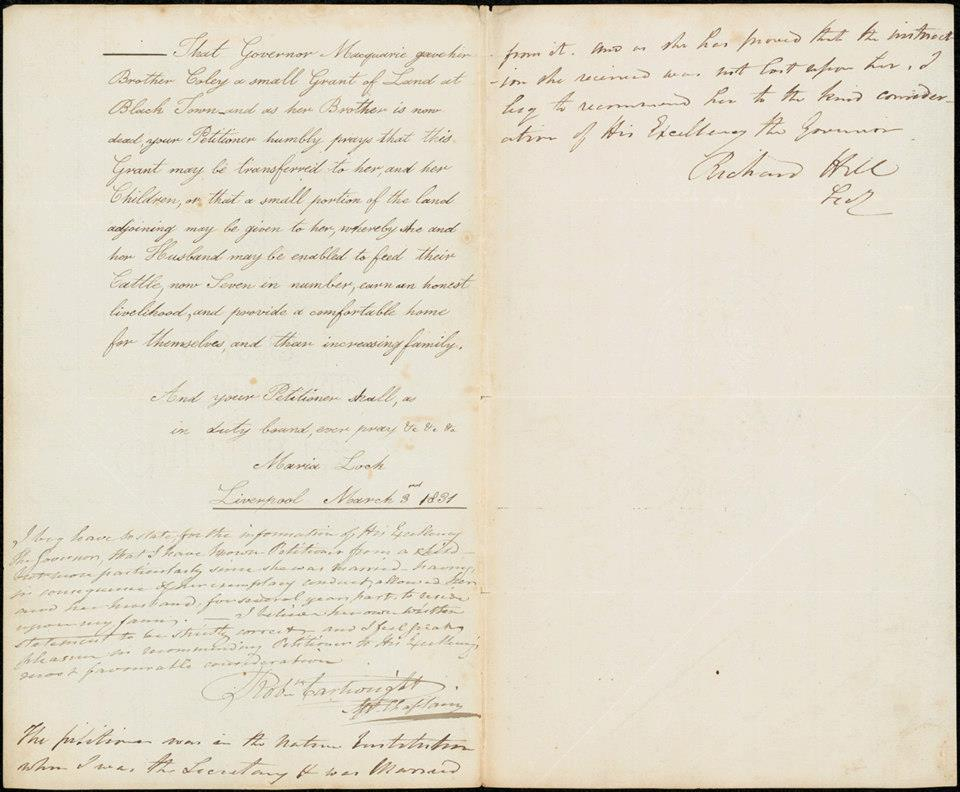
Macquarie arrived in the colony in 1810, not only determined to re-establish the rule of law after the military coup of 1808, but also determined to ‘civilise’ the Aboriginal people. He stated that he would do this through education – ‘in habits of industry and decency’ – and farming. He established the Native Institution in Parramatta, opened at the end of 1814 with four Aboriginal children. You can read its history here, and you can see the document that established it here. You can read an 1819 article about it from the Sydney Gazette here, including the report that the 14-year-old Aboriginal girl, Maria Lock, had won the overall prize for the schools in the colony. Maria Lock’s brother Colebee was granted 30 acres of land (with Nurragingy) in 1819, in the area now known as Blacktown. When both Colebee and Nurragingy died, Maria Lock petitioned Governor Darling for the land. You can see the petition here. She was eventually successful.

One of the saddest things about my research has been discovering, for so many institutions that I seek information about, ‘find and connect’ web pages, with their content warnings before you open the page:

This website contains material that is sometimes confronting and disturbing. Words or images can cause sadness or distress, or trigger traumatic memories for people, particularly survivors of past abuse, violence or childhood trauma.

There is one for the Parramatta Girls Home, established in 1887 in Fleet Street, North Parramatta. It operated under various names until 1975, with as many as 30,000 girls being placed in it over those years. Here is its ‘find and connect’ page.

Switching to the future, and a more hopeful aspect of life in the Parramatta area, is the Westmead Innovation District. John Richardson, a Consulting Partner with COX Architecture, has worked with the team developing this project. He outlined, in our interview, what an innovation district is and why Westmead was such a good choice for one.

There are obvious sustainability and social benefits of people living close to their work and high-class health facilities. Sydney – and the world – needs as much action on sustainability as we can get. Australia’s first National Climate Risk Assessment, finally released in September 2025, warns that the changing climate is likely to lead to more intense and extreme climate hazards – such as floods, cyclones, drought, fires and increased temperatures – in places where they haven’t been experienced before, more frequently and for longer periods.

But Penrith, on the northern edge of Western Sydney, has already been named the hottest place on Earth, with a temperature of 48.9 degrees recorded on January 4 2020. This was also the hottest day ever recorded in Greater Sydney.

Keeping with this episode’s theme of time travel, a 2023 article takes us travelling into the not-too-distant future. The first sentence of that article, ‘Impact of Accelerated Climate Change on Maximum Temperature Differences between Western and Coastal Sydney’ states:

“Increasing global emissions threaten to disproportionately impact the future of Greater Western Sydney (GWS), with some suburbs already experiencing temperatures 8 °C to 10.5 °C greater than the Sydney coastal region during heatwaves.”

And finally, going back to the past, Grace Karskens concludes episode 9 with the story of Nah Doong. You can hear, and read, a longer version of it here or here.

I hope you’ve been enjoying Seeking Sydney. Please share it, and listen out for Episode 10 – the last episode.

Acknowledgements

Interviewees for episode 9: my thanks to you all

Grace Karskens, Emeritus Professor of Australian History at the University of New South Wales. Her books include The Rocks: Life in Early Sydney (1997), The Colony: A History of Early Sydney (2009) and People of the River: Lost Worlds of Early Australia (2020). 

Felicity Castagna, on Instagram under @Felicity Castagna 

Naomi Parry Duncan, professional historian on Bluesky under @drnaomi 

Paul Irish, historian and archaeologist, author of Hidden in Plain View

Deborah Lennis, Cultural Advisor Inner West Council

John Richardson, Sydney architect

Thanks also to:

Bronwyn Mehan, Spineless Wonders

Martin Gallagher, Echidna Audio: sound design

Zoe Hercus: publicity

Bettina Kaiser: logo & artwork

Peter Barley: extra voices

References

In this episode I referred to two books that are full of insights and different ways of looking at Australia’s past:

Billy Griffiths, Deep Time Dreaming, Black Inc (2018), p4 and p234.

Heather Goodall and Allison Cadzow. Rivers and resilience: Aboriginal people on Sydney’s Georges River. UNSW Press, 2009, p53.

Seeking Sydney, Episode 8: What must it take?

Featured

Tags

Seeking Sydney is a podcast that travels to the landscapes and landmarks of Sydney, adding the people and their stories. I will publish one episode every month for ten months. Episode 8 is now available in your podcast subscription, on the Spineless Wonders website, in Apple podcasts or Spotify or iHeart!

In this episode I spend some more time discussing ideas of migration, identity and racism with three people who have lived them and considered them deeply. The title comes from Bette Mifsud saying:

“I tried to put myself in my parents’ shoes actually thinking, What must it take? What it must have been like for my mum to leave a very large family behind, where you’ve got a village community, where everybody supports everyone, where your grandparents live with you until they die, where the grandparents look after the children when you’re at work. All of those things were gone. Mum didn’t have that.”

I interviewed Bette late in 2024, travelling to her home in the Blue Mountains to interview her in her home, surrounded by the bush. She and her partner Trevor have made their block very productive, with fruit trees and a huge veggie patch, and she sent me away with bags of lemons and limes, just as her parents would:

“my parents being the incredibly generous people that they are – this is a thing you always did in Malta. You gave your neighbours food, so they got to know us by dad giving them lots of fresh fruit and veggies every week.”

Bette describes her life growing up as the child of migrants from Malta, and how it became urgent for her to leave her parents’ home in order to establish her own life. It struck me how similar this story was to Kylie Kwong’s story – which you can read here – with similarities right down to the father crying, for the first time that anyone had ever seen, and how momentous this was.

I also interviewed Lucy Taksa. Her father’s family originated in Ukraine near Kiev, her mother’s family from Poland. After an upsurge of anti-semitism in Poland, they obtained humanitarian migrant assistance to migrate to Australia in 1960.

In July 1945 Arthur Calwell had become the first Minister of the newly-created Department of Immigration. He initiated a massive program of migration on the grounds that it was going to arrest Australia’s falling birth rate, provide labour to rebuild the post-war economy, and inhabit Australia’s furthest corners to stop potential invaders. (Remember Felicity Castagna talking about invasion novels in episode 7?) The preferred migrants were British, but Calwell also looked to the Scandinavian countries and Western Europe, then to the camps holding 1.6 million refugees from the war. In the ten years between 1951 and 1961, 833,000 people migrated, with Southern Europeans slightly outnumbering British (33% to 32%). The vast majority of immigrants settled in the major cities, with 55% of Sydney’s growth between 1947 and 1966 attributed to post-war immigration.

Immigrants might have provided the labour needed to boost Australia’s economy, but they weren’t getting any special treatment. They had to assimilate, somehow, and get on with it.

The third person interviewed in this episode is Jing Han. She came to Australia first in 1988 as an international student, went back to China after finishing her PhD but found that her heart belonged to Sydney. She talks about the culture shock of moving, the good and the bad, and concludes that:

“… there are always cons and pros in every system. So there is no system which has all bad things.”

Jing worked at SBS TV for many years, translating Chinese programs into English and becoming Head of SBS Subtitling. She now works at Western Sydney University as Professor of Translation and director of the Institute for Australian and Asian Arts and Culture.

In 1980 Joe Dolce released his single, ‘Shaddap you face’, tackling the Australian approach to immigrants head-on. He parodied how Australians stereotyped immigrants (in this case, Italians) as well as letting the stereotypes fight right back: ‘ah, shaddap you face!’ I wrote to him about it in 2006, and he wrote back – a generous, fascinating email that he gave me permission to reproduce.

“It was mostly unconscious at the time as I was twenty-five years younger,” he wrote. “I had always been a ‘peace and love’ hippy in the decades before I wrote the song, and when I moved to Australia and saw how marginalised ethnic people were, I guess it must have just sunk in on some level and the song just sort of wrote itself, as a kind of humorous protest declaration. I mean, sometimes making things funny is a great way to disarm pain and frustration. But it also was a great singalong. There were a lot of things that came together to make it work, not just the social aspect. Now however, I sing the song much more politically consciously and have even had it translated into an Aboriginal language which I teach people to sing the Aboriginal words to at concerts. At the Cygnet Folk Festival in Tasmania in January [2007] I am hosting the second ‘Inspired Shaddap You Face Contest’ where other serious festival guests are invited to perform their interpretation of the song. It was a big hit concert at last year’s National Folk Festival (won by a Celtic Bagpipe band!) and so far the acts who are participating are: 1. Los Capitaines – a nasty, black Nick Cave-y ‘Bad Seeds’ version; 2. Will Lane – an experimental classical version – avant-garde contemporary viola virtuoso; 3. One Step Back – Bluegrass; 4. Gorani – male choral tradition from Georgia; 5. Kazakstan Kowgerls – Bulgarian women’s a capella; 6. DUO SWANGO – ‘European Gypsies travel to Latin America’ version; 7. Kavisha Mazzella – traditional Italian.”

Before ‘Shaddap you face’ there was the 1957 book, They’re a Weird Mob, a comedy about Australian attitudes to migrants, and the Australian language. Its author, John O’Grady, published it under the name of ‘Nino Culotta’. It was filmed in 1966, giving me the link to my final interview for Episode 8 – Naomi Parry Duncan telling her favourite Sydney story, about the TV series, Skippy.

They’re a Weird Mob is not only a film about the migrant experience, but it stars Claire Dunne as Kay Kelly. Claire Dunne, OAM, was a foundation director of SBS (where Jing Han worked for many years), and worked there herself as a presenter and producer of radio and television. She strongly opposed attempts in 1986 to close SBS and merge it with the ABC. Her OAM (Order of the Medal of Australia) was awarded for her contributions to multicultural education and broadcasting. She’s even had her portrait painted by Sinead Davies and selected for the Archibald, with the title ‘The Irish immigrant – portrait of Claire Dunne OAM’.

But there’s more. The producers of Skippy – Lee Robinson, Bob Austin and John McCallum – met during the making of They’re a Weird Mob. John McCallum is credited with ‘luring’ producer Michael Powell to Australia to film it. (Remember Felicity Castagna in Episode 7 pointing out that “we didn’t even start publishing books in Australia until the 1950s. Our books were imported from the UK. Even our authors had their books published overseas and brought back.”? Here, in 1966, we have British producer Michael Powell being ‘lured’ to Australia to produce a very Australian film.)

Just to cement the connection between immigration and Skippy, the film’s cast included Ed Devereaux (ie Skippy’s Matt Hammond, head ranger of Waratah National Park) and Tony Bonner (ie Jerry King, handsome helicopter pilot and ranger) plus other actors who would go on to guest-star in Skippy.

You can see all this for yourself. Here’s They’re a Weird Mob. And here’s a collection of information about Skippy, including clips of Skippy dubbed into other languages: https://www.nfsa.gov.au/collection/curated/skippy-bush-kangaroo-celebrating-hit-1960s-tv-show

Acknowledgements

Interviewees for episode 8: my thanks to you all

Bette Mifsud: a first-generation Maltese-Australian visual artist who grew up on family market-gardens in North Western Sydney during the 1960s and 70s, and now lives on Dharug and Gundungurra lands in the Blue Mountains. Her website is at https://www.bette-mifsud.com/#/ and Instagram is https://www.instagram.com/bette.mifsud/  Special thanks to Bette for the use of her family photos and personal photos from https://www.bette-mifsud.com/portraits.html#/

Lucy Taksa, Professor of Management, Deakin University Business School 

Jing Han, a leading intercultural communication expert and director of the Institute for Australian and Asian Arts and Culture at Western Sydney University. Instagram: jinghan2020

Naomi Parry Duncan: Professional historian on Bluesky under @drnaomi 

Thanks also to:

Bronwyn Mehan, Spineless Wonders

Martin Gallagher, Echidna Audio: sound design

Zoe Hercus: publicity

Bettina Kaiser: logo & artwork

Peter Barley: extra voices

References

Statistics and quotes on migration from Collins, J. Migrant Hands in a Distant Land. Pluto Press, 1991 (2nd ed.) pp 22, 36, 228.

Maria Paolini’s story in Give me strength: Forza e coraggio. Italian Australian Women Speak. Anna Maria Kahan-Guidi and Elizabeth Weiss (eds), Women’s Redress Press, 1990, p67.

Angela Signor’s story in Give me strength: Forza e coraggio. Italian Australian Women Speak. Anna Maria Kahan-Guidi and Elizabeth Weiss (eds), Women’s Redress Press, 1990, p107.

John McCallum is credited with ‘luring’ producer Michael Powell to Australia: from https://www.smh.com.au/national/renaissance-man-of-entertainment-20100204-ng3e.html

Dr Naomi Parry Duncan’s significance statement about Skippy: https://naomiparry.net/wp-content/uploads/2021/03/Skippy-Collection-Significance-Statement.pdf

More about Skippy: https://aso.gov.au/titles/series/skippy/

Seeking Sydney, Episode 7: Change and the river

Featured

Tags

, , , , , , ,

Seeking Sydney is a podcast that travels to the landscapes and landmarks of Sydney, adding the people and their stories. I will publish one episode every month for ten months. Episode 7 is now available in your podcast subscription, on the Spineless Wonders website, in Apple podcasts or Spotify or iHeart!

In Episode 7, I travel down the Parramatta River on the ferry. Leaving from Circular Quay, the ferry stops often, and you move from hectic Sydney Cove – Warrane – to the slow-moving river, surrounded by mangroves.

Along the way, there are so many stories. We catch sight of the cat’s cradle that is the Anzac Bridge. We stop at the Barangaroo wharf, named for the Cammeraygal woman who was highly critical of the white colonists. Grace Karskens has written about her, and her skill as a fisherwoman, here. We go past the island Me-Mel [Goat Island] where Judge-Advocate David Collins saw her with her husband, Bennelong, noting that Bennelong claimed it as his. That claim is finally being honoured.

Birchgrove marks the official spot where river meets harbour. At the next stop, Cockatoo Island, we can look across to Kelly’s Bush and remember the 13 residents who became the Battlers for Kelly’s Bush, joining forces with the unions and turning their patch of local bush into a celebrated first: the first green ban. Ben Ewald gives a first-hand account of the importance of the bush to the local children, and remembers the scale of the opposition to development.

2021 was the 50th anniversary of this momentous event and to celebrate, Hunters Hill Museum put together a fascinating exhibition. This was unfortunately affected by Covid closures but, with the help of Hunters Hill Council, an electronic presentation of The Battle for Kelly’s Bush can be viewed here. There are lots of websites that discuss the battle. The Hunters Hill Trust has a page dedicated to the battle and to the upkeep of the area. And this is a nice one that discusses a green ban in Eastlakes that drew strength from the Kelly’s Bush precedent. This one includes some contemporary footage from ABC news, including a short interview with Elizabeth James, one of the Battlers. This one is a general description of the first green bans, and this one is a whole website dedicated to green bans. This one describes the industries in Woolwich. This is an interesting article on green bans from 1974, including a list of green bans at the time. The article is based on a booklet produced by Wendy Bacon and others. Wendy is still fighting for the protection of communities and the environment, and she talks knowledgeably in this episode about the value of protest.

Two questions arise for me: what are the legacies of the green bans, and, could green bans work today? Wendy answers the first – large swathes of Sydney, particularly the inner city, would have vanished – and Sydney lawyer Steven Penning answers the second – spoiler alert: probably not.

Past the wharves at Drummoyne, Chiswick and Abbotsford we chug, then Cabarita and Kissing Point. Bennelong was buried at Kissing Point, as news reports in 2011 told us, but that site is yet to be honoured.

Opposite Kissing Point there is a pretty little building on the shore: the watergate to the Thomas Walker Convalescent Hospital. There is a picture of it here, along with a history of the site.

After Meadowbank is the Sydney Olympic Park wharf, reminding me of the 2000 Olympics and happy Sydney. It also reminds me of Matthew Doyle saying that he contributed music and choreography, and his own performance. Here is a link to the Indigenous section of the opening ceremony. Take the time to watch it through – it’s brilliant.

A little further along we go under Silverwater Road, and I’m reminded of a story that Wendy Bacon told me about the Silverwater Women’s Correctional Centre, once called Mulawa. She was there as part of the Women Behind Bars group, in support of Violet Roberts. Here is some more information about that action, and here is a radio program about it.

The river has slowed considerably, and as we approach Rydalmere I realise that we’re going to have to get off there, and not actually reach Parramatta. This is reminiscent of the days when Redbank Wharf was the end of the ferry service, so here is a photo of that wharf. Press on ‘Info’ to see more about the photo. Here is some information about the tram between Parramatta and Duck River.

One of the reasons I wanted to interview Felicity Castagna was because of her essay, The Loop. Both she and Jing Han work at the Parramatta South Campus of the University of Western Sydney. The campus includes The Female Orphan School, which now houses the Whitlam Institute. You can sing along to ‘It’s Time’ here. Try to smile as convincingly as everyone in the video.

Finally, there are lots of sites with more information on the notorious Tampa affair, but you could start here with Amnesty International.

And here are a couple of general sites that talk about the Parramatta River.

This one is from a talk given in 1919 by a Parramatta resident, recalling the river between 1848 and 1861.

This one is a beautiful, sad, insightful essay about the river and its meaning for its traditional owners, by Willem Brussen. He says, ‘I know that the river is not the same as it was for my ancestors, and despite attempts at restoration, I’m not sure it will ever be the same. However, the river like its people is still here and therein lies some hope for the future.’

Acknowledgements

Interviewees for episode 7: my thanks to you all

Felicity Castagna, on Instagram under @Felicity Castagna 

Ben Ewald, former resident of Balmain and Hunters Hill

Wendy Bacon, https://www.wendybacon.com/

Steven Penning, Sydney employment lawyer specialising in workplace relations and safety

Jing Han, leading intercultural communication expert and director of the Institute for Australian and Asian Arts and Culture at Western Sydney University. Instagram: jinghan2020

Thanks also to:

Bronwyn Mehan, Spineless Wonders

Martin Gallagher, Echidna Audio: sound design

Zoe Hercus: publicity

Bettina Kaiser: logo & artwork

Peter Barley: extra voices

References

The quote from Judge-Advocate David Collins is from An Account of the English Colony of NSW Vol 1 by David Collins, Appendix 1X. http://gutenberg.net.au/first-fleet.html

Information about Goat Island’s uses by the colonists from The Islands of Sydney Harbour. Mary Shelley Clark and Jack Clark. Kangaroo Press, 2000.

Information about the Louise Rd subdivision from Conservation Management Plan for Birchgrove Park, Birchgrove NSW. Prepared for Leichhardt Council by Mayne-Wilson and Associates, August 2005.

Information on current union membership is from the ABS website.

Information about the extent of the lands of the Wallumedegal is from https://www.ryde.nsw.gov.au/Library/Local-and-Family-History/Historic-Ryde/Aboriginal-History [viewed 7/8/25]

The naming of Ryde and the Field of Mars: https://www.ryde.nsw.gov.au/Library/Local-and-Family-History/Historic-Ryde/History-of-Ryde [viewed 7/8/25]

Letter from Rev William Walker to Rev Richard Watson November 1821. Mitchell Library, Bonwick Transcripts Box 52. Reproduced in Focus on Ryde: a local studies resource. Ryde Bicentenary Schools and Youth task Force, 1992, item 1.3.

The description of the produce from the area in 1899 is from Focus on Ryde: a local studies resource. Ryde Bicentenary Schools and Youth task Force, 1992, section 4 introduction.

Maria Paolini’s reminiscences are in Give me strength: Forza e coraggio. Italian Australian Women Speak. Anna Maria Kahan-Guidi and Elizabeth Weiss (eds), Women’s Redress Press, 1990, p71.

The quote from Governor Phillip is from, The Voyage of Governor Phillip to Botany Bay, London 1789 (facsimile edition Hutchinson 1982) p102.

The description of Rivendell school is from their website.

The description of the retinue accompanying Gregory Blaxland, William Wentworth and Lt William Lawson Gregory Blaxland across the Blue Mountains comes from, A journal of a tour of discovery across the Blue Mountains, New South Wales in the year 1813. Reprinted by Sydney University Press 2004, p5.

Information about the electorate of Werriwa is from here.

Statistics on the birthplace of Parramatta residents is here.

Seeking Sydney, Episode 6: Leichhardt, a case study OR The history’s not fabulous

Featured

Tags

, ,

Seeking Sydney is a podcast that travels to the landscapes and landmarks of Sydney, adding the people and their stories. I will publish one episode every month for ten months. Episode 5 is now available in your podcast subscription, on the Spineless Wonders website, in Apple podcasts or Spotify or iHeart!

Episode 6 is called A Case Study, OR, The history’s not fabulous. It’s a case study because it’s all about Leichhardt, about how it sits on Dharawal land and how that land has been carved up since colonisation. It’s a case study because this happened in Leichhardt but also throughout Sydney, and Australia.

It’s called, ‘The history’s not fabulous’ because that’s what Aunty Deborah Lennis – Dharawal woman, Cultural Advisor to Inner West Council – says, with magnificent understatement. She’s talking about how things have been from ‘day dot, when Cook first put his feet on the shores, at Stingray Bay, at Kamay, there.’

That’s how she ends this episode, but she also starts it, with a magnificent welcome to country. She then describes the lands and people of the Dharawal, and how they traded along the route that became Parramatta Rd.

Speaking of Parramatta Rd – could it ever be improved? And what does architect John Richardson mean when he talks about it as a ‘high street’? I look at it differently since my discussion with him.

Parramatta Rd is the southern boundary of the suburb of Leichhardt, so we look at how the suburb was developed, from being Dharawal land to being divided up into smaller and smaller plots for the colonists and those who came after them. You might be interested to look at some of the following links:

Leichhardt is commonly associated with the Italian people who started settling there in the 1940s, so we look at that influence and start to consider the experience of migrants in Sydney. Looking at the census figures over the years, the numbers of Italians rise and fall.

And speaking of censuses – don’t forget that Aboriginal people weren’t included in the census until after the 1967 referendum. Lawyer and activist Professor Mick Dodson wrote an article in 1999 called, CITIZENSHIP IN AUSTRALIA: An Indigenous Perspective that powerfully describes how Aboriginal and Torres Strait Islander peoples were denied citizenship before 1967. Historian Ann-Mari Jordens has also written an interesting article about Australian citizenship, and Professor Aileen Moreton-Robinson considers the nature of the citizenship granted here.

Having no citizenship rights included being governed by the NSW Aborigines Welfare Board. A good place to start to read about those restrictions is here, with Anita Heiss’s article.

To view the beautiful Breathe memorial that Deborah Lennis refers to, find it here. The designers, mili mili, describe it here. The other survival memorial that we discuss is Douglas Grant’s Harbour Bridge in Callan Park. Some more information here.

And, just for comic relief – for those who remember the old Leichhardt Council and would like to relive those days, what could be better than watching (or rewatching) Rats in the Ranks?

By the way …

Some fun facts about previous episodes that show that research is a never-ending process:

  • A beautiful telling of the Gweagal people’s discovery of James Cook and his crew that I could have referred to in Episode 1: https://www.sl.nsw.gov.au/stories/eight-days-in-kamay/introduction/1
  • Also in Episode 1, I referred to dugong bones that were excavated during the creation of the Alexandra Canal. On this page of the Dictionary of Sydney there’s a lot of information about the area, and a photo of that excavation. Architect John Richardson has since told me that his great-grandfather, Robert Etheridge Jr, is one of the men in that photo standing over the dig as he was Curator of the Australian Museum. John suspects that the ‘head’ in the image is probably Edgeworth David.
  • There’s a clever website that maps Liverpool St Darlinghurst from the 1850s to the 1940s that I could have referred to in Episode 2: https://darlostories.au/
  • In Episode 4, I spoke to Felicity Castagna about her collaboration on a performance called ‘What is the city but the people?’. Turns out that title is a quote from Shakespeare’s Coriolanus, and a very revolutionary statement it is too.
  • And in Episode 5 I referred to the Eveleigh Railway Workshops employing many Aboriginal people: here’s an article, with pictures, that gives some great details on Aboriginal workers in Sydney, written by Anita Heiss. The whole Barani website is worth a (lengthy) browse.

Acknowledgements

Interviewees for episode 6: my thanks to you all

Deborah Lennis, Cultural Advisor Inner West Council

John Richardson, Sydney architect

Bette Mifsud: A first-generation Maltese-Australian visual artist who grew up on family market-gardens in North Western Sydney during the 1960s and 70s, and now lives on Dharug and Gundungurra lands in the Blue Mountains. Her website is at https://www.bette-mifsud.com/#/ and Instagram is https://www.instagram.com/bette.mifsud/ 

Thanks also to:

Bronwyn Mehan, Spineless Wonders

Martin Gallagher, Echidna Audio: sound design

Zoe Hercus: publicity

Bettina Kaiser: logo & artwork

Here are the sources for the figures that I quote :

Information about ‘the first coffee machine’:

Other references:

The Road to Parramatta: Some notes on its history, by James Jervis. Royal Australian Historical Society Journal 1927 Vol. XIII, Part II, p.65.

B Groom and W Wickman. Leichhardt: an era in pictures. Macleay Museum, University of Sydney, 1982, p77.

David Sironi. A look at Leichhardt from 1962 on. Leichhardt Local History Library 994.41/SIR

Grenville to Phillip, 22 August 1789. HRA I, 1, pp.124-6. Reproduced in Select Documents in Australian History 1788-1850. CMH Clark (ed). A&R 1950, p218.

Instructions to Phillip, 25 April 1787. HRA I, 1, pp.14-15. Reproduced in Select Documents in Australian History 1788-1850. CMH Clark (ed). A&R 1950, p219.

Anthony Cusick, “Leichhardt West: Original land grants and subdivisions” in Leichhardt Historic Journal #16 June 1989, p18 & 45.

Phil Dowling. Leichhardt Public School Centenary Souvenir 1962.

‘Migrants in Leichhardt’: notes on a talk given at Leichhardt Town Hall 1 August 1972 by Penny Lush, Michael White, Margaret Jervis

Information on Italians in Leichhardt relies on IH Burnley, ‘Italian settlement in Sydney 1920-78’, Australian Geographical Studies, 1981, Vol.19; IH Burnley, The impact of immigration on Australia: A demographic approach, OUP 2001; Jock Collins, ‘Ethnic Diversity Down Under: Ethnic precincts in Sydney’ International Journal of Diversity in Organisations, Communities and Nations Vol 4, 2004-2006; The History and Heritage of Italian-Australians in the Leichhardt Local Government Area, Leichhardt Municipal Council, 2001.

Seeking Sydney, Episode 5: Power at work

Featured

Tags

, ,

Seeking Sydney is a podcast that travels to the landscapes and landmarks of Sydney, adding the people and their stories. I will publish one episode every month for ten months. Episode 5 is now available in your podcast subscription, on the Spineless Wonders website, in Apple podcasts or Spotify or iHeart!

This episode starts at Carriageworks, a building that was once part of the Eveleigh Railway Workshops. I was drawn to this important part of our working history by a chance meeting with Lucy Taksa. She’s done an enormous amount of research on Eveleigh, and you can find a list of her articles in the Sources section of the Eveleigh Stories website, a wonderful, layered collection of material about the site and its workers. She touches on the Great Strike of 1917, which started at Eveleigh. If you want to read more about that, this is a good place to start. And this is the Labour Heritage Register that she was instrumental in setting up.

The story of Eveleigh is a story of work and a story of labour history. Through their unions its workers fought for improved conditions and pay but also for social justice issues. It was a place of high employment for Aboriginal people, and this is reflected in the support for Aboriginal rights, including protesting against the gaoling of Albert Namatjira in 1958. You can read more about him here and here.

The railway workers weren’t the only unionists who took action for social justice issues. Wendy Bacon describes the breadth of actions taken by the BLF, the Builders Labourers’ Federation, and then we look at the time when Frank Sinatra was told to walk on water. It’s sort of hilarious and sort of an object lesson in how the unions were willing to, and able to, use the power of their labour.

John Richardson describes how the nature of work changed through the 1980s and ‘90s. The shape of Sydney, and of unions, changed with it. The Hungry Mile is a good example of that. Once a place of backbreaking work (literally), of fierce battles for a job and lockouts it is now the city edge of the Barangaroo development, with its sleek canyons of polish and glass. But the Hungry Mile is not quite forgotten. It’s a name that’s given rise to songs and poems, a play, and a documentary.

In the 1960s and ‘70s, the unions weren’t the only groups in Sydney who were fighting for a different world order. There were people fighting for gay rights, Indigenous rights, women’s rights, and Glebe Point Road became a hub for those activities.

CAMP Inc – Campaign against Moral Persecution – a focus for gay and lesbian activity – was at 33a Glebe Point Road. It was an important place for Diane Minnis. She had come to Sydney in 1973 to attend a lesbian conference. The next day she went to a gay pride demo and was arrested. She got off ‘the usual charges of assaulting police, resisting arrest and some sort of unseemly words, you know, sort of language type of thing’ because the magistrate allowed that there was reasonable doubt. Amazingly, she had ‘a newspaper photograph of me being arrested by uniformed police, not the plainclothes detectives who swore that they arrested me.’ She also had pro bono legal representation from the Redfern Legal Centre.

Women’s House was at 67 Glebe Point Road and I spoke to Diane, Wendy Bacon and Julie Gibson about the women’s movement and the general feeling of change in the air. I highly recommend watching Brazen Hussies, if you haven’t already done so.

I couldn’t resist including a short clip from my favourite feminist band from the time – the Stray Dags: Tina Harris (vocals/guitar), Chris Burke (drums), Celeste Howden (bass), Mystery Carnage (vocals/percussion) Ludo McFerran (sax). More on them here, and the whole of Self Attack is here.

The beginnings of NAISDA were around the corner from Glebe Point Road in St Johns Rd, and Elsie, the first women’s refuge in Sydney, nearby in Westmoreland St.

A couple of blocks back, predating all of these places was Tranby in Mansfield Street. The 1964 photo of Charles Perkins that I refer to on his way to, or from, Tranby is here. He was one of 29 students who boarded a bus on 12 February 1965 outside the ‘Great Hall’ of Sydney University, just across Victoria Park from the beginning of Glebe Point Road. Their travels through western NSW were to become known as the Freedom Ride (here and here) and another photo of Perkins has come to epitomise that protest. The quote from Ann Curthoys’ diary is from Freedom ride: a freedom rider remembers, Allen & Unwin, 2002 p71 but you can see her actual diaries here. What an extraordinary resource!

Legacies are always nuanced, and I asked Wendy, Diane and Julie about the excitements and revelations of the movements of the 1960s and ‘70s, and about what those times mean to us today. Diane sees tangible improvements in how gay and lesbian people are treated, and in their visibility and opportunities. Julie sees some progress for women – for example, in access to abortion – but on a general level is disappointed that there hasn’t been more progress. Wendy acknowledges that there’s been change, but also feels that some of the progress that was made then has gone backwards. Both Julie and Wendy concluded on a sombre note. Julie: ‘Sometimes we have too much faith in some essential human goodness that maybe isn’t always there.’ And Wendy: ‘I think you do have to maintain hope, but optimism is harder.’

Interviewees for episode 5: my thanks to you all

Lucy Taksa, Professor of Management, Deakin University Business School

John Richardson, Sydney architect

Diane Minnis, ‘78er

Wendy Bacon, https://www.wendybacon.com/

Julie Gibson, revolutionary, activist, organiser, philosopher, filmmaker, photographer, Glebe resident for 30 years. Bodysurfer, student, computer programmer, mother, teacher, friend, kayaker, walker, ping pong player, cyclist, technical writer. Farmer and Landcare activist.

Acknowledgements

Bronwyn Mehan: Spineless Wonders

Martin Gallagher: Echidna Audio: sound design

Peter Barley: special voices

Zoe Hercus: publicity

Bettina Kaiser: artwork

Frequency of stage-coaches and steam boats from Maclehose, J. Picture of Sydney and Strangers’ Guide in New South Wales for 1839. John Ferguson, Sydney in association with The Royal Australian Historical Society, facsimile edition 1977, p139.

Description of the railway viaduct from The beginning of the Railway Era in Australia. Royal Australian Historical Society Journal 1955 Vol. 41, Part 4, p.272.

Information on the WWF draws on Wharfies – The history of the Waterside Workers’ Federation. Margo Beasley, Halstead Press, 1996.

Information on the boundary markers from the 1830s: https://dictionaryofsydney.org/entry/sydneys_boundary_markers

Information on the Australian Aboriginal Progressive Association from Heather Goodall and Allison Cadzow. Rivers and resilience: Aboriginal people on Sydney’s Georges River. UNSW Press, 2009, p144.

Feminist journals in the National Library of Australia: Womanspeak and Mabel.

A tribute to Professor Hanna Neumann.

April 2025 30 words for 30 days

Featured

Tags

, ,

Another month with 30 days, another set of prompts from @WritingDani (explained here). This time I used the prompts to diarise, and you can follow as the house is packed up and everything moved into storage. Then we set off for Europe. I enjoyed recording my days so much that I kept going when April finished, until we got home again.

This time I got the highest number of ‘likes’ and comments for April 22. That was a lovely evening, so I’m glad that others picked up on that.

1

Flow

It should be easy, this packing up a house, filling boxes. But my flow is obstructed – by messages of rainbows and lovehearts, or a set of origami boxes, with smiles.

2

Spring

If new ideas spring up in the intersections between different ways of thinking, but so much thinking is now done for us – even casually – is this the end of knowledge?

3

Float

Years ago, the swell off Tamarama dug a deep drop, close to shore. In these nights of sleepless tossing, I hold the memory of floating there, swung by the waves.

4/5

Twirl / Flutter

Imagine that. Twirling. Fluttering. Like leaves, dried and yellowed, drifting slowly on a sweet breeze. Wafting. Dancing.

No, I can’t imagine that. Leaden. Robotic. Sort. Pack. Tape. Sort. Pack. Tape.

6

Swivel

A Russian, a Ukrainian and a German walk through my door. My head swivels as they remove the furniture and carefully packed boxes. They are the ace team of removalists.

7

Flip

It flips so quickly. It was my home. Now it is empty rooms and drooping curtains, floorboards visible. No furniture. Walking out is like walking out of a box, into …

8

Jangle

… facing people with pasted-on smiles, throwing words like ‘pricing guide’ and ‘off-market opportunity’ at me – words that totter then plummet, to jangle as they fall, a mournful farewell to language.

9

Dive

Time to dive into this world, of labyrinthine corridors and swamps of tables, jungles of shops and waiting area deserts. Indecipherable announcements squawk overhead. Our fellow passengers murmur. Plane delayed.

10

Switch

In 26 hours we changed countries, currencies, clocks and climate, Sydney’s perfect autumn of warm sun, cool air, switching to Warsaw’s welcome of grey sleet, then puffs of flying snow. 

11

Wander

No wandering today. A quick walk, made brisker by the rain, to Polin, Museum of the History of Polish Jews. Many hours later we emerged, not just quiet, but speechless.

12

Plunder

Museums are teaching me Poland’s history; centuries of conquest and plunder. Today, Praga, on the north side of the Vistula – vulnerable on Warsaw’s outskirts, destroyed by Napoleon for his fortifications. 

13

Fizz

She strides down the aisle, bangs the piano open, attacks it with expert hands. Keys plonk. She frowns. Chopin winces. At interval there is ‘sparkling wine’ but nothing fizzes here. 

14

Pop

Never met either of my grandfathers. Both gone before I was born. Never would have called them Pop anyway. Too informal for one of them. Wrong language for the other. 

15

Wiggle

Not possible to wiggle out of it now. The taxi has arrived at the front gate. We’re pushing the door open. Walking into the foyer. Being taken to the hall. 

16

Collect

I’m collecting thoughts, impressions, images as we travel. Words. Nothing as coherent as a feeling yet, although – I did gasp in the courtyard that my grandmother would have walked in.

17

Stretch

The Gdansk museum of the Second World War. Displays of propaganda posters, swastika Christmas baubles, uniforms and guns lead to a sign saying, Horror. I am stretched to my limits. 

18

Slide

For a moment the sights, sounds, tastes, the many exhaustions of body and mind of these last few days slide into place. A lightness replaces the weights of the past. 

19

Swoop

A bright green field, edged with blossom. A dot in the sky becomes a raptor gliding, hovering, wings blurring. The train carries me on before I can see the swoop. 

20

Feast

We decided to eat on Potsdamer Platz before the concert. I hadn’t expected a feast, but our choices were bratwurst from a stall or a bowl of mass-produced Thai salad. 

21

Wind

Small sections of the Wall, die Mauer, that used to wind its way between East and West Berlin, have been left in place. Berliners don’t need these remnants to remember.

22

Weave

She speaks little English. I speak little German. But we weave words to learn stories and laugh a lot. After dinner we hug, walk away, turn and wave. Smile again. 

23

Pounce

On the edge of a shaded street a grey cat stares into a garden, motionless, ready to pounce. A toddler toddles, points and gurgles. ‘Cat language’, her father says proudly. 

[Better as:

Grey cat with a punched-face stares at a silent bush, readying its pounce in a shaded street. Toddler with an unsteady gait gurgles and points. Proud father says, ‘Cat language!’]

24

Ripple

We moved from the garden flat into the Kurfurstendamm hotel. More a tsunami than a ripple through our holiday. No bobbing greenery outside. Just heavy-anchored cranes and a blank wall.

25

Challenge

Yesterday a man exercised under an oak tree, clothes neatly folded at its base, his nakedness a challenge to passers-by to look or look away. Today, only cyclists flash by. 

26

Rummage

I wake, rummage through my head. Today – Saturday. We are in – Berlin. Language – German. I must order my coffee ‘mit Hafermilch’. Not in Poland now. No ‘bez laktozy’ milk available.

27

Skip

The Ku’damm is empty in bright spring Sunday sparkle, the street washed clean, innocent as a skipping child. Last night’s hordes, revving and rumbling through the siren-heavy dark, are gone. 

28

Wave

So we say auf wiedersehen Berlin. Wave goodbye! Off to the north via high speed autobahns to smoked eel and novelty marzipan, Baltic Sea beach huts and fresh-leafed dappled-light woods. 

29

String

The dogs pull at their leads as we approach the dog park, a fenced-off section of the forest. They’re released and, like balloons freed of strings, they catch the wind. 

30

Gather

I feel the need to gather myself. Rescue my legs from endless airport corridors; remind my eyes that clouds and patchwork fields and the birds-eye view are for the birds. 

Extra one – May 1

Launch

Before she launches into her solo, exposed, alone, does the soprano have a moment of doubt? I prefer writing, where you have a second chance at hitting the right word. 

#travelling2025 #30 words

May 2

It stays light until all hours here. We walk home from the concert, all of the bridges completed in water mirrors, small ovals of light forming within the stone chains. 

May 3

The bus to Cobh’s last stop is at the cemetery. The timetable had said it was at O’Neills. I had expected a lolly shop. Still, this is an actual terminus. 

May 4

Boys on the bridge jostle and call, push and bellow, elbowing, staggering, falling into the passers-by. Bottles of rum and coke litter the bench. We eat our lunch.

May 5

Goodbye to Cork with its looping river and many bridges, its big white seagulls wheeling and squealing. Its grey stone churches where choirs sang. Its tiny pubs where fiddles sawed.

May 6

At the museum the map’s green lines are the Irish spreading; missionaries with their beliefs, soldiers with their might. Speedy videos claim everyone as Irish: US presidents to Che Guevara.

May 7

While Seamus Heaney dedicated himself to poetry, and the ethics of the Troubles, I grappled with nappies, and my own troubled heart. I’m not bitter. Not a bit of it.

May 8

Coming down from the wide brown mountain we heard a cuckoo. Cuck-oo. We heard the high-pitched maaaa of a lamb and the combined growl of sheep running down a field.

May 9

The path hugged the edge as it neared the summit and I studied my feet at each step. But I knew it was there, that deep glistening lough, far below.

May 10

‘Just keep the sea on your left,’ she said as she waved us off. Fourteen kilometres of lapping sea-on-our-left later, we arrived at the pick-up point, dazed by glinting waves. 

May 11

Water trickles in hidden channels, feeding the rushing river, tumbling through grey boulders down to the calming valley. Yellow gorse clumps along its edges. Brown hills rise up, encompassing it.

May 12

Over five days we walked 74 kms, total elevation gain of 1925 metres. I’m already missing the rasp of my own breath, lungs filling with forest air, legs pushing forward.

May 13

London. She darts out of nowhere and stops. Face contorted, hands reaching. ‘Help me!’ she whines, eyes widening, watering. I want to run, like the deer on the forest path.

May 14

London. Where a young man walks onto Penge West station holding a nice bunch of cellophaned flowers. He looks at them, surprised, as if they’ve just been presented to him.

May 15

London. The weather has turned, blue skies replaced by grey, light winds now bitter, and the summer clothes in the window displays have resumed their traditional roles. Forlorn. Aspirational. Laughable.

May 16

London, like Berlin, has canals. Wild places that look forgotten, with littered paths of birdsong and nettles running quietly below bus-jammed roads. A family of white-billed ducks dips for waterweed.

May 17

We change trains at Shadwell, a different London. No Ottolenghi here. Faded signs in dusty shop windows. Narrow doorways, patched doors. A man stares at our intrusion, and looks away.

May 18

Suddenly they fill the station, arms raised, marching to drums, football shirts like solid armour. Old men setting the pace, young men on bouncing feet, boys running, in the pack. 

May 19

We join the canal at The Angel, head east. Gardens grow on the boats. Cats and bikes and solar panels. Cyclists and joggers and walkers jostle for the narrow path.

May 20

For the second time a worried man has pulled me back from the closing doors of a Tube train. Beware their fierce unforgiving jaws. They are trained to savage latecomers.

May 21

And now it’s time to return, into the real world where we don’t spend hours strolling, imagining lives in these quiet streets, these places that don’t match my noisy memories.

May 22

Flying over central Australia, I look down on red waves caught in motion, held there by time. Far away, white patches of salt lakes. Black riverbeds curve, snaking towards them.

Seeking Sydney, Episode 4: Sydney growing up

Featured

Tags

,

Seeking Sydney is a podcast that travels to the landscapes and landmarks of Sydney, adding the people and their stories. I will publish one episode every month for ten months. Episode 4 is now available in your podcast subscription, in Apple podcasts or Spotify!

This episode starts on the light rail near Central and travels down George Street, using a selection of early maps to describe how the city grew, and how the colonists colonised Sydney’s land. Then John Richardson, a Sydney architect, takes up the story and gives this episode its name.

At the light rail’s terminus near Circular Quay, I try to imagine the Tank Stream, the water source that attracted the colonists to Sydney Cove in 1788.

Then we’re at the Opera House, looking at its transformative role in reconciling mid 20th century Sydneysiders with their harbour.

I speak to Matthew Doyle about his roles in productions of I am Eora and Patygerang. You can hear his performance in Ross Edwards’ Dawn Mantra here (scroll down to it) given from the sails of the Opera House on the first of January 2000, as part of the ABC Millenium broadcast to welcome in the new century.

Matthew also talks about his work with Bangarra Dance Theatre, advising them on the language that Patygerang would have used. Some of her language was written down by one of the first white settlers, Lieutenant William Dawes, and his journals were used by Professor Jakelin Troy to write The Sydney Language. This is a book well worth having on your bookshelf, but if you want to find out more about Aboriginal languages there are many resources, including Rediscovering Indigenous Languages and the Barani website – a treasure in itself – which has a tab devoted to language. While we’re speaking about language, if you want to learn more about Sydney harbour’s original names, the Australian Museum has a handy chart.

For a complete change of pace you can view the performance of What is the city but the people? that was part of the Opera House’s 50th anniversary celebrations. This performance, as Felicity Castagna explains in the podcast, is an iteration of an idea originally conceived by UK artist Jeremy Deller in 2009 and developed by director Richard Gregory.

Having arrived at the harbour I speak to historian Grace Karskens about the relationships that developed between Aboriginal people and the colonists, centred on the harbour. In the interview she refers to name exchange, where Aboriginal people would take a white person’s name. She has sent me some additional information about this.

I’ve just been writing about name exchange again – the people exchanging names were one another’s damelian. Aboriginal people did this within their own society, and they tried to do it with the white people too, to try to draw them in and make allies of them.

Historian Naomi Parry Duncan tells of another set of relationships that developed on the harbour between Aboriginal people and members of Nicolas Baudin’s expedition in 1802. Their visit was extended when they needed to careen one of their boats and their artist, Nicholas-Martin Petit, did a series of portraits of the people he met. Naomi also refers to name exchange in describing these portraits.

So there’s all these incredible portraits of people like Gnung-a Gnung-a, who was known as Collins, and a boy called Toulgra, who was known as Bulldog, and then a man called Musquito, who the French called Y-erran-gou-la-ga. They were all done by Nicholas-Martin Petit … I think he was one of the most sensitive observers of Aboriginal people.

This episode finishes with two overlapping descriptions of the harbour’s formation. Deborah Lennis retells the Sow and Pigs Reef origin story with acknowledgement to Frances Bodkin and Gawaian Bodkin-Andrews. Their telling of it can be read here. And if you want to read more scientific evidence of the value of these stories, there are articles such as this one or this one.

Interviewees for episode 4: my thanks to you all

John Richardson, Sydney architect

Matthew Doyle, Aboriginal Performing Artist. Find Matthew on Linked In and @wuruniri

Felicity Castagna, on Instagram under @Felicity Castagna 

Grace Karskens, Emeritus Professor of Australian History at the University of New South Wales. Her books include The Rocks: Life in Early Sydney (1997), The Colony: A History of Early Sydney (2009) and People of the River: Lost Worlds of Early Australia (2020). 

Naomi Parry Duncan, professional historian on Bluesky under @drnaomi 

Deborah Lennis, Cultural Advisor Inner West Council

Acknowledgements

Bronwyn Mehan: Spineless Wonders

Martin Gallagher: Echidna Audio: sound design

Peter Barley: special voices

Zoe Hercus: publicity

Bettina Kaiser: artwork

The description of the master brickmaker’s role in 1790 is from 1788, by Watkin Tench. Reprinted in Two Classic Tales of Australian Exploration, Tim Flannery (ed.), Text Publishing, 2002, p152.

The description of flattening Brickfield Hill is from Maclehose, J. Picture of Sydney and Strangers’ Guide in New South Wales for 1839. John Ferguson, Sydney in association with The Royal Australian Historical Society, facsimile edition 1977, p69-70.

The book of maps I reference is Ashton, P & Waterson, D. Sydney takes shape: a history in maps. Hema Maps, 2000.

Information about windmills comes from Fox, L. Old Sydney Windmills. Published by Len Fox, 1978.

Information on PPPs comes from https://infrastructure.org.au/public-private-partnerships-by-jurisdiction-year/

The quote from Watkin Tench is from Captain Watkin Tench, Sydney’s First Four Years. First published 1788. Reprint by Angus & Robertson, 1961, p38-9.

Information about midget submarines is from Jervis, J. The History of Woollahra. Municipal Council of Woollahra, 1960 p144 and the description of Kings Cross in 1942 from Memories: Kings Cross 1936-1946, Kings Cross Community Aid and Information Service, 1981, p108.

The description of the story of Patygerang comes from Bangarra’s 2014 annual report.

The 1988 description of the Opera House as ‘evoking a feeling of reconciliation of the city and harbour’ is from Webber, GP (ed). 1988. The design of Sydney. The Law Book Co Ltd, p1.

Marjorie Barnard’s description of Sydney Harbour is from The Sydney Book. Written by Marjorie Barnard, drawings by Sydney Ure Smith. Ure Smith, 1947, p11.

The Harbour Bridge’s architect, John Job Crew Bradfield, was quoted in a caption at Bridging Sydney, an exhibition at the Museum of Sydney December 2006-April 2007.

Information on Nicholas Baudin’s voyage is from The Baudin Expedition in Port Jackson, 1802: cultural encounters and enlightenment politics, by Margaret Sankey and Correspondence relating to the sojourn in Port Jackson of the Baudin expedition.

The quote about the spearing of Governor Philip is from Inga Clendinnen, Dancing with Strangers, Text Publishing, 2003, p110.

Descriptions of the geology of Sydney harbour are from Griffith Taylor, Sydneyside Scenery. Angus & Robertson, 1958, p23 and Val Attenbrow, Sydney’s Aboriginal Past. UNSW Press, 2010, p38, p20, p56.

Seeking Sydney, Episode 3: That’s how Sydney got going

Featured

Tags

, , , , , ,

Seeking Sydney is a podcast that travels to the landscapes and landmarks of Sydney, adding the people and their stories. I will publish one episode every month for ten months. Episode 3 will be turning up in your podcast subscription on April 10, in Apple podcasts or Spotify!

This episode shakes up a lot of myths – old myths that should be well and truly busted by now, like terra nullius, and persistent myths about Aboriginal people ‘dying out’, and convicts being lazy good-for-nothing drunkards.

The episode starts with some statistics and a definition of ‘Sydney’, then takes a look at planning in Sydney. Early parts of the city had no planning at all. Most of the plans that were carried through were, as Sydney architect John Richardson calls them, ‘finger plans’. Parramatta Rd is one of those ‘fingers’ – one of the routes that leads to the Sydney CBD. It reaches the city at Surry Hills, described so vividly by Ruth Park in her prize-winning novel, The Harp in the South. The streets that she populated with such memorable characters were demolished in the 1950s. Historian Naomi Parry Duncan describes the history of the area and how the Northcott Estate was built to replace the houses that had been in ‘a big kind of nest of alleyways and little tiny narrow streets’.

This ‘slum clearance’ was as much an attempt to improve morals as streetscapes. Earlier slum clearances had been part of the reason behind the construction of Daceyville, and we hear again from Joss Bell from episode 1. Note her reference to verandah sleeping. On hearing that, John Richardson added a personal recollection about his father and uncle sleeping on the verandah at their home in Pymble during that period. As he said, ‘It was secured by retractable timber louvres so it literally served as their bedroom!’

From Surry Hills we go north, and historian Grace Karskens talks about the interactions between Aboriginal people and colonists in Hyde Park. And while we’re mentioning Governor Macquarie, let’s have a look at Bern Emmerichs’ fabulous interpretations of the period in her show, Mainly Macquarie. Scroll down on that page to see ‘May the best man win’, a lively drawing of a fist fight with horses racing behind.

Back to the podcast where Grace Karskens describes the ‘incredible diversity’ of the country and its peoples before colonisation. She goes on to discuss how Sydney came to exist at all, and how it was ‘an amazing social experiment’. There’s some discussion about exactly how many people arrived on the First Fleet – reputable websites vary, between ‘approximately 1500’ and a confident ‘1030’.

Many myths have grown up about the Aboriginal people, who didn’t ‘die out’, and about the convicts, who were the guinea pigs in the British experiment. Grace Karskens describes how, for many of the convicts, Sydney was a place of opportunity, and they grabbed it with both hands. They built houses and a community which became The Rocks – a higgledy piggledy place where no-one bothered asking for permission to build from the white authorities, let alone the Aboriginal owners.

Lucy Taksa takes up the story of The Rocks with the Chinese artisans who moved into the area in the 1860s after leaving the goldfields, and Jing Han adds a sad note about abiding racism against Chinese people.

We jump to the 1970s then, with Wendy Bacon talking about a scheme that would have completely changed the face of Sydney. Thanks to Nita McRae, the resident action group that she led, and their alliance with the Builders Labourers’ Federation, The Rocks survived. You can see a lot more about that story in Pat Fiske’s film, Rocking the Foundations, a history of the BLF that she produced, directed and narrated. You can pay homage to two of the heroes of the battle for The Rocks at Nita McRae Park and Jack Mundey Place.

There’s one more surprise in store, one more myth to challenge. Grace Karskens returns to talk about the conspicuous consumption in early Sydney, and how the convicts got relegated to the bottom rung of Sydney’s history. Listen out for the ever-adaptable Peter Barley voicing quotes from both the sophisticated Baron de Bougainville and the pompous James Maclehose in these last few minutes!

Interviewees for episode 3: my thanks to you all

Grace Karskens, Emeritus Professor of Australian History at the University of New South Wales. Her books include The Rocks: Life in Early Sydney (1997), The Colony: A History of Early Sydney (2009) and People of the River: Lost Worlds of Early Australia (2020). 

John Richardson, Sydney architect

Naomi Parry Duncan, professional historian on Bluesky under @drnaomi 

Joss Bell, resident of Daceyville

Lucy Taksa, Professor of Management, Deakin University Business School 

Jing Han, A leading intercultural communication expert and director of the Institute for Australian and Chinese Arts and Culture at Western Sydney University. Instagram: jinghan2020

Wendy Bacon, https://www.wendybacon.com/

Acknowledgements

Bronwyn Mehan: Spineless Wonders

Martin Gallagher: Echidna Audio: sound design

Peter Barley: special voices

Zoe Hercus: publicity

Bettina Kaiser: artwork

Early records about Parramatta Road: The Road to Parramatta: Some notes on its history, by James Jervis. Royal Australian Historical Society Journal 1927 Vol. XIII, Part II, p.66, 67.

‘In 1805 tenders were called for the erection of ten bridges on the road, but in 1806 the Sydney Gazette noted that there was a “danger of horses being lamed in the deep ruts near Sydney.”’: Sydney Gazette July 6, 1806. Quoted in The Road to Parramatta: Some notes on its history, by James Jervis. Royal Australian Historical Society Journal 1927 Vol. XIII, Part II, p.70.

Quotes from Ruth Park and Darcy Niland’s autobiography: Ruth Park and Darcy Niland, The Drums go Bang!, Angus & Robertson, 1956, p138-9; p192; p151.

The Northcott Estate: What have they done there? Two years at Northcott: An observation of a work in progress. Emily Mayo – In consultation with all partners. Big hART, December 2004.

Numbers on the First Fleet: CMH Clark, A History of Australia Vol. 1. 1962. p76.

‘one source said that 20 convicts were added on the journey’

‘The Australian population quadrupled between 1851 and 1871’

The Baron de Bougainville describing a ‘sumptuous dinner’: The Governor’s Noble Guest: Hyacinthe de Bougainville’s account of Port Jackson 1825, translated and edited by Marc Serge Rivière, The Miegunyah Press, Melbourne 1999, p.68.

‘Selected by the British Government as the great repository of national crime …’: J Maclehose, Picture of Sydney and Strangers’ Guide in New South Wales for 1839. John Ferguson, Sydney in association with The Royal Australian Historical Society, facsimile edition 1977, p1-2.

Seeking Sydney, Episode 2: A big visible beacon

Featured

Tags

, , ,

Seeking Sydney is a podcast that travels to the landscapes and landmarks of Sydney, adding the people and their stories. I will publish one episode every month for ten months. Episode 2 is now available!

In this episode we’re in Sydney’s eastern suburbs. From Christina Stead at Watson’s Bay in the 1930s, to the Aboriginal people living around what came to be known as ‘Sydney Harbour’. On to Redleaf on New South Head Rd, and a book published in 1949 that includes a casual story showing that the colonisers did know that the myth of Aboriginal people dying out was, indeed, a myth.

On to Rushcutters Bay and Paddington, seeing them through descriptions from the 1850s, and up to Kings Cross and Darlinghurst. Note the voices for these descriptions, and for Watkin Tench earlier. They were all carefully researched and narrated by Peter Barley. Thanks Peter!

And, although I couldn’t squeeze them in, as in episode 1, there are Patrick White connections in this episode too. Not far from Redleaf is Cranbrook, school for Patrick White and a plethora of other Whites, co-founded by Patrick’s father, home and death-place of Patrick’s great-uncle, James White. Then, about halfway up the hill between Rushcutters Bay and Macleay St lies White’s childhood home, Lulworth House. It is now residential aged care, and is the place where Manoly Lascaris, White’s life partner, died in 2003.

Then we’re at 115 Victoria St. If you want to see the 1888 map that I refer to, it’s here.

In 1973, 115 Victoria St featured in the battle for Victoria St. It’s where a group of people, including Wendy Bacon, squatted for many months to try to save the houses from demolition. A local resident action group approached the BLF (Builders Labourers Federation) and a green ban was imposed to try to protect the houses – both because they provided low-income housing and because of their heritage value. It was a vicious and protracted battle, only ending in 1974, very violently, when the police threw out the squatters. In the following year, 1975, newspaper editor Juanita Nielsen lost her life fighting that battle. Wendy’s longer account is here.

Running parallel to Victoria St is Macleay St where you will find the El Alamein fountain – site of a very different sort of battle on June 24, 1978. On this date the institution that we now know as the Sydney Mardi Gras was born. Again, police violence was on show. Diane Minnis and Gary Dunne tell the story, from unpromising beginnings to upswellings of gratitude and appreciation. The prime minister, Anthony Albanese, makes a guest appearance.

Interviewees for episode 2: my thanks to you all

Paul Irish, historian and archaeologist, author of Hidden in Plain View

Wendy Bacon, https://www.wendybacon.com/

Diane Minnis, ‘78er

Gary Dunne, ‘78er

Acknowledgements

Bronwyn Mehan, Spineless Wonders

Martin Gallagher, Echidna Audio: sound design

Zoe Hercus: publicity

Bettina Kaiser: artwork

Christina Stead, For Love Alone. Virago, 1978. First published by Peter Davies Ltd, 1945.

Watkin Tench, 17 August 1788. A Complete Account of the Settlement at Port Jackson in New South Wales. London, 1793. In Sydney’s First Four Years, Angus & Robertson 1961, p134.

G Nesta Griffiths, Some Houses and People of New South Wales. Ure Smith, Sydney, 1949, p131.

JB Gribble: Sydney Morning Herald 13 May 1880, p3. Viewed on Trove 2/3/25 https://trove.nla.gov.au/newspaper/article/13459977?browse=ndp%3Abrowse%2Ftitle%2FS%2Ftitle%2F35%2F1880%2F05%2F13%2Fpage%2F1427699%2Farticle%2F13459977

Paddington in the 1850s: Norman, LG. Historical Notes on Paddington. The Council of the City of Sydney, 1961 pp2, 3.

Mardi Gras: David Marr, ‘A Night out at the Cross’. In The National Times, 8 July 1978 [reprinted in David Marr, My Country: Stories, Essays and Speeches, Black Inc. 2018 p263]

Seeking Sydney, Episode 1: The desire to listen

Featured

Tags

, , , ,

Seeking Sydney is a podcast that travels to the landscapes and landmarks of Sydney, adding the people and their stories. I will publish one episode every month for ten months.

In episode 1 I wander from Bondi to La Perouse, via Bronte, Centennial Park and Anzac Parade.

As Paul Irish says in this episode, ‘there’s actually layers to history in places like Sydney, just like anywhere in the world. And when you start to tune your eyes into them, suddenly they become really obvious. And you’re like, oh, okay, I now have a way of looking at that city that I didn’t have before.’

He’s talking about recognising the continuous presence of Aboriginal people in Sydney, but he could be describing Seeking Sydney.

I hope that in the future, if you go into Centennial Park you will seek out the Guriwal Trail and remember that emus were once hunted on this land. That you’ll nod to Patrick White and Manoly Lascaris in their home.

Then, as you go down Anzac Parade, past NIDA (National Institute of Dramatic Art), you’ll think about Matthew Doyle and his didgeridoo playing, and his straight way of talking. I hope you’ll remember how he says that his mother’s and grandmother’s generation weren’t allowed to speak their own language, but ‘Doesn’t mean they forgot it. They just put it to bed for a while. And knowing that hopefully in the future, times change, then they’re going to bring it back out and start teaching it to their children and families and the community. And that’s what’s happening now.’

And, although I couldn’t fit it into the podcast, here’s a strange connection to think about: in his will Patrick White left a quarter of his capital to NAISDA (then known as National Aboriginal and Islander Skills Development Association), where Matthew Doyle trained. The other three quarters were left to the Smith Family, the Art Gallery of NSW, and the Aboriginal Education Council of NSW.

I hope this podcast leaves you with an impression – of a city that extends in all directions, connected to other cities and countries, into the past and the future. These connections are through the heritage and legacies of the people who have lived here, through the lives of the people who are here now, through what has been said about Sydney and the books that have been written about it, through the long histories of its places. I hope this podcast gives you a sense of some of those histories and inspires you to seek out more.

After doing the first interview for this podcast one of the sound engineers, Zoe Hercus, said kindly, ‘You should try not to say mmm or yes so often when the other person is speaking.’ You’re right Zoe, but I just can’t stop myself. It feels so rude, when someone is telling you something interesting, to not respond. So you’ll hear a lot of ‘mmm’s and ‘yeh’s and ‘really!’s throughout the interviews. That’s me, being a bad interviewer. Sorry Zoe!

Interviewees for episode 1: my thanks to you all

Ben Ewald, former resident of Balmain and Hunters Hill

Matthew Doyle, Aboriginal Performing Artist. Find Matthew on Linked In and @wuruniri

Deborah Lennis, Cultural Advisor Inner West Council

Joss Bell, resident of Daceyville

Paul Irish, historian and archaeologist, author of Hidden in Plain View

Acknowledgements

Bronwyn Mehan, Spineless Wonders

Martin Gallagher, Echidna Audio: sound design

Zoe Hercus: publicity

Bettina Kaiser: artwork

Bondi: Historic Houses Trust, Bondi: a biography. Exhibition catalogue 2005.

Bondi name: https://dictionaryofsydney.org/entry/bondi_rock_carvings

Bondi points: Val Attenbrow, Sydney’s Aboriginal Past. UNSW Press, 2010 p154 and p102. 

Bronte family: Lynne Reid Banks, Dark Quartet. Penguin, 1986.

Bertha Lawson affidavit: https://lsj.com.au/articles/divorce-have-attitudes-really-changed/

Henry Reynolds, The Other Side of the Frontier. Penguin, 1982, p21-2.

Pre-colonial Aboriginal land and resource use in Centennial, Moore and Queens Parks, Val Attenbrow 2002: https://www.centennialparklands.com.au/getmedia/e32ae90a-e730-4c28-82c4-4b17e9e3c5e1/Appendix_S_-_Pre-colonial_Archaeology_report_Val_Attenbrow.pdf.aspx

Dugongs: https://australianmuseum.net.au/learn/animals/mammals/dugong/

Alexandra Canal is described as ‘the most severely contaminated canal in the southern hemisphere’: https://dictionaryofsydney.org/entry/from_sheas_creek_to_alexandra_canal

The Cooks River has the unenviable title of ‘Australia’s most polluted river’: https://www.smh.com.au/national/nsw/cooks-river-20190110-h19wqs.html

Guriwal Trail: https://www.centennialparklands.com.au/learn/community/tours/bush-tucker-trail

David Marr, Patrick White: A Life. Vintage 1991.

Patrick White, The Vivisector. Vintage, 1994.

Trams make way for buses: Greg Travers, From City to Suburb … a fifty year journey. The Sydney Tramway Museum, 1982.

NAISDA: https://naisda.com.au/

Jakelin Troy, The Sydney Language. Produced with the assistance of the Australian Dictionaries project and AIATSIS, Canberra 1993.

Daceyville: http://www.daceyville.com/heritage_documents/DACEY%20GARDEN%20SUBURB.pdf

Governor Phillip described the area towards Botany Bay as ‘a kind of heath, poor, sandy, and full of swamps.’: The Voyage of Governor Phillip to Botany Bay, London 1789 (facsimile edition Hutchinson 1982) p59.

Paul Irish, Hidden in Plain View. Newsouth Publishing, 2017.

The Seeking Sydney podcast – coming soon!

Featured

Tags

,

Many years ago I started writing a book about Sydney. Now that unpublished book has become the Seeking Sydney podcast. It looks at parts of Sydney, then looks at them again, adding the layers of people and stories. It is not a history, although it draws on histories. It is not an attempt to lay down facts as solid objects, but it does rely on truths – the truths of observation. This is a recording of Sydney as I, and others, see, hear and remember it. Together we show where it has come from, and the past that it relies on for its existence. History’s web of connections stretches tight, and that’s what interests me.

Seeking Sydney comes from reading something like this.

The University grounds are on part of a broad ridge system which forms the watershed between Port Jackson and Botany Bay. An arm of the ridge system extends north from the watershed down between Blackwattle Bay and Rozelle Bay and their respective tributaries.[i] 

That makes me rethink everything. To me, the university grounds (University of Sydney) are not ever ‘part of a broad ridge system’. Nor is that high bit of Sydney, for me, ‘the watershed between Port Jackson Bay and Botany Bay’. The University of Sydney is a cluttered collection of buildings and people, with narrow winding roads that I can only negotiate to reach Fisher Library. The university grounds are the bits of lawn and road that I walk through to get to the books.

Seeking Sydney also comes from reading something like this.

Albions? For kids who lived on the southside, Albions were regarded as queer old buses from the north. They didn’t even sound like buses. After all, we came from Leyland territory and Leylands sounded like a bus should. Any contact with an Albion was almost always an unfortunate experience, usually associated with homeward journeys on hot summer Sundays …[ii]

This shows me how big Sydney is, with groupings and tribes running across any number of lines – in this case, the type of bus you catch.

And then Sydney is small – small enough for me to be reading a book about one 19th century businessman – Thomas Holt – at night, while researching the University of Sydney during the day, and discovering that Holt and William Windeyer and John Le Gay Brereton (the father) all shared a passion for Turkish baths.

And Seeking Sydney comes from standing in a field in Brittany, France, and looking at megaliths that are, at most, 7000 years old – megaliths that are viewed by countless numbers of people every year, revered for their age and mystery – and knowing that back home in Australia we have much more ancient carvings and paintings. We can see them on rock ledges, in caves and overhangs, and they have a direct link to a living culture.

It’s thrilling to finally see this project come to life, and in a different form to what I originally intended. Thanks to Bronwyn Mehan of Spineless Wonders for suggesting a podcast in the first place; thanks to Martin Gallagher of Echidna Audio for sound design and to Zoe Hercus for recording the studio interviews, and for publicity. Thanks to Bettina Kaiser for the wonderful artwork. Thanks to all the people I interviewed. I’m sorry I had to cut out any of your words. They were all so inspiring.


[i] http://www.facilities.usyd.edu.au/documents/docs/gcp_chapter2.pdf. Summary History Of The Development Of The University Of Sydney

[ii] Neil Munro quoted in Greg Travers, From City to Suburb … a fifty year journey, The Sydney Tramway Museum, 1982, p164.

Some writers look inwards

Featured

Tags

, , , ,

At the end of October I was listening to a Jhumpa Lahiri story, The Third and Final Continent, on the New Yorker fiction podcast. In the story a man goes to a house to enquire about renting a room, and I was reminded that I want to write about my own experience of going to a house to enquire about renting a room. It was in London, late 1979 or early 1980, and the house I went to was like a vision of Utopia. When the owner turned me away at the door, I felt utter despair.

In the Jhumpa Lahiri story the man is successful in renting the room. It seemed unbelievable, given my own experience, and I decided to write a better, truer, version of room renting. The November 30 words for 30 days was about to start (thank you @WritingDani) so I could kill two birds with the one writing stone.

In the middle of November I was listening to another podcast – Rachel Kushner on Read This. Of the many fascinating things she said, in dialogue with Michael Williams, this hit hard: ‘Some writers look inwards. Some look outwards.’ She looks outwards. I thought about my own writing. I thought about what I’d been writing in my 30 words series. And at day 15, I changed course. I couldn’t bear to be a writer who looked inwards.

For a few days I looked outwards for inspiration – at the research that I was doing for my own podcast; at a woman walking down the street; at a baby being passed, with infinite gentleness, around the table at a café; at two little boys in a school playground, glimpsed as I waited at traffic lights. I responded, on a couple of days, to the sad world of news reports. But it couldn’t last. I reverted to writing from the inner prompt, finding unashamed joy in the placement of words. I couldn’t, in the end, fight my own newly-named nature.


30 words for 30 days: November 2024

1

Plant

Sally is wearing lipstick to make a good impression. She plants her feet on the doormat, arranges her fringe to cover her forehead. Desirable tenants don’t droop, or have acne.

2

Scatter

Sally’s rehearsed words are windblown husks, scattering on the black slate doorstep. I’m d-d-d. Determined? Dull? Debauched? What if that slips out? Dependable! That was it. ‘I’m dependable,’ she mutters.

3

Herb

Living here, perfection would be natural. Clothes would grace her lean body. Epics flow from her pen. Meals would be fragrant, meat browned, herbs plucked, sprigs of parsley in attendance.

4

Factory

She wouldn’t work in the factory kitchen where roasted ox hearts smelt of death and the underground walls made a dungeon. She would float, cossetted through life by invisible hands.

5

Decoy

She could leave her Self behind, a decoy for the Fates, its empty factory-fodder body going to and from the nosy people’s room. She could make a bright new Sally.

6

Drop
The door opens abruptly, pulled back by a woman who keeps her hand on the jamb. Her eyes drop to the young person on her slate doorstep, huddled and shrinking.

7

Seed

Some young people are lanky like seedlings pulled upwards by the surge of new energy. This young person’s lankiness was a frailty, ready to topple her. The woman saw trouble.

8

Mole

No, not a seedling. A little mole, head tucked down, eyes hidden. This young person was someone who would burrow into you, suckers delving to bleed you dry. Stay away.

9

Agent

‘I told the agent,’ the woman said into the cooling evening air. ‘The room is taken. Sorry for your trouble,’ her unapologetic voice concluded as she shut the door. Hard.

10

Perennial

Next to the door a modest garden of herbs said ‘cuisine’. Tarragon, sage, perennial basil. Sally watched those plants, concentrated on detecting each one’s scent. Better than turning for home.

11

Bush

The ink-blue sky darkened. Warm light filled a window, touching the herbs. Sally walked away stiff-legged, forced to the path’s edge by looming bushes. A night of shadows lay ahead.

12

Laboratory

Maybe she was a rat in a celestial laboratory, observed from on high by tutting analysts. Maybe, one day, she would penetrate the maze, be rewarded with pats and treats.

13

Vegetable

She could be a vegetable, no will left. Follow the streets to the station entrance glaring. Down to the trains pushing filthy air before them. Into the carriage, head down.

14

Plot

She was beyond plot. No neat bows would be tied. No rainbows appear. Her life was the dungeon-kitchen, her room in the house with those people, always there, always watching.

15

Fruit

Realising that November’s series of 30-word posts wasn’t bearing fruit, the writer abruptly changed direction. From now on she would be cheerful and outward-looking. She would smile as she wrote.

16

Mill

First, that ridge was Gadigal land. Then windmills tossed their sails. Then the wealthy built whitewashed villas. Bush gave way to manicured gardens. But still, that ridge is Gadigal land.

17

Snoop

When I’m frail and bent like her, head bowed to the ground, will I snoop on my own memory, snuffle in the mulch like some bandicoot looking for fragrant morsels?

18

Sow

The seed was sown, the egg fertilised and welcomed and now this little fragment of life is passed from person to person, sowing content, held up to view the world. 

19

Sting

The little boys take turns with the found stick, sort of. For both of them, handing it over to the other involves a darting, jabbing, poking sting in the tail.

20

Raise

She’d never raised the dead before. It had never been necessary. Plus, consider the mess. Soil, decayed coffins, bones. Ashes recomposing. Maybe there was another way to stop the bastard.

21

Spark

Fire at dusk, golden sparks ascend, splash on through the night, grow wings and spread. By morning the bush is alight, darkened trunks left behind. Homeless birds sing sinking songs. 

22

Leaves

When she leaves, only a slight hurry in her step betrays her impatience to be gone, to be away from this place where the air grows stale with unfulfilled need. 

23

Conceal

Her heart conceals, even from herself, a desire for a moment that never came. Glimpsed in the curve of a smiling mouth that can rattle the key in the lock. 

24

Place

Each grandchild made a nest in my heart, a place of feathers, soft and downy. As they grew, it grew rougher, like them, but stronger, with a more determined love.

25

Grass

The grass is bleaching, leaching out colour as it learns the danger of the sun. Once, it sought that glorious presence, turning its blades in adoration to catch every ray.

26

Embed

The message, embedded in the burning days the shifting ice the torrents of rain the tempests of storm the cracking creekbeds the whispering bones the vanishing of species, cries out. 

27

Tree

The girl stands tall and innocent, like a young tree, a sapling. She waits her turn and runs like the wind. A soft and graceful wind that bounds and smiles. 

28

Harvest

Should I be grateful that it’s only our words that they’re harvesting for their profits? In the past, and even now, people’s bodies have been harvested and set to work.

29

Blossom

Love didn’t blossom it burst open. Opened wide, petals overlapping, flapping onto each other, flesh of petals bruising in their haste. Rushing to open. Colours streaking edges, running through veins. 

30

Nature

It’s not in my nature to be effusive but this calls for trumpets and fanfare. Thanks

@WritingDani for another month of fabulous prompts, reminding me daily that I’m a writer. 

Yet more 30 words

Featured

Tags

Another month with 30 days, another set of prompts from @WritingDani (explained here). She’s spoiling us! As ever, some are observations, some fiction. Strangely, I again got the highest number of ‘likes’ for #3. Am I writing my best on the third day, or does interest in the series wane after that?

1

Grow

Her love had grown horns as she’d waited that day, thrumming her fingers on the beer-stained tear-stained table, slippery wind in the curtains, heavy sun outside. What if? What if?

2

Flourish

When I was nineteen my grandmother gave me some advice. Maidenhair ferns like tealeaves. Hers did flourish, spilling their delicacy over the steps. Subtle advice, of limited appeal, and usefulness.

3

Dwindle

My life was fine. Completely fine. I followed my prescribed paths, within my porcelain shell. But all my appetites had dwindled. I see that now, as I stroke your arm.

4

Broaden

At the point where the river smoothed and broadened, a castle rose. In the castle a flock of flamingos flaunted their improbability, more exotic than me in that French town.

5

Potential

She is learning to read now, and to do backstroke. Every railing is for swinging on, every step for jumping. She sings sweet songs. So much potential. Not in Afghanistan.

6

Swell

As the days go by those moments gather, each dazzling play of sunlight, every brush of hand on hand collecting, swelling to a glory of clouded senses, clear thinking vanquished.

7

Evolve

I didn’t evolve for three billion years for this, this wanton destruction of our own and so many other species. For what? Money. Money! That hoax, that emperor we worship.

8

Wilt

Her strength was unbreakable but the child was wilting, falling behind, easy to lose. ‘Hop on my back,’ she said, shifting the baby to her shoulder, rejoining the straggling convoy.

9

Sprout

Her head is down as she shares out the salad, soft brown hair lifted gently by the breeze, and he gazes steadily at her. Love sprouts among the pea sprouts.

10

Fizzle

They had talked until all talk had fizzled out, leaving words like ‘never’ and ‘wouldn’t’ and ‘forgotten’ to hang in the air, forming bubbles that leaked out of her eyes.

11

Quicken

She knew what it meant. Never again would a baby quicken inside her, tickling with the faint frill of its fingers, lunging its head, promising the optimism of new life.

12

Harvest

Surely, he no longer loved her. His thoughts were elsewhere.

She looked up, stilled her hands and her mind.

If she nourished these seeds she would reap a bitter harvest.

13

Galvanise

Cone-shaped robots bristling with artillery jerked along the corridor. ‘Gal-van-ise! Gal-van-ise!’ their voices grated. Liquid zinc shot from their flailing guns, coating the row of cowering steel cans. Mission. Accomplished.

14

Crumple

When I accept the way you look at me, my heart crumples, all resistance gone. I look back with the same searching eyes, find my love was there all along. #30words30days

15

Balloon

While her heart ballooned with need, mine grew hands and drew him to me. Now she mutters to our friends, pinning me with icy glares, turning away as I approach.

16

Thrive

Once I taught them to sheathe their claws whenever they petted me, I thrived with the wolves. Their fierce commitment to bonding, to me, was a first. I was home.

17

Gather

I’d sent the children into the garden. I was watching them gather grass and flowers for their magic potions when the news came in. A quiet ting on my phone.

18

Become

Tonight the road, normally cluttered with drab, end-of-day drivers, has become a circus. Festive blue and red lights flash over two cars, astray, silent. On the tarmac, two blanketed shapes.

19

Wane

Summer had come and gone, long days grown thick with heat had finally waned, the promise of autumn sweet. And yet the nights were silent, no knock upon the door.

20

Ripen

The moon ripens, a butter-yellow round beside us, and the motorway is beautiful. The restless traffic becomes a glitter of ruby-red lights, driving towards an eternity of deep purple sky.

21

Wither

Her hand slips gracefully from his at the doorway. She drapes herself on a chair, not seeing, not looking. He walks towards me, smile lopsided. Words wither on my lips.

22

Progress

Progress is slow. One hand for Harry, stopping to look and point; one for Goose, sniffing, straining. I bite the inside of my mouth, the only place left to me.

23

Flop

She circuits the tiny room, door to window to cot – don’t hope too much at the cot. Finally, squawking is whimpering, then snuffling. Finally the stiff body softens, head flops.

24

Overflow

She’s directed out of the queue to the overflow area. Given a number, told to wait, not critical enough for urgent admission. She fingers her wrist, considers making herself urgent.

25

Bud

He gripped my hand at the school gate and I wanted to gather him up. ‘You’ll have a buddy,’ I said, twitching a smile. He sagged in his too-big clothes.

26

Develop

She had developed a stutter during the year. I noticed it after the holidays. When I saw her nails were bitten to the quick I knew I had to act.

27

Expand

She needs to stand at a periphery. Preferably the edge of a cliff, grasses swirling, swelling ocean before her. She needs to see the world expand, let life’s narrowness recede. 

28

Abound

Goals abound, but not in the right direction. His team doesn’t march onwards to victory. The wrong team celebrates, thrusting arms skyward, grinning like looking-glass felines. ‘Doesn’t matter,’ he mutters. 

29

Unfold

Not so much unravelling as unfolding, new layers of our friendship are exposed as time goes by. I’m no geologist, but I’m hoping he’s not so much sedimentary as metamorphic. 

30

Plant

Inside their shifting castle they plant their feet and twist, giggling as the fortifications slip. They dare the tide to attack the walls, filling cracks with grabs of wet sand. 

A derelict hotel, a horse, and mould

Featured

Tags

I’m a sucker for writing competitions that provide prompts, particularly in microfiction (don’t ask me to define it because it varies too much, but maybe no more than 1000 words). I recently entered the Trash Cat Lit pop-up competition, where each writer was given their prompts according to a complex set of choices giving 6 x 5 x 5 x 5 = 750 possible sets of prompts. Probably, no two writers were using the same set.

My prompts were:

setting: a derelict hotel

character: horse

includes: mould.

My story was successful in being chosen for publication. You can read it here. You can read all 14 stories chosen for this issue here. There are some real beauties. Note the different prompts, and remember that they were written with time constraints.

More 30 words

Featured

This year @WritingDani gave us a treat with a second month of ‘30 words for 30 days’. Unlike the April posts, where I wrote a series, this time I let each prompt take me in its own direction. Interestingly, I got the highest number of ‘likes’ for #3 and #6. Not sure which of the 30 is my favourite.

1

Green

Green as innocence. Fresh dew on sharp new shoots. 

Green as jealousy. Jaundiced light fading into dark shadows. 

Green as life itself, sappy and striving. Dancing, catching at the breeze.

2

Raw

I hadn’t seen them for years. Then there on the bus. We were going to the train station. They got off at the stop for the cemetery. Their faces raw.

3

Verdant

Looking back, I would describe those months with him as ‘verdant’. Lush, alive with possibility. We had nourished that time, made it plump. We must have missed some browning tendrils. 

4

Leaf

Every leaf has fallen in its own way. Gliding, or fluttering down. Every leaf, lying inert, has its own complexion. Yellows, reds, oranges. All this has happened since you left. 

5

Bitter

Only the wind is bitter on this sweet morning. I shelter on the bridge with my pirate captain as she steers us through the sharks massing below the slippery dip.

6

Square

Probably shouldn’t have put your photo in a square frame, cropping your head and the bottom of your chin. Probably shouldn’t have stood there laughing when you were behind me. 

7

Emerald

Emerald Isle? Nuh-uh. Fried eggs in grease Isle. Dusty rooms with nylon sheets Isle. What am I doing here Isle. Wanting this baby but oh should I do it Isle.

8

Lush

When the sun came out the land turned green, the grasses lush, full from days of rain. They stood tall. A flock of firetails darted in, and the wattle shivered.

9

Covet

Covetousness rises in her like bile, burning, etching a path. She turns away, feigns interest in something undesirable. But it has taken hold, uncontrollable, irrefutable. The shoes are soon hers.

10

Olive

By the end of that evening – longed for, wished for – empty glasses stood aghast. Olive pits punctured my faltering feet. Hugh had passed out long ago. So much for love.

11

Hope

Of all the mealy-mouthed yellow-bellied piss-weak utterances. Saying you ‘hope’ things will improve is right up there, mate. Improvement is yours to make, yours to take, with your lily-white hands.

12

Vegetable

‘Mum always served up burnt chops and,’ splutter, ‘vegetables boiled to mush. Then she discovered nouvelle cuisine.’ We were falling about laughing when mum’s weary face appeared in the doorway. 

13

Innocent

There’s always a time when you are innocent, and the moment (day, year) is delight. The apple beckons, the kiss is sweet. There’s always a snake, waiting to enlighten you.

14

Lime

Three years ago they were sprigs with lime-green leaves. Some have reached dark-green maturity; most have yellowed, browned or shrivelled. Still he tends them, on his knees, worshipping the box-hedge.

15

Pine

He opines. She listens. He describes. She droops. He explains. She wilts. He interprets. She dwindles. He lectures. She shrinks. He expounds. She shrivels. He remonstrates. She fades. And disappears.

16

Tender

Where had it come from, that tenderness? She’d never shown it before. It must have been hidden by her judging eyes and armoured heart. How soft it was, and pale.

17

Envy

Nothing to envy there. Sticky mouths tugging hands. Air thick with demands. But before that. The flutter within. The soft glide of life, turning and butting. My raw, buoyant wonder.

18

Moss

At this rate I’ll be putting down roots, deep into the soil. There will be moss growing between my toes. I’ll be embraced by vines before I’m in your arms.

19

Meadow

Out the back gate. Mind the nettles. Along the path by the water meadows, little chirrup of water flowing. Some of us are missing now. Some of us are gone.

20

Natural

In front of us, that girl. Woman. Frank round face, fresh strong hair. Easy smile and open eyes. The natural beauty of the young. I imagine you were like that.

21

Young

Each of the squad girls turns her cartwheel like the spokes of a wheel, smooth and inexorable, flying over the cushions on the strength of one lightly placed young hand.

22

Fir

Fir trees dot the beech forest, dark green caves of shadow. There’s a skitter of squirrels. You lead me out to the clearing where wasps grow heady on fallen apples.

23

Organic

It was organic, the way it budded and grew. Grew leaves of visibility, flowers of beauty. Beauty as its colours changed. Changed form until it dropped. Dropped back to earth.

24

Tart

Joy is startling, after those years of cardboard days. Happiness leaps out of unexpected corners, ambushes her with playful bounding. She watches it flex, running rings around her wooden legs.

25

Jade

‘Oh Paris! Done that.’ I’d never seen her so jaded. That city had been ours to get lost in, to embrace and be embraced by. She turned away, suddenly frail.

26

Pliable

Maybe a time machine could save us both from your rebellion. Memory tells me you were pliable once, in your Peter Rabbit t-shirt, your hand in mine, your feet skipping.

27

Pea

The mall appears to be deserted, lit only by flickering light. On. Off. Through the strobing a mound on the floor shifts, shuffles, changes shape. I’m not ready for this.

28

Sage

Sage tea, steeped well, is good for sore throats. Sage goes well with pork, and veal. Add it towards the end of cooking. That’s the sum total of my sagacity.

29

Mint

Only the mint has survived the rain. It sprawls where a garden was meant to flourish. Just so, your tendrils occupied my heart. My eyes were distracted by the deluge.

30

Growth

Time had passed, according to the trees and trembling vines. Their growth made the bird-pocked fruit remote. Only I had stayed the same, bitter as olive brine, sour as vinegar.

30 words for 30 days

Featured

Tags

,

For some years – maybe five or six – I’ve been doing ‘30 words for 30 days’ in April. This is a competition with no prizes where a one-word prompt is posted each day and writers respond with a 30-word microfiction, hopefully for the entire 30 days of the month. Initially it was run by Writers Victoria but for the past two years it’s been run on Twitter (yes) by some keen writers. In 2023 by Sumitra Singam (@pleomorphic2) and Danielle Baldock (@WritingDani) and this year by Dani, doing a heroic task on her own.

It’s a great way to get into a writing practice with this short piece of work every day. Once it’s over and we enter May, I always have a sense of loss, of something missing from my life.

This year I decided to write my 30 pieces as a series. I let the prompts inspire me for each new segment, but about halfway through I knew how I wanted it to end. Luckily, Dani obliged with the perfect prompt of ‘green’ on day 30.

If you’re on Twitter follow the #30words30days tag to see some magnificent stories in miniature. My favourites are regularly from @pleomorphic2 and @WritingDani, obviously, but also reliably beautiful words from @sugarpigblog, @TomNotes1 and @KatiBumbera, while @rat_ink nearly always raises a chuckle with wry observations and clever wordplay.

1

Nature

It’s not in Leah’s nature to confront Ari in public. She lets the comment slide into the usual place. He scrolls through his phone. She hunches further over her coffee.

2

Wild

He continues to scroll, shoulders loose, face relaxed. Driving her wild. His comment. Her own passivity. She clutches her coffee cup. Maybe it will crack. She could scream then. Scalded.

3

Blossom

Once, Leah thought of their love as a tree; strengthening, branching, blossoming. Today she watches the last translucent petals fall, limp, brown-rimmed. Today she doubts that tree will bear fruit.

4

Sanctuary

The café is my sanctuary. A place where I can’t cry. But today the love songs hammer down. Don’t sink. There’s a woman to look at. I wish her well.

5

Flow

Leah’s gripping hand loosens. It’s as if something has – flowed – into her. Ari’s comment still whines and buzzes, but she no longer needs to crumple. She breathes, gathering her strengths.

6

Rock

Earlier, Leah had crooned. She’d rocked and jived in her seat. Boomers love songs all the way. At the ‘Woah …’ of ‘Unchained melody’ Ari smiled. ‘Please. Don’t sing again.’

7

Discover

The last falsetto notes of ‘Unchained melody’ were long gone when Leah discovered her cramping fingers, stiff around her coffee cup. Sunlight beamed tenderly into the café. Not for her.

8

Dynamic

Did you think I would forget you? Human dynamics were never your strong point. But I can’t stand and watch as your frailty devours you. The café is my sanctuary.

[alternative possibility for this one:] I have argued frantically with the second law of thermodynamics, but it always wins. I can’t watch as your fine mind increases in disorder, randomness. The café is my sanctuary.

9

Light

The slammed door leaves your gaping behind. Cuts off the disorder of your once-fine mind. In sodden rage I reach the café. Sunbeams drop through open skylights. Not for me.

10

Remote

The cup-clutching woman edges sideways. Sleeves no longer touch. Those centimetres grant her remoteness from the man. I see that her problem is worse than mine. She must have hopes.

11

Spirit

I once had hopes, fed beside that gleaming beach. Memories rattle my sunken spirits. The gentle give of the sand. The murmuring sea, opening its waves to let me in. 

12

Fire

The fire inside Leah is failing, a smouldering branch, sparks gone. Its flames hover and roll, wispy, sputtering with her breath. She is the only one scorched by its heat.

13

Mould

To say something to Ari now, here, would be to break the mould that’s been curing for 44 years. Leah was trained for silence. One fire won’t touch the edges.

14

Space

The space between Leah and Ari grows solid. Six years of slights swell. They crowd and poke. They bloat, filling the gaps where thighs and shoulders should be gently touching. 

15

Desert

That space is so taut it fractures, splitting apart their life together. Through the breach Leah sees the pain of Ari leaving. Beyond that, the raw thrill of deserting him.

16

Pattern

The tree above the skylight throws shadows across the floor. They shimmer with each breeze, the movement of leaves, little birds. Those dancing patterns will scatter consolation through my day.

17

Air

I’ve overstayed. Time to walk home. The air around me will thin as I near the house. It will disappear at the front step, and I will be suffocating again.

18

Being

I’m not just being discreet as I leave the café, taking one last glance at the fractured couple. My head is lowered to resume the reins, and the biting bit.

[alternative possibility for this one:] I’m being circumspect with my metaphors and hyperbole. What is the point of a journal if you can’t be honest? Who do you think will see it?

19

Grow

Leah grows ever quieter. She could be a piece of moss by a creek. She’ll be green, moist moss enjoying the water’s splash. Not shrivelled moss, waiting for somebody’s rain.

20

Element

The air between them is brittle, cracking into its elements. Leah sorts through the nitrogen and oxygen, wonders how to combine them. Laughing gas could be useful at this point.

21

Void

Leah pulls herself upright. Keep this up and she’ll disappear into the void. Look. The sun is shining. There’s shadow puppetry on the floor, with dancing leaves on swaying branches. 

22

Water

She could let Ari’s comment wash away, let a tide of rushing water dislodge it from her shrinking heart. Let it be tumbled until its sharp edges are smooth. Again.

23

Bones

Leah cannot let his words float away this time, to bob on that river of forgiveness. She gnaws at the bone of resentment, tastes the poison of her own deference.

[alternative possibility for this one:] If the water rages for long enough, strong enough, it will uncover bones. Leah’s own bones, hidden beneath this creaking armour, built of resentment, held together with strings of deference.

24

Character

At the front gate I stop. Get into character. Clamp on the smile. Fill my veins with patience. Lock down irritation. Forge chains that keep me nearby. At your command.

25

Wind

Rewind. Let memory feed compassion. Once there was. A train that clacked through terraced mountains, your hand in mine. Long nights and gleaming stars. Our bodies. No boundary between us.

26

Lost

My heart opens, pulsing me across the threshold. It falters at the first vacant stare, locks fast at the first sullen sigh. Today is another lost day in my life.

27

Shape

Once again I am contorted and contorting. Liquefying, pouring myself into the necessary mould. Diligently shaving off the protesting elements. I have never known the shape of my own heart.

28

Earth

I escape to the garden, close my eyes, sink down. In the moist soil, among the worms, I am one with the earth, flesh dissolving, bones crumbling. Nothing left now. 

29

Essence

Leah sighs, sensing the undeniable. She has moulded and broken and stapled that fragile truth in place for too long. The essence of their relationship, once fragrant, is now rancid.

30

Green

Standing up, Leah takes a long look at Ari. Feels nothing. No anger or hope, disappointment or desire. She takes that first solid step away. Heads out to pastures green.

This piece is called, When people die it takes all the fun out of Christmas cards.

Featured

I put off writing Christmas cards then I thought of a couple of people I’d like to send one to, then that turned into a list and I started writing the cards and crossing off names but when I looked for their addresses I saw other names I should write to and when I looked up one name in my mother’s old address book I saw her desperate, increasingly large and shaky letters writing out the same name again and again and when I put my address on the back of each envelope I remembered that Martin and I had made a stamp that we used to press gleefully during our annual Christmas card writing evenings.

Two weeks in Greenmount

Featured

In October 2020 I received an email telling me that I had been awarded a fellowship for 2021 at the Katharine Susannah Prichard Writers’ Centre in Perth. This was the biggest and most exciting award for my writing that I had ever received. Dates were set and changed and held in limbo while the WA lockdown dragged on. I put my excitement, like the dates, on hold. But eventually, unbelievably, I was packing my bag, getting in a taxi, and going to the airport.

This is the report I wrote about my time as a fellow at KSP, June 6 to 19, 2022.

I’d forgotten the tedium of airports and boarding planes, the extreme act of faith involved in packing yourself into a tin can to fly across the country. I’d forgotten the exhilaration of take-off, of watching the earth glide by below, reduced to patterns and hints of life.

My tin can took me to Perth, and a taxi took me to Greenmount. I found my keys and my cabin, opened the door onto a cosy room with a giant desk. I breathed it in, dropped my bags, and went out for provisions. I did battle with tardy taxis and dreary supermarkets but finally I was back with bags of food, coffee and lactose-free yogurt. There was a knock on the door. It was Chris, from the top cabin. She and Ashley, from the bottom cabin, had been worried about me and were glad I was there. I was glad I was there too.

That night, making our first dinner together in the kitchen, we each made a simple meal and talked about the joy of being at the beginning of two weeks of writing. Ashley and Chris had plans for each day. I had a manuscript of 65,000 words and a bag of notes.

The next morning I sat at the enormous desk, stared out the window at the bees buzzing around the tree trunk, and spread out the notes that I had been accumulating for the last six months. Little bits of paper on which I’d scribbled snippets of conversations, explanations for actions, my characters’ characteristics. To incorporate them into my manuscript took minutes for some, hours for others. I crossed out each one as I used it and threw it away. At some stage I ate lunch. At some stage I went for a walk, tramping up Old York Road to admire enormous gumtrees with massive gumnuts, twenty-eights singing on their branches, galahs flying overhead. Coming back I saw little furry figures, low to the ground, dashing through the grass and behind my cabin, and I realised I’d been lucky enough to see the quendas.

And that became my life. Wildlife, desk, manuscript. Walking, shopping, dinner. I compiled the remaining notes into two documents: One-offs (something that just had to happen in one place) and More than one-off (something that was a feeling or a general idea). I worked through them, striking through each one, and then they were done too. I listed issues I wanted to consider for continuity of actions and characters and checked through them. I drew up a sort of map with a range of pretty colours showing how my two main characters felt in each chapter, then used that to make changes that gave their actions and interactions psychological continuity.

On day 9 I wrote in my diary, ‘Want to stay here forever.’

On day 11 I knew I needed to make sure my manuscript wasn’t just a patchwork of notes and ideas. I printed it out in Katharine’s room and walked back to my cabin, holding the pages like a newborn baby. I read through it and made more revisions.

On day 13 I put my novel aside. A UK organisation had decreed it was National Flash Fiction Day [see my previous post] and was putting up one prompt per hour, all with a theme of ‘eleven’ for their eleventh anniversary. The first prompt was to write a flash of eleven words. Apart from the one I sent them, I wrote four more.

Lizard eats snail. Magpie sings fluidly. Parrot gnaws branch. I’m leaving.

Rain pours down. Bees are sheltering. Quendas stay hidden. I’m leaving.

Writing went well. Book took shape. Words still missing. I’m leaving.

New friends made. Good advice given. Keep in touch. We’re leaving.

Extra note: I started this novel some years back and very quickly gave it the title ‘The Dogs’. When John Hughes’s novel of the same name was published in 2021 I cursed, and started thinking of a new title. When ‘The Dogs’ became embroiled in plagiarism charges I cursed even more. What a waste of a good title.

National flash fiction day

Featured

June 18 was national flash fiction day, as decreed on the UK NFFD website, and they posted a prompt every hour at The Write-in. All of the prompts had a reference to ‘eleven’ as this was NFFD’s eleventh anniversary. Well that was a fun way to spend a few hours. Looking forward to NFFD 2023 now.

Here are my published responses to four of the prompts.

Prompt 0: a flash using eleven words

https://thewrite-in.blogspot.com/2022/06/eleven-word-story-by-kathy-prokhovnik.html

Prompt 1: Reactions (because sodium is highly reactive and is atomic number 11)

https://thewrite-in.blogspot.com/2022/06/it-was-mean-night-by-kathy-prokhovnik.html

Prompt 2: a modern fairy tale

https://thewrite-in.blogspot.com/2022/06/luna-by-kathy-prokhovnik.html

Prompt 5: Hit the highway (a real means of transport that includes the number 11)

https://thewrite-in.blogspot.com/2022/06/the-lift-to-level-11-royal-prince.html

Flash fiction

Featured

Tags

For the past three or four years I’ve been participating in the Writers Victoria Flash Fiction challenge. Each morning in April they send out a prompt, and the challenge is to write 30 words in response. Here are my 30 entries for this year (plus one extra – after encountering her on the street, I couldn’t resist writing about the little girl in the dusky pink coat on April 21 for the prompt, ‘Gold’).

1 Hint

Alex operated stealthily, secreting $20 notes in toilet rolls, stacking strategic piles of clothes like tidiness. But somehow Barry got the hint, ramping up surveillance, his tentacles of righteousness quivering.

2 Pyrite

Of course she’d believed him. She’d swallowed it whole and bathed in its glow. The gifts, the flowers, the candlelight. But if he was pyrite, that made her the fool.

3 Glow

The glow of those first days remained for years, cocooning us in a world where everything was good. I thought we could only emerge as butterflies, our wings delicate, together.

4 Fortune

The rainbow spread colours across the bay. We ran to the headland to seek our fortune in the rockpools, finding instead a ghostly stingray pup, undulating in slowly swirling seaweed.

5 Icon

We’d always laughed at the icon on the shelf, its tealights and oranges. Tonight it laughed at us, faces grey, toying with noodles. ‘Who’re you gonna call, atheists,’ it chuckled.

6 Intermittent

‘Yes, his good days are becoming more intermittent,’ she agreed, remembering that there was a time before ‘good days’ and ‘bad days’. There had been a life lived together, unquestioned.

7 Bright

You were no bright star, neither steadfast nor patient. Your moving waters more restless than a river. No swooning, no death for me when the pillow of your breast disappeared.

[sorry Keats]

8 Moon

Solemn-faced, they’d given her a year. Twelve rotations of the sun, or thirteen of the moon. She chose the moon, her hope shrinking with it, swelling with it by turn.

9 Perceive

‘You “appreciate” that I “perceive” it that way!’ she echoed, fingers working overtime on air quotes. ‘You appreciate …’ She shook her head, slamming the door on her way out.

10 Twinkle

Jean was careful with knives, not so careful with people. She could skewer you with a sharp look, metallic twinkle in her eyes, while cutting onions to a fine dice.

11 Sequin

Emmy squeals. Shiny, green! Picks it up. Sticks it on her arm, then her leg, her cheek. ‘Don’t put the sequin …’ I start, ‘in your nose,’ I finish, lamely.

12 Shimmer

There had been a time. There was a photo. She’s smiling, laughing. He must have been behind the camera. The memory shimmers, just on the horizon, just out of reach.

13 Altar

You had been to Granada before, her ghost there with us. She could have the golden altar in the cathedral, but I wanted the Alhambra’s glory for our eyes only.

14 Horizon

I had anticipated clouds appearing on the horizon, eventually. They’d be little white fluffy things, puffing up, ebbing away. I hadn’t expected this solid bank of bulbous purple and black.

15 Subdued

I wake, screaming, from a nightmare. A room full of subdued people. Decorations – streamers, balloons – hang forlornly. From a screen, Antony Green says, ‘We’re starting to see some trends here.’

16 Oasis

At midnight it had seemed romantic. Now it seemed, well, ill-conceived. You’d been more shake than sheik. Trudging back to the oasis, sand chafes. Ill-conceived! That might be tomorrow’s problem.

17 Dappled

We used to walk in dappled light among these crowding trees.

It’s your ashes that I’ll put here now. You’re always close to me.

18 Faint

In Agrigento, the light was failing. We ate pomegranate on the terrace. Faint calls crossed the valley. Small shapes careered down the hill, guiding goats into pens. Darkness set in.

19 Blink

It became awkward to have her children visit. Their blinking, averted eyes, their silences and wooden smiles showed what they’d overheard, and what they thought they knew of me. 

20 Waver

I’m wavering now. Is he really gold, or just pyrite? An oasis for my resurrected heart or just another mirage, his glow vanishing where the dunes blink on the horizon?

21 Gold

1851. Sydney. City emptied, roads clogged with wagons and walkers. A dusty, shuffling corridor of people, miscellaneous tools at their shoulders. Gold fever lured them. Typhoid fever struck them down.

The little girl wears a dusky pink coat and matching bonnet. She stops in the driveway and pulls off the bonnet. Lips, mouth turn down, arms cross. Gold standard toddler.

22 Scintillate

Margaret tapped on the grid. ‘What about this one?’ she said. ‘Eleven letters. “Shine in verbal naughtiness until the wee hours”.’ She looked longingly into his ever-sparkling eyes. ‘Ah! Scintillate.’

23 Hope

I have hope without expectation. Hope in the shape of a tiny kernel. It may grow, it may overtake me with its winding tendrils. Or it may rot.

24 Inkling

You came into my life like, like what? Like unexpected rain on a dusty roof. I suspect you had an inkling of how it would turn out. I didn’t.

25 Sparkle

I dream of a prime minister whose intelligence sparkles. This one is a puffed-up meringue, a confection of promises spun from highly-processed sugar, vanishing in your mouth as you bite.

26 Neon

We sit with our backs to the ocean. She has ice-cream. I have coffee. We talk about seagulls, watch them hover and swoop. Her neon smile lights up my life.

27 Soft

This time has softened me, making insistence less attractive, knowledge less sure. And it’s hardened me, closing off the pores in my skin, stopping them from hungering for his touch.

28 Flash

‘Things were simpler when we were kids,’ she says. Yes, I think. We only had the flash and the mushroom cloud to fear. Not this perpetual grinding away of hope.

29 Eye

He had the softest hands. He had a roving eye. He had an angry ex. More than one angry ex. Both knocked at the door that morning. ‘Shhh!’ he said.

30 Glimmer

Oh my poor heart. This glimmer of care you make embryonic. You bud arms and legs, eyes and ears. From this speck you confect faces smiling stupidly, vows and evermore.

A day at the salvia pot

Featured

Tags

,

At 8.30 am the air is still a little crisp, but the pot of salvia is in full sun. There are a few blue-banded bees (Amegilla murrayensis) on the pink-tipped Hot Lips flowers, some sucking from the sides but most delving deep into the flower, its petals swallowing all but their quivering round stripy bottoms. I’m reminded of that description, ‘nectar robbers’, that I discovered in researching my previous blog (here) and its inherent judgement of bad behaviour. Today I’m noticing that the bees go to the sides of the thinner flowers, and plunge into the ones that are more open. Maybe they only ‘rob’ when they can’t get into the flower by other means, and if their behaviour is to be judged, it should be seen as pragmatic rather than illicit.

At 11 am the flowers are surrounded by a haze of tiny Tetragonula carbonaria, doing more hovering than harvesting. Once they do select a flower and land on it they spend some busy time there, collecting. A blue-banded bee hurries in, tongue already out, ready for action. This one hurtles into the centre of a flower and stays there until I move, and it moves. A couple of honey bees glide around. One is repelled by a tetragonula in one flower even though the honey bee is many times larger. A hover fly darts in for a look, slips sideways from one flower to another then flies off again.

At midday the miasma of tetragonula is still there, searching. A honey bee flies in, targeting the flowers that look dead, brown and limp. Some fall off as it lights on them, but most produce what it wants, and a packet of yellow pollen develops on one back leg as it digs and scrapes.

At 1 pm the honey bees are favouring the shadier undergrowth of blue salvia, leaving the wilder reaches of Hot Lips to the tetragonulas.

At 1.30 pm a blue-banded bee hovers in the middle of a wire basket, little wings beating, apparently at frequencies of up to 350 Hz. There is nothing in the wire basket but the bee, and I wonder if it’s performing some sort of arcane mating ritual with its own shadow. If it would just sit still I could see if it has 4 bands (female) or 5 bands (male). A honey bee is still pursuing the dead flowers, now checking out the last little wispy bits of flower that have dropped to the ground. More than a memory, it calls up the sensation of walking with trepidation in bare feet on a path covered in jacaranda flowers – followed by exasperation at my own stupidity when the inevitable happens and the sole of my foot is stung by a bee hidden inside those wilting purple trumpets.

The afternoon clouds over. When the sun re-emerges it appears as a ball of brightness behind the trees. With each moment it falls, its gleams shifting as they hit trunks and branches.

At 4.15 pm, one lone blue-banded bee buzzes its noisy buzz in the pot of salvia.

Nectar robbers

Featured

Tags

A year ago, after the bushfires, when everything that wasn’t burnt was scorched or looking like it had heat stroke, I planted a big pot of salvia for a quick burst of flowers for whatever insects had survived. It became a gathering point for native bees and honey bees alike, and every time I looked at it I felt I’d done something good. This summer it reflowered, and it continues to flower: an enormous coronet of ‘Hot Lips’ salvia with its circus flowers of pink and white; smaller, more compact, deep purple salvia beneath. Earlier this morning there was a dragonfly on its stalks, and just now two blue-banded bees (Amegilla cingulata), with their familiar buzz, careering around, dipping in and out. One is carrying a big yellow bundle of pollen on one of its back legs.

Not for the first time I wondered about nectar and pollen. Does the flower just keep exuding nectar, or does it run out? Why do the bees choose one flower over another? Why do they sometimes pop into one then pop out again immediately? And why are the blue-banded bees sometimes in the flower and sometimes under the flower, below the base of the petals?

Many hours later I have some answers. But first, I had to get some definitions.

Nectar.

Nectar is a sweet, nutritious secretion produced by a flower’s nectaries. It is mainly sugars (fructose, glucose and sucrose), but may contain traces of other elements, such as amino acids, salts and essential oils. Its composition varies enormously, depending on the plant species, soil and air conditions. Fascinatingly, the connection between a plant and its pollinator may be built in to the nectar:

All these substances often impart a particular taste and odour that may be essential for maintaining certain pollinator groups.[1]

Nectar is secreted from the nectaries in a distinctive pattern for each species, maybe in response to or just in tune with the different pollinators’ needs. The sugar levels may change as nectar is taken, or not. One study of nectar production in salvia showed varying levels of nectar production through the day, depending on the type of salvia, with average production ranging from lows of less than 0.5 µl to highs of 1.75 µl per flower between 9 am and 2 pm. The researchers found that most of the flowers stopped producing nectar after 2 pm. Removal of nectar, either by the researchers or by bees, did not stop the flower from producing nectar.

Nectaries.

The position of the nectaries is not fixed within the flower.

To ensure that ideally only legitimate pollinators can access the reward (and in that way successfully transfer pollen), flowers are often “built” around the nectary or the nectar.[3]

However, nectaries are usually found at the base of the stamens, so the pollinator comes into contact with the pollen as it goes into the flower.

Pollen, and other parts of the flower.

At this point I had to go back to flower terminology. Pollen grains contain the male gametes of plants. They are found on the anther, which is at the top of the stamen. When pollen is transferred to the stigma, it (hopefully) germinates. A pollen tube grows from the stigma down the style to fuse with the female nucleus in the ovary. The style and stamen are those fine upright parts of a flower, typically visible in the middle of the petals. So the importance of attracting pollinators lies in the fact that pollen may be being produced in one flower at a time when its stigmas are not receptive. The pollen carried by the pollinator to another plant’s flowers may find a more receptive stigma, leading to germination.

Putting it all together.

So nectar attracts bees (and other pollinators) in the hope that they will pick up some pollen and carry it around, leading to the survival of the species. Nectar is often exuded in small amounts to attract many different pollinators throughout the day, improving the chances of spreading the pollen around.

And those blue-banded bees sucking at the base of the flower?

Some insects, known generally as nectar robbers, bypass the sexual organs of the flowers to obtain nectar, often by penetrating the outside of the flower rather than entering it. In this way, nectar robbers ‘steal’ the nectar reward without facilitating pollination.[4]

Ooh. Nectar robbers!

[1] https://academic.oup.com/aob/article/94/2/269/174092

[2] http://sixseven.org/NectarMonitoring.pdf

[3] https://www.botany.one/2018/07/on-nectaries-and-floral-architecture/

[4] https://www.britannica.com/science/nectar

People = male Part 1

Featured

In 2019 my story, ‘Still Life’, was published by Margaret River Press in their anthology, We’ll stand in that place and other stories, and in 2020 MRP invited me to be one of their guest bloggers. For a long time I’ve wanted to do some research on how using the male pronoun as a general pronoun affects our perception. This was my chance to explore. I had four posts to do it in.

This is the first post.

Fifty words for one day

Featured

9 October 2020

Miss you already, my fifty word habit. One last kiss as I say goodbye to you, slumped on the couch in your tight party clothes before being hustled out the door by the designated driver, poured onto the back seat and driven deep into the night on dark, rain-soaked streets.

Fifty words for two days

Featured

8 October 2020

The seeds we germinated, the trees we planted are no longer ours. They flourish – I hope – in that garden we built from a paddock of kikuyu. The garden beds are tended by other people now – I hear – and they live in the house that we built. It shelters others now.

Fifty words for three days

Featured

7 October 2020

The children are asleep. The tumult and the shouting have died, but that anthem is awakened in my mind. The only one I would sing at school assembly, avoiding saying g-o-d, yet loving the swell of the music and emotion. Contrite. That’s a word you don’t often hear these days.

Fifty words for four days

Featured

6 October 2020

My father’s favourite phrase – family motto even – was ‘Sufficient is enough’. While there was no arguing with its assertion of synonymity, I always found its lack of breadth of vision disturbing. Today I would rather quote another phrase that my father liked using: ‘You can’t be unlucky all the time’.

Fifty words for five days: night-time

Featured

5 October 2020

A moth is stuck in my room, veering towards the window then lurching away. Can’t you hear the wind calling you moth? Can’t you hear the trees shaking, the air whipping its way along the street? Don’t you want to leave this room and be carried on the calling wind?

Fifty words for five days

Featured

5 October 2020

A kookaburra sitting on a mound of dirt watches me, as I watch it through my kitchen window. Yesterday glossy black cockatoos watched us as we watched them, then a tawny frogmouth. Hard for us to spot it, silent as a branch; easy for it to spot the lumbering humans.

Fifty words for six days

Featured

4 October 2020

As we come down the hill our guide stops us. He can hear sacred kingfishers. He points. ‘Two pairs. Fighting for territory.’ Now we see their small bodies darting rapid rings around one big old tree. ‘It takes 180 years for a tree to develop nesting holes,’ our guide says.

Fifty words for eight days

Featured

2 October 2020

A chance sighting of a bank of cyclamens, a crowd of pink in deep shade on the twisting road between Sapri and the Greek ruins at Ascea, returns to me now. I won’t tell the cyclamen in its windowbox about its wild Italian cousins, for fear it will lose heart.

Fifty words for nine days

Featured

1 October 2020

Amongst my mother’s things I find an envelope of photos for me. One is of a small girl, a pigeon perched on her head. Trafalgar Square, 1962, and the pigeons were famous then. She holds her hands out in anxious excitement. My hands. I almost remember that jacket, that smile.

Fifty words for ten days

Featured

30 September 2020

Drinking coffee with a friend of twenty years, talking of work and idiots we have known, I slowly reassembled who I am. It’s not hard to lose all sense of being, be thrown into chaos as tumbled as a gully where magpies dive and rustle, where the sky just disappears.

Fifty words for eleven days

Featured

29 September 2020

I was last in a mall months ago. Today, in the overbright lights and constant barrage of music that is almost familiar, a sense of nostalgia was beginning to creep up, a nascent desire for a visit to a mall to be commonplace, when I saw shelves of Christmas merchandise.

Fifty words for twelve days

Featured

28 September 2020

Of course it was just for the four-year-old that I stopped by the side of the road to delight in tiny black-faced lambs, leaping behind their mothers in the paddock. And only for her did I accept the farmer’s invitation to feed the lamas that nibbled soft-lipped at our hands.

Fifty words for thirteen days

Featured

27 September 2020

After a day in the Wattle Garden, with prostrate wattles, and swamp wattles, wattles with leaves of diamonds or fluff, leaves that droop or splay, in greys and greens and grey-greens, covered in little balls of yellow, my eyes have to adjust outside Bowral to a neat bed of ranunculus.

Fifty words for fourteen days

Featured

26 September 2020

Can I mention that in The Hitchhiker’s Guide to the Galaxy the answer to the meaning of the universe is 42, and that it’s 42 years since the radio program first aired. And that Ford Prefect and Arthur encounter survivors from Golgafrincham, a planet wiped out by a virulent disease.

Fifty words for fifteen days

Featured

25 September 2020

People have put their rubbish on the street, as if this wind won’t take it and distribute the pieces, the box upended behind a car, the plastic wrap flapping out across the road, the polystyrene booming down the road to flop in front of a too-fast truck and be shredded.

Fifty words for sixteen days

Featured

24 September 2020

We first see the train as we turn at the end of the street. ‘We’re following it!’ my granddaughter laughs, and so we are. We see it again across the paddocks, reduced in size, a matchbox train. ‘It’s smaller because it’s further away!’ my granddaughter exclaims. Both rational and magic.

Fifty words for seventeen days

Featured

23 September 2020

Down in the street two young teenagers are walking, shoelaces undone, school backpacks drooping. His arm is draped over her shoulder. They both smile dreamy smiles of contentment. They kick across the road in the benevolent afternoon. Mild sun warms their backs, and a breeze is animation in the trees.

Fifty words for eighteen days

Featured

22 September 2020

The woman at the playground tells me that her baby is seven weeks old, then that her daughter is two. I tell her that my granddaughter is also two, and we compare birth dates. ‘Never come across anyone so stubborn.’ She gestures towards her daughter. ‘Except me,’ she adds grimly.

Fifty words for nineteen days

Featured

21 September 2020

The sky is enormous with shredded white clouds. Signs warn us of endangered seabirds but an illiterate raptor sweeps past, eyes on the nesting sites. Magpies, swooping in rotation, tiny in the sky, chase it down the beach. The pied oyster catcher digs in wet sand as the waves retreat.

Fifty words for twenty days

Featured

20 September 2020

Looking for the river we drive to Bangalee Reserve, then follow a sign beckoning, ‘Start of walk’. Past an ancient forked bunya pine, with razor-tipped leaves. Slabs of cliff hold rock orchids in flamboyant bloom. Palm trees and stinging trees in sheltered pockets. Views of the river ebb and flow.

Fifty words for twenty-one days

Featured

19 September 2020

Fairy lights and swathes of material have transformed the old green shed, now fit for a celebration. Plates of food make way for guitars and singing. Jenny will only dance to Dancing Queen so here it is. John jumps up for Jumping Jack Flash. Not bad for an old guy.

Fifty words for twenty-two days

Featured

18 September 2020

It’s a good day for curling up in bed – damp, soft grey sky – and the sea-eagle chicks have nestled down. Just when you think the white one has finally dozed off it scratches itself, or cleans under its wing, jostling the darker one, making it wriggle irritably in its sleep.

Seeking Sydney, Episode 10: Survival and adaptation

Featured

Seeking Sydney is a podcast that travels to the landscapes and landmarks of Sydney, adding the people and their stories. This episode, Episode 10, is the final episode. The whole series is now available in your podcast subscription, on the Spineless Wonders website, in Apple podcasts or Spotify or iHeart!

I’m starting this post with special mention and thanks to Bronwyn Mehan, Spineless Wonders; Martin Gallagher, Echidna Audio: sound design; Zoe Hercus: publicity; Bettina Kaiser: logo & artwork; Peter Barley: extra voices and extra above-and-beyond support. I really couldn’t have done it without you.

All the people whose interviews I’ve used in this episode are acknowledged below, but I would also like to add thanks to the many people who suggested interviews and helped me to contact interviewees. Thanks to the people who I nearly interviewed, but where the timing just didn’t work. Thanks also to the people who declined to be interviewed – most of you were very kind (and far too self-effacing) in your refusals. The letter of rejection from Paul Keating, with its official letterhead, I will treasure forever.

Finally, to the person who many friends recommended and tried to contact for me, thank you for your one-line email – ‘I’m too busy’. It has given my household much amusement, and a personal by-word for not doing something.

Once this blog is written I’m off to do something very important. I’m too busy for this.

The final episode

In this, the final episode of Seeking Sydney series 1, we’re wrapping it all up. We go west to the Hawkesbury River and talk more about survival and adaptation. And I include what the people I’ve interviewed have had to say about Sydney. It’s really surprisingly sweet.

I started this series on the east coast of Sydney and wandered a route that took us from Bondi to La Perouse. I jumped from Bondi to Watson’s Bay and from there up to Darlinghurst and Kings Cross. The next two episodes took us west into the CBD, from Surry Hills down to the harbour, and then further west into Glebe and Leichhardt. The Parramatta River carried us down to Parramatta and the story of Nah Doong took us on to Penrith. Now we’re at the Hawkesbury River, or Dyarubbin.

I could also say I travelled from Eora country into Darug.

The Hawkesbury officially starts where the Grose and Nepean Rivers meet, north of Penrith, nearly at Richmond. Jakelin Troy defines ‘the Sydney language’ as being spoken by a tribe that lived across an area from the coast to the Hawkesbury and Nepean Rivers to the north and west, and as far south as Appin. The Hawkesbury was the western boundary of the original colony of Sydney – the County of Cumberland. Permanent settlement wasn’t authorised outside the County of Cumberland until 1820.

The first interview of this episode is with Grace Karskens. Her research into the convicts who went to the Hawkesbury shows that they came from rural areas of England, and she’s convinced that they were farmers. The land was rich, and they were successful in producing enough grain by 1796 to support the colony.

But that rich soil out around the Hawkesbury is Aboriginal land. Those convict farmers paved the way for an influx of colonisers, and – despite fighting hard for their land – the Darug and Darkinjung people were eventually driven off.

It’s land that has continued to be possessed and dispossessed, as Bette Mifsud relates. Her family arrived in Sydney from Malta in 1954 and established their first market garden there. They went on to establish three more market gardens, each time being forced off when the land was rezoned for housing. And, as Bette says, ‘you can’t compete with that kind of money and power.’

The British colonisers were not of one mind in their attitude to the Aboriginal people. Some of them, like Richard Windeyer – a barrister who arrived in Sydney in 1835 – were determined to expose and address the dispossessions and cruelty suffered by the Aboriginal population. He convened the Select Committee on the Condition of the Aborigines in 1845. The committee’s report was published in 1847, but by then Windeyer was dead, and unable to continue his work.

Grace Karskens and Paul Irish are both historians of early Sydney, and they agree that you have to acknowledge the dead but also the living – the survivors. As Paul Irish says:

‘Aboriginal people were smashed by that early impact of the arrival of Europeans – of violence, dispossession of lands and resources, disease, which was a particularly stark thing that happened in Sydney. But there were survivors and they regrouped and they regrouped and continued to live, as much as they could, in ways that they could determine themselves. They also adapted to their new situations and made a way of life that included interacting with the colony. If we stop the story soon after Europeans arrive, it makes it really impossible to see that continuity.’ [interview 30 August 2024]

In 2017 Grace Karskens made a discovery that has given Darug people back a missing link in their culture and language – a list of 177 of their Dyarubbin place names. They were collected by a Presbyterian minister, Reverend John McGarvie, in 1829 and they remained hidden in his journal until Grace unearthed them nearly 200 years later. You can see reproductions of the lists here. You can hear Grace’s description of that discovery, still excited by its meaning, in this episode of Seeking Sydney, or you can read it here. Darug and Darkinjung language was still being spoken in the early 20th century and an early anthropologist, RH Matthews, wrote down some of its words and grammar, but the list of place names brings a whole culture back to life.

Language, and the names of people and places are so important to our identity. Jing Han tells how early Chinese immigrants to Australia were misunderstood, giving rise to a surname that’s not really a surname. Bette Mifsud tells how her parents maintained their Maltese dialect in Australia, but when they went back to Malta after 25 years they found that it had virtually died out. In her Masters of Fine Arts thesis on migration Bette described history as ‘a collection of layered elements – a sedimentation of theory, ideas, fiction, emotion and memory. Whilst a story is being told, other stories are being written and others still being retold again, but differently.’ For me, this sums it up perfectly.

I finish episode 10 with the ‘stories of Sydney’ that the people I interviewed told me. They range from appreciation of its environmental beauty to the variety of its urban landscapes, and how it’s viewed by its artists. Matthew Doyle had a memory of performing woggan-ma-gule, the morning ceremony, in the Royal Botanic Gardens, and Julie Gibson had a memory of body surfing at Cronulla (here she is).

You’ll have to listen to the episode to hear me give architect John Richardson the final word. His delivery is immaculate.

Acknowledgements

Interviewees for episode 10: my thanks to you all

Grace Karskens, Emeritus Professor of Australian History at the University of New South Wales. Her books include The Rocks: Life in Early Sydney (1997), The Colony: A History of Early Sydney (2009) and People of the River: Lost Worlds of Early Australia (2020). 

Paul Irish, historian and archaeologist, author of Hidden in Plain View

Felicity Castagna, on Instagram at @Felicity Castagna 

Deborah Lennis, Cultural Advisor Inner West Council

John Richardson, Sydney architect

Bette Mifsud, a first-generation Maltese-Australian visual artist who grew up on family market-gardens in North Western Sydney during the 1960s and ‘70s, and now lives on Dharug and Gundungurra lands in the Blue Mountains. Website: https://www.bette-mifsud.com/#/ Instagram: https://www.instagram.com/bette.mifsud/ 

Matthew Doyle, Aboriginal Performing Artist, Muruwari/ Yuwalaraay nations. Instagram: @Wuruniri

Jing Han, a leading intercultural communication expert and director of the Institute for Australian and Asian Arts and Culture at Western Sydney University. Instagram: jinghan2020

Wendy Bacon, https://www.wendybacon.com/

Steven Penning, Sydney employment lawyer specialising in workplace relations and safety

Joss Bell, resident of Daceyville

Julie Gibson, revolutionary, activist, organiser, philosopher, filmmaker, photographer, Glebe resident for 30 years. Bodysurfer, student, computer programmer, mother, teacher, friend, kayaker, walker, ping pong player, cyclist, technical writer. Farmer and Landcare activist.

References

Jakelin Troy’s definition of the Sydney Language is from Troy, J. The Sydney Language. Produced with the assistance of the Australian Dictionaries project and AIATSIS, Canberra 1993, p8.

The description of the Australian Aborigines Progressive Association is from: Heather Goodall and Allison Cadzow. Rivers and resilience: Aboriginal people on Sydney’s Georges River. UNSW Press, 2009, p144.

NSW Legislative Council Votes and Proceedings, 1846. ‘Replies to a circular letter from the Select Committee on the Aborigines’. Microfilm, p554.

The description of the next Select Committee in the Legislative Council to consider the Aboriginal people – the 1849 inquiry into the Protectorate and the Aborigines – as ‘a body strongly weighted in favour of the pastoralists’ is from: Heather Goodall. Invasion to Embassy: Land in Aboriginal Politics in New South Wales 1770-1972. Allen & Unwin in association with Black Books. 1996, p53.

Seeking Sydney, Episode 9: Time travel

Featured

Tags

, , ,

Seeking Sydney is a podcast that travels to the landscapes and landmarks of Sydney, adding the people and their stories. I will publish one episode every month for ten months. Episode 9 is now available in your podcast subscription, on the Spineless Wonders website, in Apple podcasts or Spotify or iHeart!

I call this episode ‘Time travel’ because we all time travel sometimes. We’re time travelling when we walk down a street and realise that a house that we’ve always looked at, is gone. We can still see every detail of it, but what is actually in front of us is a wire fence barricading off a piece of empty land.

Felicity Castagna sees how the streets and surrounds of Parramatta tell stories of their past and present inhabitants. She sees the migrant stories in the grand columns and staircases, and the stories of aspiration and hope in the fibro and red brick cottages.

Parramatta was established as part of the colony soon after the settlement at Sydney Cove. The soil at Parramatta was better than Sydney’s, and Governor Phillip was keen to make it the colony’s focus. But, as Naomi Parry Duncan says, the move out to Parramatta,

“was a military invasion. It wasn’t like Sydney Cove where it had been reasonably friendly, a beachhead settlement. Aboriginal people were like, oh yeah, these guys, well they don’t seem to be going very far. They don’t seem to know what they’re doing. So, yeah, it’s fine. We can hang around with them. We can enjoy their company. But once they went out to Parramatta and started to gobble up the land and push the people away from their lagoons and their rivers, and the places where they caught eel, the places of ceremony, the important places. Once they did that, then it was like, hang on a minute. And so war was the result. But they were outgunned. Literally.”

Naomi has been researching one of the people who fought in that war, the warrior Mousqueda [also Musquito], probably an Eora man, for 20 years. She tells his story vividly, giving us a sense of the people and dilemmas of that time. Mousqueda was arrested in 1805, but the war in the wider frontier beyond Parramatta continued. The Appin massacre of at least 14 Aboriginal men, women and children in April 1816, ordered by Governor Macquarie, marks the beginning of the final stage of that war.

Macquarie arrived in the colony in 1810, not only determined to re-establish the rule of law after the military coup of 1808, but also determined to ‘civilise’ the Aboriginal people. He stated that he would do this through education – ‘in habits of industry and decency’ – and farming. He established the Native Institution in Parramatta, opened at the end of 1814 with four Aboriginal children. You can read its history here, and you can see the document that established it here. You can read an 1819 article about it from the Sydney Gazette here, including the report that the 14-year-old Aboriginal girl, Maria Lock, had won the overall prize for the schools in the colony. Maria Lock’s brother Colebee was granted 30 acres of land (with Nurragingy) in 1819, in the area now known as Blacktown. When both Colebee and Nurragingy died, Maria Lock petitioned Governor Darling for the land. You can see the petition here. She was eventually successful.

One of the saddest things about my research has been discovering, for so many institutions that I seek information about, ‘find and connect’ web pages, with their content warnings before you open the page:

This website contains material that is sometimes confronting and disturbing. Words or images can cause sadness or distress, or trigger traumatic memories for people, particularly survivors of past abuse, violence or childhood trauma.

There is one for the Parramatta Girls Home, established in 1887 in Fleet Street, North Parramatta. It operated under various names until 1975, with as many as 30,000 girls being placed in it over those years. Here is its ‘find and connect’ page.

Switching to the future, and a more hopeful aspect of life in the Parramatta area, is the Westmead Innovation District. John Richardson, a Consulting Partner with COX Architecture, has worked with the team developing this project. He outlined, in our interview, what an innovation district is and why Westmead was such a good choice for one.

There are obvious sustainability and social benefits of people living close to their work and high-class health facilities. Sydney – and the world – needs as much action on sustainability as we can get. Australia’s first National Climate Risk Assessment, finally released in September 2025, warns that the changing climate is likely to lead to more intense and extreme climate hazards – such as floods, cyclones, drought, fires and increased temperatures – in places where they haven’t been experienced before, more frequently and for longer periods.

But Penrith, on the northern edge of Western Sydney, has already been named the hottest place on Earth, with a temperature of 48.9 degrees recorded on January 4 2020. This was also the hottest day ever recorded in Greater Sydney.

Keeping with this episode’s theme of time travel, a 2023 article takes us travelling into the not-too-distant future. The first sentence of that article, ‘Impact of Accelerated Climate Change on Maximum Temperature Differences between Western and Coastal Sydney’ states:

“Increasing global emissions threaten to disproportionately impact the future of Greater Western Sydney (GWS), with some suburbs already experiencing temperatures 8 °C to 10.5 °C greater than the Sydney coastal region during heatwaves.”

And finally, going back to the past, Grace Karskens concludes episode 9 with the story of Nah Doong. You can hear, and read, a longer version of it here or here.

I hope you’ve been enjoying Seeking Sydney. Please share it, and listen out for Episode 10 – the last episode.

Acknowledgements

Interviewees for episode 9: my thanks to you all

Grace Karskens, Emeritus Professor of Australian History at the University of New South Wales. Her books include The Rocks: Life in Early Sydney (1997), The Colony: A History of Early Sydney (2009) and People of the River: Lost Worlds of Early Australia (2020). 

Felicity Castagna, on Instagram under @Felicity Castagna 

Naomi Parry Duncan, professional historian on Bluesky under @drnaomi 

Paul Irish, historian and archaeologist, author of Hidden in Plain View

Deborah Lennis, Cultural Advisor Inner West Council

John Richardson, Sydney architect

Thanks also to:

Bronwyn Mehan, Spineless Wonders

Martin Gallagher, Echidna Audio: sound design

Zoe Hercus: publicity

Bettina Kaiser: logo & artwork

Peter Barley: extra voices

References

In this episode I referred to two books that are full of insights and different ways of looking at Australia’s past:

Billy Griffiths, Deep Time Dreaming, Black Inc (2018), p4 and p234.

Heather Goodall and Allison Cadzow. Rivers and resilience: Aboriginal people on Sydney’s Georges River. UNSW Press, 2009, p53.

Seeking Sydney, Episode 8: What must it take?

Featured

Tags

Seeking Sydney is a podcast that travels to the landscapes and landmarks of Sydney, adding the people and their stories. I will publish one episode every month for ten months. Episode 8 is now available in your podcast subscription, on the Spineless Wonders website, in Apple podcasts or Spotify or iHeart!

In this episode I spend some more time discussing ideas of migration, identity and racism with three people who have lived them and considered them deeply. The title comes from Bette Mifsud saying:

“I tried to put myself in my parents’ shoes actually thinking, What must it take? What it must have been like for my mum to leave a very large family behind, where you’ve got a village community, where everybody supports everyone, where your grandparents live with you until they die, where the grandparents look after the children when you’re at work. All of those things were gone. Mum didn’t have that.”

I interviewed Bette late in 2024, travelling to her home in the Blue Mountains to interview her in her home, surrounded by the bush. She and her partner Trevor have made their block very productive, with fruit trees and a huge veggie patch, and she sent me away with bags of lemons and limes, just as her parents would:

“my parents being the incredibly generous people that they are – this is a thing you always did in Malta. You gave your neighbours food, so they got to know us by dad giving them lots of fresh fruit and veggies every week.”

Bette describes her life growing up as the child of migrants from Malta, and how it became urgent for her to leave her parents’ home in order to establish her own life. It struck me how similar this story was to Kylie Kwong’s story – which you can read here – with similarities right down to the father crying, for the first time that anyone had ever seen, and how momentous this was.

I also interviewed Lucy Taksa. Her father’s family originated in Ukraine near Kiev, her mother’s family from Poland. After an upsurge of anti-semitism in Poland, they obtained humanitarian migrant assistance to migrate to Australia in 1960.

In July 1945 Arthur Calwell had become the first Minister of the newly-created Department of Immigration. He initiated a massive program of migration on the grounds that it was going to arrest Australia’s falling birth rate, provide labour to rebuild the post-war economy, and inhabit Australia’s furthest corners to stop potential invaders. (Remember Felicity Castagna talking about invasion novels in episode 7?) The preferred migrants were British, but Calwell also looked to the Scandinavian countries and Western Europe, then to the camps holding 1.6 million refugees from the war. In the ten years between 1951 and 1961, 833,000 people migrated, with Southern Europeans slightly outnumbering British (33% to 32%). The vast majority of immigrants settled in the major cities, with 55% of Sydney’s growth between 1947 and 1966 attributed to post-war immigration.

Immigrants might have provided the labour needed to boost Australia’s economy, but they weren’t getting any special treatment. They had to assimilate, somehow, and get on with it.

The third person interviewed in this episode is Jing Han. She came to Australia first in 1988 as an international student, went back to China after finishing her PhD but found that her heart belonged to Sydney. She talks about the culture shock of moving, the good and the bad, and concludes that:

“… there are always cons and pros in every system. So there is no system which has all bad things.”

Jing worked at SBS TV for many years, translating Chinese programs into English and becoming Head of SBS Subtitling. She now works at Western Sydney University as Professor of Translation and director of the Institute for Australian and Asian Arts and Culture.

In 1980 Joe Dolce released his single, ‘Shaddap you face’, tackling the Australian approach to immigrants head-on. He parodied how Australians stereotyped immigrants (in this case, Italians) as well as letting the stereotypes fight right back: ‘ah, shaddap you face!’ I wrote to him about it in 2006, and he wrote back – a generous, fascinating email that he gave me permission to reproduce.

“It was mostly unconscious at the time as I was twenty-five years younger,” he wrote. “I had always been a ‘peace and love’ hippy in the decades before I wrote the song, and when I moved to Australia and saw how marginalised ethnic people were, I guess it must have just sunk in on some level and the song just sort of wrote itself, as a kind of humorous protest declaration. I mean, sometimes making things funny is a great way to disarm pain and frustration. But it also was a great singalong. There were a lot of things that came together to make it work, not just the social aspect. Now however, I sing the song much more politically consciously and have even had it translated into an Aboriginal language which I teach people to sing the Aboriginal words to at concerts. At the Cygnet Folk Festival in Tasmania in January [2007] I am hosting the second ‘Inspired Shaddap You Face Contest’ where other serious festival guests are invited to perform their interpretation of the song. It was a big hit concert at last year’s National Folk Festival (won by a Celtic Bagpipe band!) and so far the acts who are participating are: 1. Los Capitaines – a nasty, black Nick Cave-y ‘Bad Seeds’ version; 2. Will Lane – an experimental classical version – avant-garde contemporary viola virtuoso; 3. One Step Back – Bluegrass; 4. Gorani – male choral tradition from Georgia; 5. Kazakstan Kowgerls – Bulgarian women’s a capella; 6. DUO SWANGO – ‘European Gypsies travel to Latin America’ version; 7. Kavisha Mazzella – traditional Italian.”

Before ‘Shaddap you face’ there was the 1957 book, They’re a Weird Mob, a comedy about Australian attitudes to migrants, and the Australian language. Its author, John O’Grady, published it under the name of ‘Nino Culotta’. It was filmed in 1966, giving me the link to my final interview for Episode 8 – Naomi Parry Duncan telling her favourite Sydney story, about the TV series, Skippy.

They’re a Weird Mob is not only a film about the migrant experience, but it stars Claire Dunne as Kay Kelly. Claire Dunne, OAM, was a foundation director of SBS (where Jing Han worked for many years), and worked there herself as a presenter and producer of radio and television. She strongly opposed attempts in 1986 to close SBS and merge it with the ABC. Her OAM (Order of the Medal of Australia) was awarded for her contributions to multicultural education and broadcasting. She’s even had her portrait painted by Sinead Davies and selected for the Archibald, with the title ‘The Irish immigrant – portrait of Claire Dunne OAM’.

But there’s more. The producers of Skippy – Lee Robinson, Bob Austin and John McCallum – met during the making of They’re a Weird Mob. John McCallum is credited with ‘luring’ producer Michael Powell to Australia to film it. (Remember Felicity Castagna in Episode 7 pointing out that “we didn’t even start publishing books in Australia until the 1950s. Our books were imported from the UK. Even our authors had their books published overseas and brought back.”? Here, in 1966, we have British producer Michael Powell being ‘lured’ to Australia to produce a very Australian film.)

Just to cement the connection between immigration and Skippy, the film’s cast included Ed Devereaux (ie Skippy’s Matt Hammond, head ranger of Waratah National Park) and Tony Bonner (ie Jerry King, handsome helicopter pilot and ranger) plus other actors who would go on to guest-star in Skippy.

You can see all this for yourself. Here’s They’re a Weird Mob. And here’s a collection of information about Skippy, including clips of Skippy dubbed into other languages: https://www.nfsa.gov.au/collection/curated/skippy-bush-kangaroo-celebrating-hit-1960s-tv-show

Acknowledgements

Interviewees for episode 8: my thanks to you all

Bette Mifsud: a first-generation Maltese-Australian visual artist who grew up on family market-gardens in North Western Sydney during the 1960s and 70s, and now lives on Dharug and Gundungurra lands in the Blue Mountains. Her website is at https://www.bette-mifsud.com/#/ and Instagram is https://www.instagram.com/bette.mifsud/  Special thanks to Bette for the use of her family photos and personal photos from https://www.bette-mifsud.com/portraits.html#/

Lucy Taksa, Professor of Management, Deakin University Business School 

Jing Han, a leading intercultural communication expert and director of the Institute for Australian and Asian Arts and Culture at Western Sydney University. Instagram: jinghan2020

Naomi Parry Duncan: Professional historian on Bluesky under @drnaomi 

Thanks also to:

Bronwyn Mehan, Spineless Wonders

Martin Gallagher, Echidna Audio: sound design

Zoe Hercus: publicity

Bettina Kaiser: logo & artwork

Peter Barley: extra voices

References

Statistics and quotes on migration from Collins, J. Migrant Hands in a Distant Land. Pluto Press, 1991 (2nd ed.) pp 22, 36, 228.

Maria Paolini’s story in Give me strength: Forza e coraggio. Italian Australian Women Speak. Anna Maria Kahan-Guidi and Elizabeth Weiss (eds), Women’s Redress Press, 1990, p67.

Angela Signor’s story in Give me strength: Forza e coraggio. Italian Australian Women Speak. Anna Maria Kahan-Guidi and Elizabeth Weiss (eds), Women’s Redress Press, 1990, p107.

John McCallum is credited with ‘luring’ producer Michael Powell to Australia: from https://www.smh.com.au/national/renaissance-man-of-entertainment-20100204-ng3e.html

Dr Naomi Parry Duncan’s significance statement about Skippy: https://naomiparry.net/wp-content/uploads/2021/03/Skippy-Collection-Significance-Statement.pdf

More about Skippy: https://aso.gov.au/titles/series/skippy/

Seeking Sydney, Episode 7: Change and the river

Featured

Tags

, , , , , , ,

Seeking Sydney is a podcast that travels to the landscapes and landmarks of Sydney, adding the people and their stories. I will publish one episode every month for ten months. Episode 7 is now available in your podcast subscription, on the Spineless Wonders website, in Apple podcasts or Spotify or iHeart!

In Episode 7, I travel down the Parramatta River on the ferry. Leaving from Circular Quay, the ferry stops often, and you move from hectic Sydney Cove – Warrane – to the slow-moving river, surrounded by mangroves.

Along the way, there are so many stories. We catch sight of the cat’s cradle that is the Anzac Bridge. We stop at the Barangaroo wharf, named for the Cammeraygal woman who was highly critical of the white colonists. Grace Karskens has written about her, and her skill as a fisherwoman, here. We go past the island Me-Mel [Goat Island] where Judge-Advocate David Collins saw her with her husband, Bennelong, noting that Bennelong claimed it as his. That claim is finally being honoured.

Birchgrove marks the official spot where river meets harbour. At the next stop, Cockatoo Island, we can look across to Kelly’s Bush and remember the 13 residents who became the Battlers for Kelly’s Bush, joining forces with the unions and turning their patch of local bush into a celebrated first: the first green ban. Ben Ewald gives a first-hand account of the importance of the bush to the local children, and remembers the scale of the opposition to development.

2021 was the 50th anniversary of this momentous event and to celebrate, Hunters Hill Museum put together a fascinating exhibition. This was unfortunately affected by Covid closures but, with the help of Hunters Hill Council, an electronic presentation of The Battle for Kelly’s Bush can be viewed here. There are lots of websites that discuss the battle. The Hunters Hill Trust has a page dedicated to the battle and to the upkeep of the area. And this is a nice one that discusses a green ban in Eastlakes that drew strength from the Kelly’s Bush precedent. This one includes some contemporary footage from ABC news, including a short interview with Elizabeth James, one of the Battlers. This one is a general description of the first green bans, and this one is a whole website dedicated to green bans. This one describes the industries in Woolwich. This is an interesting article on green bans from 1974, including a list of green bans at the time. The article is based on a booklet produced by Wendy Bacon and others. Wendy is still fighting for the protection of communities and the environment, and she talks knowledgeably in this episode about the value of protest.

Two questions arise for me: what are the legacies of the green bans, and, could green bans work today? Wendy answers the first – large swathes of Sydney, particularly the inner city, would have vanished – and Sydney lawyer Steven Penning answers the second – spoiler alert: probably not.

Past the wharves at Drummoyne, Chiswick and Abbotsford we chug, then Cabarita and Kissing Point. Bennelong was buried at Kissing Point, as news reports in 2011 told us, but that site is yet to be honoured.

Opposite Kissing Point there is a pretty little building on the shore: the watergate to the Thomas Walker Convalescent Hospital. There is a picture of it here, along with a history of the site.

After Meadowbank is the Sydney Olympic Park wharf, reminding me of the 2000 Olympics and happy Sydney. It also reminds me of Matthew Doyle saying that he contributed music and choreography, and his own performance. Here is a link to the Indigenous section of the opening ceremony. Take the time to watch it through – it’s brilliant.

A little further along we go under Silverwater Road, and I’m reminded of a story that Wendy Bacon told me about the Silverwater Women’s Correctional Centre, once called Mulawa. She was there as part of the Women Behind Bars group, in support of Violet Roberts. Here is some more information about that action, and here is a radio program about it.

The river has slowed considerably, and as we approach Rydalmere I realise that we’re going to have to get off there, and not actually reach Parramatta. This is reminiscent of the days when Redbank Wharf was the end of the ferry service, so here is a photo of that wharf. Press on ‘Info’ to see more about the photo. Here is some information about the tram between Parramatta and Duck River.

One of the reasons I wanted to interview Felicity Castagna was because of her essay, The Loop. Both she and Jing Han work at the Parramatta South Campus of the University of Western Sydney. The campus includes The Female Orphan School, which now houses the Whitlam Institute. You can sing along to ‘It’s Time’ here. Try to smile as convincingly as everyone in the video.

Finally, there are lots of sites with more information on the notorious Tampa affair, but you could start here with Amnesty International.

And here are a couple of general sites that talk about the Parramatta River.

This one is from a talk given in 1919 by a Parramatta resident, recalling the river between 1848 and 1861.

This one is a beautiful, sad, insightful essay about the river and its meaning for its traditional owners, by Willem Brussen. He says, ‘I know that the river is not the same as it was for my ancestors, and despite attempts at restoration, I’m not sure it will ever be the same. However, the river like its people is still here and therein lies some hope for the future.’

Acknowledgements

Interviewees for episode 7: my thanks to you all

Felicity Castagna, on Instagram under @Felicity Castagna 

Ben Ewald, former resident of Balmain and Hunters Hill

Wendy Bacon, https://www.wendybacon.com/

Steven Penning, Sydney employment lawyer specialising in workplace relations and safety

Jing Han, leading intercultural communication expert and director of the Institute for Australian and Asian Arts and Culture at Western Sydney University. Instagram: jinghan2020

Thanks also to:

Bronwyn Mehan, Spineless Wonders

Martin Gallagher, Echidna Audio: sound design

Zoe Hercus: publicity

Bettina Kaiser: logo & artwork

Peter Barley: extra voices

References

The quote from Judge-Advocate David Collins is from An Account of the English Colony of NSW Vol 1 by David Collins, Appendix 1X. http://gutenberg.net.au/first-fleet.html

Information about Goat Island’s uses by the colonists from The Islands of Sydney Harbour. Mary Shelley Clark and Jack Clark. Kangaroo Press, 2000.

Information about the Louise Rd subdivision from Conservation Management Plan for Birchgrove Park, Birchgrove NSW. Prepared for Leichhardt Council by Mayne-Wilson and Associates, August 2005.

Information on current union membership is from the ABS website.

Information about the extent of the lands of the Wallumedegal is from https://www.ryde.nsw.gov.au/Library/Local-and-Family-History/Historic-Ryde/Aboriginal-History [viewed 7/8/25]

The naming of Ryde and the Field of Mars: https://www.ryde.nsw.gov.au/Library/Local-and-Family-History/Historic-Ryde/History-of-Ryde [viewed 7/8/25]

Letter from Rev William Walker to Rev Richard Watson November 1821. Mitchell Library, Bonwick Transcripts Box 52. Reproduced in Focus on Ryde: a local studies resource. Ryde Bicentenary Schools and Youth task Force, 1992, item 1.3.

The description of the produce from the area in 1899 is from Focus on Ryde: a local studies resource. Ryde Bicentenary Schools and Youth task Force, 1992, section 4 introduction.

Maria Paolini’s reminiscences are in Give me strength: Forza e coraggio. Italian Australian Women Speak. Anna Maria Kahan-Guidi and Elizabeth Weiss (eds), Women’s Redress Press, 1990, p71.

The quote from Governor Phillip is from, The Voyage of Governor Phillip to Botany Bay, London 1789 (facsimile edition Hutchinson 1982) p102.

The description of Rivendell school is from their website.

The description of the retinue accompanying Gregory Blaxland, William Wentworth and Lt William Lawson Gregory Blaxland across the Blue Mountains comes from, A journal of a tour of discovery across the Blue Mountains, New South Wales in the year 1813. Reprinted by Sydney University Press 2004, p5.

Information about the electorate of Werriwa is from here.

Statistics on the birthplace of Parramatta residents is here.

Seeking Sydney, Episode 6: Leichhardt, a case study OR The history’s not fabulous

Featured

Tags

, ,

Seeking Sydney is a podcast that travels to the landscapes and landmarks of Sydney, adding the people and their stories. I will publish one episode every month for ten months. Episode 5 is now available in your podcast subscription, on the Spineless Wonders website, in Apple podcasts or Spotify or iHeart!

Episode 6 is called A Case Study, OR, The history’s not fabulous. It’s a case study because it’s all about Leichhardt, about how it sits on Dharawal land and how that land has been carved up since colonisation. It’s a case study because this happened in Leichhardt but also throughout Sydney, and Australia.

It’s called, ‘The history’s not fabulous’ because that’s what Aunty Deborah Lennis – Dharawal woman, Cultural Advisor to Inner West Council – says, with magnificent understatement. She’s talking about how things have been from ‘day dot, when Cook first put his feet on the shores, at Stingray Bay, at Kamay, there.’

That’s how she ends this episode, but she also starts it, with a magnificent welcome to country. She then describes the lands and people of the Dharawal, and how they traded along the route that became Parramatta Rd.

Speaking of Parramatta Rd – could it ever be improved? And what does architect John Richardson mean when he talks about it as a ‘high street’? I look at it differently since my discussion with him.

Parramatta Rd is the southern boundary of the suburb of Leichhardt, so we look at how the suburb was developed, from being Dharawal land to being divided up into smaller and smaller plots for the colonists and those who came after them. You might be interested to look at some of the following links:

Leichhardt is commonly associated with the Italian people who started settling there in the 1940s, so we look at that influence and start to consider the experience of migrants in Sydney. Looking at the census figures over the years, the numbers of Italians rise and fall.

And speaking of censuses – don’t forget that Aboriginal people weren’t included in the census until after the 1967 referendum. Lawyer and activist Professor Mick Dodson wrote an article in 1999 called, CITIZENSHIP IN AUSTRALIA: An Indigenous Perspective that powerfully describes how Aboriginal and Torres Strait Islander peoples were denied citizenship before 1967. Historian Ann-Mari Jordens has also written an interesting article about Australian citizenship, and Professor Aileen Moreton-Robinson considers the nature of the citizenship granted here.

Having no citizenship rights included being governed by the NSW Aborigines Welfare Board. A good place to start to read about those restrictions is here, with Anita Heiss’s article.

To view the beautiful Breathe memorial that Deborah Lennis refers to, find it here. The designers, mili mili, describe it here. The other survival memorial that we discuss is Douglas Grant’s Harbour Bridge in Callan Park. Some more information here.

And, just for comic relief – for those who remember the old Leichhardt Council and would like to relive those days, what could be better than watching (or rewatching) Rats in the Ranks?

By the way …

Some fun facts about previous episodes that show that research is a never-ending process:

  • A beautiful telling of the Gweagal people’s discovery of James Cook and his crew that I could have referred to in Episode 1: https://www.sl.nsw.gov.au/stories/eight-days-in-kamay/introduction/1
  • Also in Episode 1, I referred to dugong bones that were excavated during the creation of the Alexandra Canal. On this page of the Dictionary of Sydney there’s a lot of information about the area, and a photo of that excavation. Architect John Richardson has since told me that his great-grandfather, Robert Etheridge Jr, is one of the men in that photo standing over the dig as he was Curator of the Australian Museum. John suspects that the ‘head’ in the image is probably Edgeworth David.
  • There’s a clever website that maps Liverpool St Darlinghurst from the 1850s to the 1940s that I could have referred to in Episode 2: https://darlostories.au/
  • In Episode 4, I spoke to Felicity Castagna about her collaboration on a performance called ‘What is the city but the people?’. Turns out that title is a quote from Shakespeare’s Coriolanus, and a very revolutionary statement it is too.
  • And in Episode 5 I referred to the Eveleigh Railway Workshops employing many Aboriginal people: here’s an article, with pictures, that gives some great details on Aboriginal workers in Sydney, written by Anita Heiss. The whole Barani website is worth a (lengthy) browse.

Acknowledgements

Interviewees for episode 6: my thanks to you all

Deborah Lennis, Cultural Advisor Inner West Council

John Richardson, Sydney architect

Bette Mifsud: A first-generation Maltese-Australian visual artist who grew up on family market-gardens in North Western Sydney during the 1960s and 70s, and now lives on Dharug and Gundungurra lands in the Blue Mountains. Her website is at https://www.bette-mifsud.com/#/ and Instagram is https://www.instagram.com/bette.mifsud/ 

Thanks also to:

Bronwyn Mehan, Spineless Wonders

Martin Gallagher, Echidna Audio: sound design

Zoe Hercus: publicity

Bettina Kaiser: logo & artwork

Here are the sources for the figures that I quote :

Information about ‘the first coffee machine’:

Other references:

The Road to Parramatta: Some notes on its history, by James Jervis. Royal Australian Historical Society Journal 1927 Vol. XIII, Part II, p.65.

B Groom and W Wickman. Leichhardt: an era in pictures. Macleay Museum, University of Sydney, 1982, p77.

David Sironi. A look at Leichhardt from 1962 on. Leichhardt Local History Library 994.41/SIR

Grenville to Phillip, 22 August 1789. HRA I, 1, pp.124-6. Reproduced in Select Documents in Australian History 1788-1850. CMH Clark (ed). A&R 1950, p218.

Instructions to Phillip, 25 April 1787. HRA I, 1, pp.14-15. Reproduced in Select Documents in Australian History 1788-1850. CMH Clark (ed). A&R 1950, p219.

Anthony Cusick, “Leichhardt West: Original land grants and subdivisions” in Leichhardt Historic Journal #16 June 1989, p18 & 45.

Phil Dowling. Leichhardt Public School Centenary Souvenir 1962.

‘Migrants in Leichhardt’: notes on a talk given at Leichhardt Town Hall 1 August 1972 by Penny Lush, Michael White, Margaret Jervis

Information on Italians in Leichhardt relies on IH Burnley, ‘Italian settlement in Sydney 1920-78’, Australian Geographical Studies, 1981, Vol.19; IH Burnley, The impact of immigration on Australia: A demographic approach, OUP 2001; Jock Collins, ‘Ethnic Diversity Down Under: Ethnic precincts in Sydney’ International Journal of Diversity in Organisations, Communities and Nations Vol 4, 2004-2006; The History and Heritage of Italian-Australians in the Leichhardt Local Government Area, Leichhardt Municipal Council, 2001.

Seeking Sydney, Episode 5: Power at work

Featured

Tags

, ,

Seeking Sydney is a podcast that travels to the landscapes and landmarks of Sydney, adding the people and their stories. I will publish one episode every month for ten months. Episode 5 is now available in your podcast subscription, on the Spineless Wonders website, in Apple podcasts or Spotify or iHeart!

This episode starts at Carriageworks, a building that was once part of the Eveleigh Railway Workshops. I was drawn to this important part of our working history by a chance meeting with Lucy Taksa. She’s done an enormous amount of research on Eveleigh, and you can find a list of her articles in the Sources section of the Eveleigh Stories website, a wonderful, layered collection of material about the site and its workers. She touches on the Great Strike of 1917, which started at Eveleigh. If you want to read more about that, this is a good place to start. And this is the Labour Heritage Register that she was instrumental in setting up.

The story of Eveleigh is a story of work and a story of labour history. Through their unions its workers fought for improved conditions and pay but also for social justice issues. It was a place of high employment for Aboriginal people, and this is reflected in the support for Aboriginal rights, including protesting against the gaoling of Albert Namatjira in 1958. You can read more about him here and here.

The railway workers weren’t the only unionists who took action for social justice issues. Wendy Bacon describes the breadth of actions taken by the BLF, the Builders Labourers’ Federation, and then we look at the time when Frank Sinatra was told to walk on water. It’s sort of hilarious and sort of an object lesson in how the unions were willing to, and able to, use the power of their labour.

John Richardson describes how the nature of work changed through the 1980s and ‘90s. The shape of Sydney, and of unions, changed with it. The Hungry Mile is a good example of that. Once a place of backbreaking work (literally), of fierce battles for a job and lockouts it is now the city edge of the Barangaroo development, with its sleek canyons of polish and glass. But the Hungry Mile is not quite forgotten. It’s a name that’s given rise to songs and poems, a play, and a documentary.

In the 1960s and ‘70s, the unions weren’t the only groups in Sydney who were fighting for a different world order. There were people fighting for gay rights, Indigenous rights, women’s rights, and Glebe Point Road became a hub for those activities.

CAMP Inc – Campaign against Moral Persecution – a focus for gay and lesbian activity – was at 33a Glebe Point Road. It was an important place for Diane Minnis. She had come to Sydney in 1973 to attend a lesbian conference. The next day she went to a gay pride demo and was arrested. She got off ‘the usual charges of assaulting police, resisting arrest and some sort of unseemly words, you know, sort of language type of thing’ because the magistrate allowed that there was reasonable doubt. Amazingly, she had ‘a newspaper photograph of me being arrested by uniformed police, not the plainclothes detectives who swore that they arrested me.’ She also had pro bono legal representation from the Redfern Legal Centre.

Women’s House was at 67 Glebe Point Road and I spoke to Diane, Wendy Bacon and Julie Gibson about the women’s movement and the general feeling of change in the air. I highly recommend watching Brazen Hussies, if you haven’t already done so.

I couldn’t resist including a short clip from my favourite feminist band from the time – the Stray Dags: Tina Harris (vocals/guitar), Chris Burke (drums), Celeste Howden (bass), Mystery Carnage (vocals/percussion) Ludo McFerran (sax). More on them here, and the whole of Self Attack is here.

The beginnings of NAISDA were around the corner from Glebe Point Road in St Johns Rd, and Elsie, the first women’s refuge in Sydney, nearby in Westmoreland St.

A couple of blocks back, predating all of these places was Tranby in Mansfield Street. The 1964 photo of Charles Perkins that I refer to on his way to, or from, Tranby is here. He was one of 29 students who boarded a bus on 12 February 1965 outside the ‘Great Hall’ of Sydney University, just across Victoria Park from the beginning of Glebe Point Road. Their travels through western NSW were to become known as the Freedom Ride (here and here) and another photo of Perkins has come to epitomise that protest. The quote from Ann Curthoys’ diary is from Freedom ride: a freedom rider remembers, Allen & Unwin, 2002 p71 but you can see her actual diaries here. What an extraordinary resource!

Legacies are always nuanced, and I asked Wendy, Diane and Julie about the excitements and revelations of the movements of the 1960s and ‘70s, and about what those times mean to us today. Diane sees tangible improvements in how gay and lesbian people are treated, and in their visibility and opportunities. Julie sees some progress for women – for example, in access to abortion – but on a general level is disappointed that there hasn’t been more progress. Wendy acknowledges that there’s been change, but also feels that some of the progress that was made then has gone backwards. Both Julie and Wendy concluded on a sombre note. Julie: ‘Sometimes we have too much faith in some essential human goodness that maybe isn’t always there.’ And Wendy: ‘I think you do have to maintain hope, but optimism is harder.’

Interviewees for episode 5: my thanks to you all

Lucy Taksa, Professor of Management, Deakin University Business School

John Richardson, Sydney architect

Diane Minnis, ‘78er

Wendy Bacon, https://www.wendybacon.com/

Julie Gibson, revolutionary, activist, organiser, philosopher, filmmaker, photographer, Glebe resident for 30 years. Bodysurfer, student, computer programmer, mother, teacher, friend, kayaker, walker, ping pong player, cyclist, technical writer. Farmer and Landcare activist.

Acknowledgements

Bronwyn Mehan: Spineless Wonders

Martin Gallagher: Echidna Audio: sound design

Peter Barley: special voices

Zoe Hercus: publicity

Bettina Kaiser: artwork

Frequency of stage-coaches and steam boats from Maclehose, J. Picture of Sydney and Strangers’ Guide in New South Wales for 1839. John Ferguson, Sydney in association with The Royal Australian Historical Society, facsimile edition 1977, p139.

Description of the railway viaduct from The beginning of the Railway Era in Australia. Royal Australian Historical Society Journal 1955 Vol. 41, Part 4, p.272.

Information on the WWF draws on Wharfies – The history of the Waterside Workers’ Federation. Margo Beasley, Halstead Press, 1996.

Information on the boundary markers from the 1830s: https://dictionaryofsydney.org/entry/sydneys_boundary_markers

Information on the Australian Aboriginal Progressive Association from Heather Goodall and Allison Cadzow. Rivers and resilience: Aboriginal people on Sydney’s Georges River. UNSW Press, 2009, p144.

Feminist journals in the National Library of Australia: Womanspeak and Mabel.

A tribute to Professor Hanna Neumann.

April 2025 30 words for 30 days

Featured

Tags

, ,

Another month with 30 days, another set of prompts from @WritingDani (explained here). This time I used the prompts to diarise, and you can follow as the house is packed up and everything moved into storage. Then we set off for Europe. I enjoyed recording my days so much that I kept going when April finished, until we got home again.

This time I got the highest number of ‘likes’ and comments for April 22. That was a lovely evening, so I’m glad that others picked up on that.

1

Flow

It should be easy, this packing up a house, filling boxes. But my flow is obstructed – by messages of rainbows and lovehearts, or a set of origami boxes, with smiles.

2

Spring

If new ideas spring up in the intersections between different ways of thinking, but so much thinking is now done for us – even casually – is this the end of knowledge?

3

Float

Years ago, the swell off Tamarama dug a deep drop, close to shore. In these nights of sleepless tossing, I hold the memory of floating there, swung by the waves.

4/5

Twirl / Flutter

Imagine that. Twirling. Fluttering. Like leaves, dried and yellowed, drifting slowly on a sweet breeze. Wafting. Dancing.

No, I can’t imagine that. Leaden. Robotic. Sort. Pack. Tape. Sort. Pack. Tape.

6

Swivel

A Russian, a Ukrainian and a German walk through my door. My head swivels as they remove the furniture and carefully packed boxes. They are the ace team of removalists.

7

Flip

It flips so quickly. It was my home. Now it is empty rooms and drooping curtains, floorboards visible. No furniture. Walking out is like walking out of a box, into …

8

Jangle

… facing people with pasted-on smiles, throwing words like ‘pricing guide’ and ‘off-market opportunity’ at me – words that totter then plummet, to jangle as they fall, a mournful farewell to language.

9

Dive

Time to dive into this world, of labyrinthine corridors and swamps of tables, jungles of shops and waiting area deserts. Indecipherable announcements squawk overhead. Our fellow passengers murmur. Plane delayed.

10

Switch

In 26 hours we changed countries, currencies, clocks and climate, Sydney’s perfect autumn of warm sun, cool air, switching to Warsaw’s welcome of grey sleet, then puffs of flying snow. 

11

Wander

No wandering today. A quick walk, made brisker by the rain, to Polin, Museum of the History of Polish Jews. Many hours later we emerged, not just quiet, but speechless.

12

Plunder

Museums are teaching me Poland’s history; centuries of conquest and plunder. Today, Praga, on the north side of the Vistula – vulnerable on Warsaw’s outskirts, destroyed by Napoleon for his fortifications. 

13

Fizz

She strides down the aisle, bangs the piano open, attacks it with expert hands. Keys plonk. She frowns. Chopin winces. At interval there is ‘sparkling wine’ but nothing fizzes here. 

14

Pop

Never met either of my grandfathers. Both gone before I was born. Never would have called them Pop anyway. Too informal for one of them. Wrong language for the other. 

15

Wiggle

Not possible to wiggle out of it now. The taxi has arrived at the front gate. We’re pushing the door open. Walking into the foyer. Being taken to the hall. 

16

Collect

I’m collecting thoughts, impressions, images as we travel. Words. Nothing as coherent as a feeling yet, although – I did gasp in the courtyard that my grandmother would have walked in.

17

Stretch

The Gdansk museum of the Second World War. Displays of propaganda posters, swastika Christmas baubles, uniforms and guns lead to a sign saying, Horror. I am stretched to my limits. 

18

Slide

For a moment the sights, sounds, tastes, the many exhaustions of body and mind of these last few days slide into place. A lightness replaces the weights of the past. 

19

Swoop

A bright green field, edged with blossom. A dot in the sky becomes a raptor gliding, hovering, wings blurring. The train carries me on before I can see the swoop. 

20

Feast

We decided to eat on Potsdamer Platz before the concert. I hadn’t expected a feast, but our choices were bratwurst from a stall or a bowl of mass-produced Thai salad. 

21

Wind

Small sections of the Wall, die Mauer, that used to wind its way between East and West Berlin, have been left in place. Berliners don’t need these remnants to remember.

22

Weave

She speaks little English. I speak little German. But we weave words to learn stories and laugh a lot. After dinner we hug, walk away, turn and wave. Smile again. 

23

Pounce

On the edge of a shaded street a grey cat stares into a garden, motionless, ready to pounce. A toddler toddles, points and gurgles. ‘Cat language’, her father says proudly. 

[Better as:

Grey cat with a punched-face stares at a silent bush, readying its pounce in a shaded street. Toddler with an unsteady gait gurgles and points. Proud father says, ‘Cat language!’]

24

Ripple

We moved from the garden flat into the Kurfurstendamm hotel. More a tsunami than a ripple through our holiday. No bobbing greenery outside. Just heavy-anchored cranes and a blank wall.

25

Challenge

Yesterday a man exercised under an oak tree, clothes neatly folded at its base, his nakedness a challenge to passers-by to look or look away. Today, only cyclists flash by. 

26

Rummage

I wake, rummage through my head. Today – Saturday. We are in – Berlin. Language – German. I must order my coffee ‘mit Hafermilch’. Not in Poland now. No ‘bez laktozy’ milk available.

27

Skip

The Ku’damm is empty in bright spring Sunday sparkle, the street washed clean, innocent as a skipping child. Last night’s hordes, revving and rumbling through the siren-heavy dark, are gone. 

28

Wave

So we say auf wiedersehen Berlin. Wave goodbye! Off to the north via high speed autobahns to smoked eel and novelty marzipan, Baltic Sea beach huts and fresh-leafed dappled-light woods. 

29

String

The dogs pull at their leads as we approach the dog park, a fenced-off section of the forest. They’re released and, like balloons freed of strings, they catch the wind. 

30

Gather

I feel the need to gather myself. Rescue my legs from endless airport corridors; remind my eyes that clouds and patchwork fields and the birds-eye view are for the birds. 

Extra one – May 1

Launch

Before she launches into her solo, exposed, alone, does the soprano have a moment of doubt? I prefer writing, where you have a second chance at hitting the right word. 

#travelling2025 #30 words

May 2

It stays light until all hours here. We walk home from the concert, all of the bridges completed in water mirrors, small ovals of light forming within the stone chains. 

May 3

The bus to Cobh’s last stop is at the cemetery. The timetable had said it was at O’Neills. I had expected a lolly shop. Still, this is an actual terminus. 

May 4

Boys on the bridge jostle and call, push and bellow, elbowing, staggering, falling into the passers-by. Bottles of rum and coke litter the bench. We eat our lunch.

May 5

Goodbye to Cork with its looping river and many bridges, its big white seagulls wheeling and squealing. Its grey stone churches where choirs sang. Its tiny pubs where fiddles sawed.

May 6

At the museum the map’s green lines are the Irish spreading; missionaries with their beliefs, soldiers with their might. Speedy videos claim everyone as Irish: US presidents to Che Guevara.

May 7

While Seamus Heaney dedicated himself to poetry, and the ethics of the Troubles, I grappled with nappies, and my own troubled heart. I’m not bitter. Not a bit of it.

May 8

Coming down from the wide brown mountain we heard a cuckoo. Cuck-oo. We heard the high-pitched maaaa of a lamb and the combined growl of sheep running down a field.

May 9

The path hugged the edge as it neared the summit and I studied my feet at each step. But I knew it was there, that deep glistening lough, far below.

May 10

‘Just keep the sea on your left,’ she said as she waved us off. Fourteen kilometres of lapping sea-on-our-left later, we arrived at the pick-up point, dazed by glinting waves. 

May 11

Water trickles in hidden channels, feeding the rushing river, tumbling through grey boulders down to the calming valley. Yellow gorse clumps along its edges. Brown hills rise up, encompassing it.

May 12

Over five days we walked 74 kms, total elevation gain of 1925 metres. I’m already missing the rasp of my own breath, lungs filling with forest air, legs pushing forward.

May 13

London. She darts out of nowhere and stops. Face contorted, hands reaching. ‘Help me!’ she whines, eyes widening, watering. I want to run, like the deer on the forest path.

May 14

London. Where a young man walks onto Penge West station holding a nice bunch of cellophaned flowers. He looks at them, surprised, as if they’ve just been presented to him.

May 15

London. The weather has turned, blue skies replaced by grey, light winds now bitter, and the summer clothes in the window displays have resumed their traditional roles. Forlorn. Aspirational. Laughable.

May 16

London, like Berlin, has canals. Wild places that look forgotten, with littered paths of birdsong and nettles running quietly below bus-jammed roads. A family of white-billed ducks dips for waterweed.

May 17

We change trains at Shadwell, a different London. No Ottolenghi here. Faded signs in dusty shop windows. Narrow doorways, patched doors. A man stares at our intrusion, and looks away.

May 18

Suddenly they fill the station, arms raised, marching to drums, football shirts like solid armour. Old men setting the pace, young men on bouncing feet, boys running, in the pack. 

May 19

We join the canal at The Angel, head east. Gardens grow on the boats. Cats and bikes and solar panels. Cyclists and joggers and walkers jostle for the narrow path.

May 20

For the second time a worried man has pulled me back from the closing doors of a Tube train. Beware their fierce unforgiving jaws. They are trained to savage latecomers.

May 21

And now it’s time to return, into the real world where we don’t spend hours strolling, imagining lives in these quiet streets, these places that don’t match my noisy memories.

May 22

Flying over central Australia, I look down on red waves caught in motion, held there by time. Far away, white patches of salt lakes. Black riverbeds curve, snaking towards them.

Seeking Sydney, Episode 4: Sydney growing up

Featured

Tags

,

Seeking Sydney is a podcast that travels to the landscapes and landmarks of Sydney, adding the people and their stories. I will publish one episode every month for ten months. Episode 4 is now available in your podcast subscription, in Apple podcasts or Spotify!

This episode starts on the light rail near Central and travels down George Street, using a selection of early maps to describe how the city grew, and how the colonists colonised Sydney’s land. Then John Richardson, a Sydney architect, takes up the story and gives this episode its name.

At the light rail’s terminus near Circular Quay, I try to imagine the Tank Stream, the water source that attracted the colonists to Sydney Cove in 1788.

Then we’re at the Opera House, looking at its transformative role in reconciling mid 20th century Sydneysiders with their harbour.

I speak to Matthew Doyle about his roles in productions of I am Eora and Patygerang. You can hear his performance in Ross Edwards’ Dawn Mantra here (scroll down to it) given from the sails of the Opera House on the first of January 2000, as part of the ABC Millenium broadcast to welcome in the new century.

Matthew also talks about his work with Bangarra Dance Theatre, advising them on the language that Patygerang would have used. Some of her language was written down by one of the first white settlers, Lieutenant William Dawes, and his journals were used by Professor Jakelin Troy to write The Sydney Language. This is a book well worth having on your bookshelf, but if you want to find out more about Aboriginal languages there are many resources, including Rediscovering Indigenous Languages and the Barani website – a treasure in itself – which has a tab devoted to language. While we’re speaking about language, if you want to learn more about Sydney harbour’s original names, the Australian Museum has a handy chart.

For a complete change of pace you can view the performance of What is the city but the people? that was part of the Opera House’s 50th anniversary celebrations. This performance, as Felicity Castagna explains in the podcast, is an iteration of an idea originally conceived by UK artist Jeremy Deller in 2009 and developed by director Richard Gregory.

Having arrived at the harbour I speak to historian Grace Karskens about the relationships that developed between Aboriginal people and the colonists, centred on the harbour. In the interview she refers to name exchange, where Aboriginal people would take a white person’s name. She has sent me some additional information about this.

I’ve just been writing about name exchange again – the people exchanging names were one another’s damelian. Aboriginal people did this within their own society, and they tried to do it with the white people too, to try to draw them in and make allies of them.

Historian Naomi Parry Duncan tells of another set of relationships that developed on the harbour between Aboriginal people and members of Nicolas Baudin’s expedition in 1802. Their visit was extended when they needed to careen one of their boats and their artist, Nicholas-Martin Petit, did a series of portraits of the people he met. Naomi also refers to name exchange in describing these portraits.

So there’s all these incredible portraits of people like Gnung-a Gnung-a, who was known as Collins, and a boy called Toulgra, who was known as Bulldog, and then a man called Musquito, who the French called Y-erran-gou-la-ga. They were all done by Nicholas-Martin Petit … I think he was one of the most sensitive observers of Aboriginal people.

This episode finishes with two overlapping descriptions of the harbour’s formation. Deborah Lennis retells the Sow and Pigs Reef origin story with acknowledgement to Frances Bodkin and Gawaian Bodkin-Andrews. Their telling of it can be read here. And if you want to read more scientific evidence of the value of these stories, there are articles such as this one or this one.

Interviewees for episode 4: my thanks to you all

John Richardson, Sydney architect

Matthew Doyle, Aboriginal Performing Artist. Find Matthew on Linked In and @wuruniri

Felicity Castagna, on Instagram under @Felicity Castagna 

Grace Karskens, Emeritus Professor of Australian History at the University of New South Wales. Her books include The Rocks: Life in Early Sydney (1997), The Colony: A History of Early Sydney (2009) and People of the River: Lost Worlds of Early Australia (2020). 

Naomi Parry Duncan, professional historian on Bluesky under @drnaomi 

Deborah Lennis, Cultural Advisor Inner West Council

Acknowledgements

Bronwyn Mehan: Spineless Wonders

Martin Gallagher: Echidna Audio: sound design

Peter Barley: special voices

Zoe Hercus: publicity

Bettina Kaiser: artwork

The description of the master brickmaker’s role in 1790 is from 1788, by Watkin Tench. Reprinted in Two Classic Tales of Australian Exploration, Tim Flannery (ed.), Text Publishing, 2002, p152.

The description of flattening Brickfield Hill is from Maclehose, J. Picture of Sydney and Strangers’ Guide in New South Wales for 1839. John Ferguson, Sydney in association with The Royal Australian Historical Society, facsimile edition 1977, p69-70.

The book of maps I reference is Ashton, P & Waterson, D. Sydney takes shape: a history in maps. Hema Maps, 2000.

Information about windmills comes from Fox, L. Old Sydney Windmills. Published by Len Fox, 1978.

Information on PPPs comes from https://infrastructure.org.au/public-private-partnerships-by-jurisdiction-year/

The quote from Watkin Tench is from Captain Watkin Tench, Sydney’s First Four Years. First published 1788. Reprint by Angus & Robertson, 1961, p38-9.

Information about midget submarines is from Jervis, J. The History of Woollahra. Municipal Council of Woollahra, 1960 p144 and the description of Kings Cross in 1942 from Memories: Kings Cross 1936-1946, Kings Cross Community Aid and Information Service, 1981, p108.

The description of the story of Patygerang comes from Bangarra’s 2014 annual report.

The 1988 description of the Opera House as ‘evoking a feeling of reconciliation of the city and harbour’ is from Webber, GP (ed). 1988. The design of Sydney. The Law Book Co Ltd, p1.

Marjorie Barnard’s description of Sydney Harbour is from The Sydney Book. Written by Marjorie Barnard, drawings by Sydney Ure Smith. Ure Smith, 1947, p11.

The Harbour Bridge’s architect, John Job Crew Bradfield, was quoted in a caption at Bridging Sydney, an exhibition at the Museum of Sydney December 2006-April 2007.

Information on Nicholas Baudin’s voyage is from The Baudin Expedition in Port Jackson, 1802: cultural encounters and enlightenment politics, by Margaret Sankey and Correspondence relating to the sojourn in Port Jackson of the Baudin expedition.

The quote about the spearing of Governor Philip is from Inga Clendinnen, Dancing with Strangers, Text Publishing, 2003, p110.

Descriptions of the geology of Sydney harbour are from Griffith Taylor, Sydneyside Scenery. Angus & Robertson, 1958, p23 and Val Attenbrow, Sydney’s Aboriginal Past. UNSW Press, 2010, p38, p20, p56.

Seeking Sydney, Episode 3: That’s how Sydney got going

Featured

Tags

, , , , , ,

Seeking Sydney is a podcast that travels to the landscapes and landmarks of Sydney, adding the people and their stories. I will publish one episode every month for ten months. Episode 3 will be turning up in your podcast subscription on April 10, in Apple podcasts or Spotify!

This episode shakes up a lot of myths – old myths that should be well and truly busted by now, like terra nullius, and persistent myths about Aboriginal people ‘dying out’, and convicts being lazy good-for-nothing drunkards.

The episode starts with some statistics and a definition of ‘Sydney’, then takes a look at planning in Sydney. Early parts of the city had no planning at all. Most of the plans that were carried through were, as Sydney architect John Richardson calls them, ‘finger plans’. Parramatta Rd is one of those ‘fingers’ – one of the routes that leads to the Sydney CBD. It reaches the city at Surry Hills, described so vividly by Ruth Park in her prize-winning novel, The Harp in the South. The streets that she populated with such memorable characters were demolished in the 1950s. Historian Naomi Parry Duncan describes the history of the area and how the Northcott Estate was built to replace the houses that had been in ‘a big kind of nest of alleyways and little tiny narrow streets’.

This ‘slum clearance’ was as much an attempt to improve morals as streetscapes. Earlier slum clearances had been part of the reason behind the construction of Daceyville, and we hear again from Joss Bell from episode 1. Note her reference to verandah sleeping. On hearing that, John Richardson added a personal recollection about his father and uncle sleeping on the verandah at their home in Pymble during that period. As he said, ‘It was secured by retractable timber louvres so it literally served as their bedroom!’

From Surry Hills we go north, and historian Grace Karskens talks about the interactions between Aboriginal people and colonists in Hyde Park. And while we’re mentioning Governor Macquarie, let’s have a look at Bern Emmerichs’ fabulous interpretations of the period in her show, Mainly Macquarie. Scroll down on that page to see ‘May the best man win’, a lively drawing of a fist fight with horses racing behind.

Back to the podcast where Grace Karskens describes the ‘incredible diversity’ of the country and its peoples before colonisation. She goes on to discuss how Sydney came to exist at all, and how it was ‘an amazing social experiment’. There’s some discussion about exactly how many people arrived on the First Fleet – reputable websites vary, between ‘approximately 1500’ and a confident ‘1030’.

Many myths have grown up about the Aboriginal people, who didn’t ‘die out’, and about the convicts, who were the guinea pigs in the British experiment. Grace Karskens describes how, for many of the convicts, Sydney was a place of opportunity, and they grabbed it with both hands. They built houses and a community which became The Rocks – a higgledy piggledy place where no-one bothered asking for permission to build from the white authorities, let alone the Aboriginal owners.

Lucy Taksa takes up the story of The Rocks with the Chinese artisans who moved into the area in the 1860s after leaving the goldfields, and Jing Han adds a sad note about abiding racism against Chinese people.

We jump to the 1970s then, with Wendy Bacon talking about a scheme that would have completely changed the face of Sydney. Thanks to Nita McRae, the resident action group that she led, and their alliance with the Builders Labourers’ Federation, The Rocks survived. You can see a lot more about that story in Pat Fiske’s film, Rocking the Foundations, a history of the BLF that she produced, directed and narrated. You can pay homage to two of the heroes of the battle for The Rocks at Nita McRae Park and Jack Mundey Place.

There’s one more surprise in store, one more myth to challenge. Grace Karskens returns to talk about the conspicuous consumption in early Sydney, and how the convicts got relegated to the bottom rung of Sydney’s history. Listen out for the ever-adaptable Peter Barley voicing quotes from both the sophisticated Baron de Bougainville and the pompous James Maclehose in these last few minutes!

Interviewees for episode 3: my thanks to you all

Grace Karskens, Emeritus Professor of Australian History at the University of New South Wales. Her books include The Rocks: Life in Early Sydney (1997), The Colony: A History of Early Sydney (2009) and People of the River: Lost Worlds of Early Australia (2020). 

John Richardson, Sydney architect

Naomi Parry Duncan, professional historian on Bluesky under @drnaomi 

Joss Bell, resident of Daceyville

Lucy Taksa, Professor of Management, Deakin University Business School 

Jing Han, A leading intercultural communication expert and director of the Institute for Australian and Chinese Arts and Culture at Western Sydney University. Instagram: jinghan2020

Wendy Bacon, https://www.wendybacon.com/

Acknowledgements

Bronwyn Mehan: Spineless Wonders

Martin Gallagher: Echidna Audio: sound design

Peter Barley: special voices

Zoe Hercus: publicity

Bettina Kaiser: artwork

Early records about Parramatta Road: The Road to Parramatta: Some notes on its history, by James Jervis. Royal Australian Historical Society Journal 1927 Vol. XIII, Part II, p.66, 67.

‘In 1805 tenders were called for the erection of ten bridges on the road, but in 1806 the Sydney Gazette noted that there was a “danger of horses being lamed in the deep ruts near Sydney.”’: Sydney Gazette July 6, 1806. Quoted in The Road to Parramatta: Some notes on its history, by James Jervis. Royal Australian Historical Society Journal 1927 Vol. XIII, Part II, p.70.

Quotes from Ruth Park and Darcy Niland’s autobiography: Ruth Park and Darcy Niland, The Drums go Bang!, Angus & Robertson, 1956, p138-9; p192; p151.

The Northcott Estate: What have they done there? Two years at Northcott: An observation of a work in progress. Emily Mayo – In consultation with all partners. Big hART, December 2004.

Numbers on the First Fleet: CMH Clark, A History of Australia Vol. 1. 1962. p76.

‘one source said that 20 convicts were added on the journey’

‘The Australian population quadrupled between 1851 and 1871’

The Baron de Bougainville describing a ‘sumptuous dinner’: The Governor’s Noble Guest: Hyacinthe de Bougainville’s account of Port Jackson 1825, translated and edited by Marc Serge Rivière, The Miegunyah Press, Melbourne 1999, p.68.

‘Selected by the British Government as the great repository of national crime …’: J Maclehose, Picture of Sydney and Strangers’ Guide in New South Wales for 1839. John Ferguson, Sydney in association with The Royal Australian Historical Society, facsimile edition 1977, p1-2.

Seeking Sydney, Episode 2: A big visible beacon

Featured

Tags

, , ,

Seeking Sydney is a podcast that travels to the landscapes and landmarks of Sydney, adding the people and their stories. I will publish one episode every month for ten months. Episode 2 is now available!

In this episode we’re in Sydney’s eastern suburbs. From Christina Stead at Watson’s Bay in the 1930s, to the Aboriginal people living around what came to be known as ‘Sydney Harbour’. On to Redleaf on New South Head Rd, and a book published in 1949 that includes a casual story showing that the colonisers did know that the myth of Aboriginal people dying out was, indeed, a myth.

On to Rushcutters Bay and Paddington, seeing them through descriptions from the 1850s, and up to Kings Cross and Darlinghurst. Note the voices for these descriptions, and for Watkin Tench earlier. They were all carefully researched and narrated by Peter Barley. Thanks Peter!

And, although I couldn’t squeeze them in, as in episode 1, there are Patrick White connections in this episode too. Not far from Redleaf is Cranbrook, school for Patrick White and a plethora of other Whites, co-founded by Patrick’s father, home and death-place of Patrick’s great-uncle, James White. Then, about halfway up the hill between Rushcutters Bay and Macleay St lies White’s childhood home, Lulworth House. It is now residential aged care, and is the place where Manoly Lascaris, White’s life partner, died in 2003.

Then we’re at 115 Victoria St. If you want to see the 1888 map that I refer to, it’s here.

In 1973, 115 Victoria St featured in the battle for Victoria St. It’s where a group of people, including Wendy Bacon, squatted for many months to try to save the houses from demolition. A local resident action group approached the BLF (Builders Labourers Federation) and a green ban was imposed to try to protect the houses – both because they provided low-income housing and because of their heritage value. It was a vicious and protracted battle, only ending in 1974, very violently, when the police threw out the squatters. In the following year, 1975, newspaper editor Juanita Nielsen lost her life fighting that battle. Wendy’s longer account is here.

Running parallel to Victoria St is Macleay St where you will find the El Alamein fountain – site of a very different sort of battle on June 24, 1978. On this date the institution that we now know as the Sydney Mardi Gras was born. Again, police violence was on show. Diane Minnis and Gary Dunne tell the story, from unpromising beginnings to upswellings of gratitude and appreciation. The prime minister, Anthony Albanese, makes a guest appearance.

Interviewees for episode 2: my thanks to you all

Paul Irish, historian and archaeologist, author of Hidden in Plain View

Wendy Bacon, https://www.wendybacon.com/

Diane Minnis, ‘78er

Gary Dunne, ‘78er

Acknowledgements

Bronwyn Mehan, Spineless Wonders

Martin Gallagher, Echidna Audio: sound design

Zoe Hercus: publicity

Bettina Kaiser: artwork

Christina Stead, For Love Alone. Virago, 1978. First published by Peter Davies Ltd, 1945.

Watkin Tench, 17 August 1788. A Complete Account of the Settlement at Port Jackson in New South Wales. London, 1793. In Sydney’s First Four Years, Angus & Robertson 1961, p134.

G Nesta Griffiths, Some Houses and People of New South Wales. Ure Smith, Sydney, 1949, p131.

JB Gribble: Sydney Morning Herald 13 May 1880, p3. Viewed on Trove 2/3/25 https://trove.nla.gov.au/newspaper/article/13459977?browse=ndp%3Abrowse%2Ftitle%2FS%2Ftitle%2F35%2F1880%2F05%2F13%2Fpage%2F1427699%2Farticle%2F13459977

Paddington in the 1850s: Norman, LG. Historical Notes on Paddington. The Council of the City of Sydney, 1961 pp2, 3.

Mardi Gras: David Marr, ‘A Night out at the Cross’. In The National Times, 8 July 1978 [reprinted in David Marr, My Country: Stories, Essays and Speeches, Black Inc. 2018 p263]

Seeking Sydney, Episode 1: The desire to listen

Featured

Tags

, , , ,

Seeking Sydney is a podcast that travels to the landscapes and landmarks of Sydney, adding the people and their stories. I will publish one episode every month for ten months.

In episode 1 I wander from Bondi to La Perouse, via Bronte, Centennial Park and Anzac Parade.

As Paul Irish says in this episode, ‘there’s actually layers to history in places like Sydney, just like anywhere in the world. And when you start to tune your eyes into them, suddenly they become really obvious. And you’re like, oh, okay, I now have a way of looking at that city that I didn’t have before.’

He’s talking about recognising the continuous presence of Aboriginal people in Sydney, but he could be describing Seeking Sydney.

I hope that in the future, if you go into Centennial Park you will seek out the Guriwal Trail and remember that emus were once hunted on this land. That you’ll nod to Patrick White and Manoly Lascaris in their home.

Then, as you go down Anzac Parade, past NIDA (National Institute of Dramatic Art), you’ll think about Matthew Doyle and his didgeridoo playing, and his straight way of talking. I hope you’ll remember how he says that his mother’s and grandmother’s generation weren’t allowed to speak their own language, but ‘Doesn’t mean they forgot it. They just put it to bed for a while. And knowing that hopefully in the future, times change, then they’re going to bring it back out and start teaching it to their children and families and the community. And that’s what’s happening now.’

And, although I couldn’t fit it into the podcast, here’s a strange connection to think about: in his will Patrick White left a quarter of his capital to NAISDA (then known as National Aboriginal and Islander Skills Development Association), where Matthew Doyle trained. The other three quarters were left to the Smith Family, the Art Gallery of NSW, and the Aboriginal Education Council of NSW.

I hope this podcast leaves you with an impression – of a city that extends in all directions, connected to other cities and countries, into the past and the future. These connections are through the heritage and legacies of the people who have lived here, through the lives of the people who are here now, through what has been said about Sydney and the books that have been written about it, through the long histories of its places. I hope this podcast gives you a sense of some of those histories and inspires you to seek out more.

After doing the first interview for this podcast one of the sound engineers, Zoe Hercus, said kindly, ‘You should try not to say mmm or yes so often when the other person is speaking.’ You’re right Zoe, but I just can’t stop myself. It feels so rude, when someone is telling you something interesting, to not respond. So you’ll hear a lot of ‘mmm’s and ‘yeh’s and ‘really!’s throughout the interviews. That’s me, being a bad interviewer. Sorry Zoe!

Interviewees for episode 1: my thanks to you all

Ben Ewald, former resident of Balmain and Hunters Hill

Matthew Doyle, Aboriginal Performing Artist. Find Matthew on Linked In and @wuruniri

Deborah Lennis, Cultural Advisor Inner West Council

Joss Bell, resident of Daceyville

Paul Irish, historian and archaeologist, author of Hidden in Plain View

Acknowledgements

Bronwyn Mehan, Spineless Wonders

Martin Gallagher, Echidna Audio: sound design

Zoe Hercus: publicity

Bettina Kaiser: artwork

Bondi: Historic Houses Trust, Bondi: a biography. Exhibition catalogue 2005.

Bondi name: https://dictionaryofsydney.org/entry/bondi_rock_carvings

Bondi points: Val Attenbrow, Sydney’s Aboriginal Past. UNSW Press, 2010 p154 and p102. 

Bronte family: Lynne Reid Banks, Dark Quartet. Penguin, 1986.

Bertha Lawson affidavit: https://lsj.com.au/articles/divorce-have-attitudes-really-changed/

Henry Reynolds, The Other Side of the Frontier. Penguin, 1982, p21-2.

Pre-colonial Aboriginal land and resource use in Centennial, Moore and Queens Parks, Val Attenbrow 2002: https://www.centennialparklands.com.au/getmedia/e32ae90a-e730-4c28-82c4-4b17e9e3c5e1/Appendix_S_-_Pre-colonial_Archaeology_report_Val_Attenbrow.pdf.aspx

Dugongs: https://australianmuseum.net.au/learn/animals/mammals/dugong/

Alexandra Canal is described as ‘the most severely contaminated canal in the southern hemisphere’: https://dictionaryofsydney.org/entry/from_sheas_creek_to_alexandra_canal

The Cooks River has the unenviable title of ‘Australia’s most polluted river’: https://www.smh.com.au/national/nsw/cooks-river-20190110-h19wqs.html

Guriwal Trail: https://www.centennialparklands.com.au/learn/community/tours/bush-tucker-trail

David Marr, Patrick White: A Life. Vintage 1991.

Patrick White, The Vivisector. Vintage, 1994.

Trams make way for buses: Greg Travers, From City to Suburb … a fifty year journey. The Sydney Tramway Museum, 1982.

NAISDA: https://naisda.com.au/

Jakelin Troy, The Sydney Language. Produced with the assistance of the Australian Dictionaries project and AIATSIS, Canberra 1993.

Daceyville: http://www.daceyville.com/heritage_documents/DACEY%20GARDEN%20SUBURB.pdf

Governor Phillip described the area towards Botany Bay as ‘a kind of heath, poor, sandy, and full of swamps.’: The Voyage of Governor Phillip to Botany Bay, London 1789 (facsimile edition Hutchinson 1982) p59.

Paul Irish, Hidden in Plain View. Newsouth Publishing, 2017.

The Seeking Sydney podcast – coming soon!

Featured

Tags

,

Many years ago I started writing a book about Sydney. Now that unpublished book has become the Seeking Sydney podcast. It looks at parts of Sydney, then looks at them again, adding the layers of people and stories. It is not a history, although it draws on histories. It is not an attempt to lay down facts as solid objects, but it does rely on truths – the truths of observation. This is a recording of Sydney as I, and others, see, hear and remember it. Together we show where it has come from, and the past that it relies on for its existence. History’s web of connections stretches tight, and that’s what interests me.

Seeking Sydney comes from reading something like this.

The University grounds are on part of a broad ridge system which forms the watershed between Port Jackson and Botany Bay. An arm of the ridge system extends north from the watershed down between Blackwattle Bay and Rozelle Bay and their respective tributaries.[i] 

That makes me rethink everything. To me, the university grounds (University of Sydney) are not ever ‘part of a broad ridge system’. Nor is that high bit of Sydney, for me, ‘the watershed between Port Jackson Bay and Botany Bay’. The University of Sydney is a cluttered collection of buildings and people, with narrow winding roads that I can only negotiate to reach Fisher Library. The university grounds are the bits of lawn and road that I walk through to get to the books.

Seeking Sydney also comes from reading something like this.

Albions? For kids who lived on the southside, Albions were regarded as queer old buses from the north. They didn’t even sound like buses. After all, we came from Leyland territory and Leylands sounded like a bus should. Any contact with an Albion was almost always an unfortunate experience, usually associated with homeward journeys on hot summer Sundays …[ii]

This shows me how big Sydney is, with groupings and tribes running across any number of lines – in this case, the type of bus you catch.

And then Sydney is small – small enough for me to be reading a book about one 19th century businessman – Thomas Holt – at night, while researching the University of Sydney during the day, and discovering that Holt and William Windeyer and John Le Gay Brereton (the father) all shared a passion for Turkish baths.

And Seeking Sydney comes from standing in a field in Brittany, France, and looking at megaliths that are, at most, 7000 years old – megaliths that are viewed by countless numbers of people every year, revered for their age and mystery – and knowing that back home in Australia we have much more ancient carvings and paintings. We can see them on rock ledges, in caves and overhangs, and they have a direct link to a living culture.

It’s thrilling to finally see this project come to life, and in a different form to what I originally intended. Thanks to Bronwyn Mehan of Spineless Wonders for suggesting a podcast in the first place; thanks to Martin Gallagher of Echidna Audio for sound design and to Zoe Hercus for recording the studio interviews, and for publicity. Thanks to Bettina Kaiser for the wonderful artwork. Thanks to all the people I interviewed. I’m sorry I had to cut out any of your words. They were all so inspiring.


[i] http://www.facilities.usyd.edu.au/documents/docs/gcp_chapter2.pdf. Summary History Of The Development Of The University Of Sydney

[ii] Neil Munro quoted in Greg Travers, From City to Suburb … a fifty year journey, The Sydney Tramway Museum, 1982, p164.

Some writers look inwards

Featured

Tags

, , , ,

At the end of October I was listening to a Jhumpa Lahiri story, The Third and Final Continent, on the New Yorker fiction podcast. In the story a man goes to a house to enquire about renting a room, and I was reminded that I want to write about my own experience of going to a house to enquire about renting a room. It was in London, late 1979 or early 1980, and the house I went to was like a vision of Utopia. When the owner turned me away at the door, I felt utter despair.

In the Jhumpa Lahiri story the man is successful in renting the room. It seemed unbelievable, given my own experience, and I decided to write a better, truer, version of room renting. The November 30 words for 30 days was about to start (thank you @WritingDani) so I could kill two birds with the one writing stone.

In the middle of November I was listening to another podcast – Rachel Kushner on Read This. Of the many fascinating things she said, in dialogue with Michael Williams, this hit hard: ‘Some writers look inwards. Some look outwards.’ She looks outwards. I thought about my own writing. I thought about what I’d been writing in my 30 words series. And at day 15, I changed course. I couldn’t bear to be a writer who looked inwards.

For a few days I looked outwards for inspiration – at the research that I was doing for my own podcast; at a woman walking down the street; at a baby being passed, with infinite gentleness, around the table at a café; at two little boys in a school playground, glimpsed as I waited at traffic lights. I responded, on a couple of days, to the sad world of news reports. But it couldn’t last. I reverted to writing from the inner prompt, finding unashamed joy in the placement of words. I couldn’t, in the end, fight my own newly-named nature.


30 words for 30 days: November 2024

1

Plant

Sally is wearing lipstick to make a good impression. She plants her feet on the doormat, arranges her fringe to cover her forehead. Desirable tenants don’t droop, or have acne.

2

Scatter

Sally’s rehearsed words are windblown husks, scattering on the black slate doorstep. I’m d-d-d. Determined? Dull? Debauched? What if that slips out? Dependable! That was it. ‘I’m dependable,’ she mutters.

3

Herb

Living here, perfection would be natural. Clothes would grace her lean body. Epics flow from her pen. Meals would be fragrant, meat browned, herbs plucked, sprigs of parsley in attendance.

4

Factory

She wouldn’t work in the factory kitchen where roasted ox hearts smelt of death and the underground walls made a dungeon. She would float, cossetted through life by invisible hands.

5

Decoy

She could leave her Self behind, a decoy for the Fates, its empty factory-fodder body going to and from the nosy people’s room. She could make a bright new Sally.

6

Drop
The door opens abruptly, pulled back by a woman who keeps her hand on the jamb. Her eyes drop to the young person on her slate doorstep, huddled and shrinking.

7

Seed

Some young people are lanky like seedlings pulled upwards by the surge of new energy. This young person’s lankiness was a frailty, ready to topple her. The woman saw trouble.

8

Mole

No, not a seedling. A little mole, head tucked down, eyes hidden. This young person was someone who would burrow into you, suckers delving to bleed you dry. Stay away.

9

Agent

‘I told the agent,’ the woman said into the cooling evening air. ‘The room is taken. Sorry for your trouble,’ her unapologetic voice concluded as she shut the door. Hard.

10

Perennial

Next to the door a modest garden of herbs said ‘cuisine’. Tarragon, sage, perennial basil. Sally watched those plants, concentrated on detecting each one’s scent. Better than turning for home.

11

Bush

The ink-blue sky darkened. Warm light filled a window, touching the herbs. Sally walked away stiff-legged, forced to the path’s edge by looming bushes. A night of shadows lay ahead.

12

Laboratory

Maybe she was a rat in a celestial laboratory, observed from on high by tutting analysts. Maybe, one day, she would penetrate the maze, be rewarded with pats and treats.

13

Vegetable

She could be a vegetable, no will left. Follow the streets to the station entrance glaring. Down to the trains pushing filthy air before them. Into the carriage, head down.

14

Plot

She was beyond plot. No neat bows would be tied. No rainbows appear. Her life was the dungeon-kitchen, her room in the house with those people, always there, always watching.

15

Fruit

Realising that November’s series of 30-word posts wasn’t bearing fruit, the writer abruptly changed direction. From now on she would be cheerful and outward-looking. She would smile as she wrote.

16

Mill

First, that ridge was Gadigal land. Then windmills tossed their sails. Then the wealthy built whitewashed villas. Bush gave way to manicured gardens. But still, that ridge is Gadigal land.

17

Snoop

When I’m frail and bent like her, head bowed to the ground, will I snoop on my own memory, snuffle in the mulch like some bandicoot looking for fragrant morsels?

18

Sow

The seed was sown, the egg fertilised and welcomed and now this little fragment of life is passed from person to person, sowing content, held up to view the world. 

19

Sting

The little boys take turns with the found stick, sort of. For both of them, handing it over to the other involves a darting, jabbing, poking sting in the tail.

20

Raise

She’d never raised the dead before. It had never been necessary. Plus, consider the mess. Soil, decayed coffins, bones. Ashes recomposing. Maybe there was another way to stop the bastard.

21

Spark

Fire at dusk, golden sparks ascend, splash on through the night, grow wings and spread. By morning the bush is alight, darkened trunks left behind. Homeless birds sing sinking songs. 

22

Leaves

When she leaves, only a slight hurry in her step betrays her impatience to be gone, to be away from this place where the air grows stale with unfulfilled need. 

23

Conceal

Her heart conceals, even from herself, a desire for a moment that never came. Glimpsed in the curve of a smiling mouth that can rattle the key in the lock. 

24

Place

Each grandchild made a nest in my heart, a place of feathers, soft and downy. As they grew, it grew rougher, like them, but stronger, with a more determined love.

25

Grass

The grass is bleaching, leaching out colour as it learns the danger of the sun. Once, it sought that glorious presence, turning its blades in adoration to catch every ray.

26

Embed

The message, embedded in the burning days the shifting ice the torrents of rain the tempests of storm the cracking creekbeds the whispering bones the vanishing of species, cries out. 

27

Tree

The girl stands tall and innocent, like a young tree, a sapling. She waits her turn and runs like the wind. A soft and graceful wind that bounds and smiles. 

28

Harvest

Should I be grateful that it’s only our words that they’re harvesting for their profits? In the past, and even now, people’s bodies have been harvested and set to work.

29

Blossom

Love didn’t blossom it burst open. Opened wide, petals overlapping, flapping onto each other, flesh of petals bruising in their haste. Rushing to open. Colours streaking edges, running through veins. 

30

Nature

It’s not in my nature to be effusive but this calls for trumpets and fanfare. Thanks

@WritingDani for another month of fabulous prompts, reminding me daily that I’m a writer. 

Yet more 30 words

Featured

Tags

Another month with 30 days, another set of prompts from @WritingDani (explained here). She’s spoiling us! As ever, some are observations, some fiction. Strangely, I again got the highest number of ‘likes’ for #3. Am I writing my best on the third day, or does interest in the series wane after that?

1

Grow

Her love had grown horns as she’d waited that day, thrumming her fingers on the beer-stained tear-stained table, slippery wind in the curtains, heavy sun outside. What if? What if?

2

Flourish

When I was nineteen my grandmother gave me some advice. Maidenhair ferns like tealeaves. Hers did flourish, spilling their delicacy over the steps. Subtle advice, of limited appeal, and usefulness.

3

Dwindle

My life was fine. Completely fine. I followed my prescribed paths, within my porcelain shell. But all my appetites had dwindled. I see that now, as I stroke your arm.

4

Broaden

At the point where the river smoothed and broadened, a castle rose. In the castle a flock of flamingos flaunted their improbability, more exotic than me in that French town.

5

Potential

She is learning to read now, and to do backstroke. Every railing is for swinging on, every step for jumping. She sings sweet songs. So much potential. Not in Afghanistan.

6

Swell

As the days go by those moments gather, each dazzling play of sunlight, every brush of hand on hand collecting, swelling to a glory of clouded senses, clear thinking vanquished.

7

Evolve

I didn’t evolve for three billion years for this, this wanton destruction of our own and so many other species. For what? Money. Money! That hoax, that emperor we worship.

8

Wilt

Her strength was unbreakable but the child was wilting, falling behind, easy to lose. ‘Hop on my back,’ she said, shifting the baby to her shoulder, rejoining the straggling convoy.

9

Sprout

Her head is down as she shares out the salad, soft brown hair lifted gently by the breeze, and he gazes steadily at her. Love sprouts among the pea sprouts.

10

Fizzle

They had talked until all talk had fizzled out, leaving words like ‘never’ and ‘wouldn’t’ and ‘forgotten’ to hang in the air, forming bubbles that leaked out of her eyes.

11

Quicken

She knew what it meant. Never again would a baby quicken inside her, tickling with the faint frill of its fingers, lunging its head, promising the optimism of new life.

12

Harvest

Surely, he no longer loved her. His thoughts were elsewhere.

She looked up, stilled her hands and her mind.

If she nourished these seeds she would reap a bitter harvest.

13

Galvanise

Cone-shaped robots bristling with artillery jerked along the corridor. ‘Gal-van-ise! Gal-van-ise!’ their voices grated. Liquid zinc shot from their flailing guns, coating the row of cowering steel cans. Mission. Accomplished.

14

Crumple

When I accept the way you look at me, my heart crumples, all resistance gone. I look back with the same searching eyes, find my love was there all along. #30words30days

15

Balloon

While her heart ballooned with need, mine grew hands and drew him to me. Now she mutters to our friends, pinning me with icy glares, turning away as I approach.

16

Thrive

Once I taught them to sheathe their claws whenever they petted me, I thrived with the wolves. Their fierce commitment to bonding, to me, was a first. I was home.

17

Gather

I’d sent the children into the garden. I was watching them gather grass and flowers for their magic potions when the news came in. A quiet ting on my phone.

18

Become

Tonight the road, normally cluttered with drab, end-of-day drivers, has become a circus. Festive blue and red lights flash over two cars, astray, silent. On the tarmac, two blanketed shapes.

19

Wane

Summer had come and gone, long days grown thick with heat had finally waned, the promise of autumn sweet. And yet the nights were silent, no knock upon the door.

20

Ripen

The moon ripens, a butter-yellow round beside us, and the motorway is beautiful. The restless traffic becomes a glitter of ruby-red lights, driving towards an eternity of deep purple sky.

21

Wither

Her hand slips gracefully from his at the doorway. She drapes herself on a chair, not seeing, not looking. He walks towards me, smile lopsided. Words wither on my lips.

22

Progress

Progress is slow. One hand for Harry, stopping to look and point; one for Goose, sniffing, straining. I bite the inside of my mouth, the only place left to me.

23

Flop

She circuits the tiny room, door to window to cot – don’t hope too much at the cot. Finally, squawking is whimpering, then snuffling. Finally the stiff body softens, head flops.

24

Overflow

She’s directed out of the queue to the overflow area. Given a number, told to wait, not critical enough for urgent admission. She fingers her wrist, considers making herself urgent.

25

Bud

He gripped my hand at the school gate and I wanted to gather him up. ‘You’ll have a buddy,’ I said, twitching a smile. He sagged in his too-big clothes.

26

Develop

She had developed a stutter during the year. I noticed it after the holidays. When I saw her nails were bitten to the quick I knew I had to act.

27

Expand

She needs to stand at a periphery. Preferably the edge of a cliff, grasses swirling, swelling ocean before her. She needs to see the world expand, let life’s narrowness recede. 

28

Abound

Goals abound, but not in the right direction. His team doesn’t march onwards to victory. The wrong team celebrates, thrusting arms skyward, grinning like looking-glass felines. ‘Doesn’t matter,’ he mutters. 

29

Unfold

Not so much unravelling as unfolding, new layers of our friendship are exposed as time goes by. I’m no geologist, but I’m hoping he’s not so much sedimentary as metamorphic. 

30

Plant

Inside their shifting castle they plant their feet and twist, giggling as the fortifications slip. They dare the tide to attack the walls, filling cracks with grabs of wet sand. 

A derelict hotel, a horse, and mould

Featured

Tags

I’m a sucker for writing competitions that provide prompts, particularly in microfiction (don’t ask me to define it because it varies too much, but maybe no more than 1000 words). I recently entered the Trash Cat Lit pop-up competition, where each writer was given their prompts according to a complex set of choices giving 6 x 5 x 5 x 5 = 750 possible sets of prompts. Probably, no two writers were using the same set.

My prompts were:

setting: a derelict hotel

character: horse

includes: mould.

My story was successful in being chosen for publication. You can read it here. You can read all 14 stories chosen for this issue here. There are some real beauties. Note the different prompts, and remember that they were written with time constraints.

More 30 words

Featured

This year @WritingDani gave us a treat with a second month of ‘30 words for 30 days’. Unlike the April posts, where I wrote a series, this time I let each prompt take me in its own direction. Interestingly, I got the highest number of ‘likes’ for #3 and #6. Not sure which of the 30 is my favourite.

1

Green

Green as innocence. Fresh dew on sharp new shoots. 

Green as jealousy. Jaundiced light fading into dark shadows. 

Green as life itself, sappy and striving. Dancing, catching at the breeze.

2

Raw

I hadn’t seen them for years. Then there on the bus. We were going to the train station. They got off at the stop for the cemetery. Their faces raw.

3

Verdant

Looking back, I would describe those months with him as ‘verdant’. Lush, alive with possibility. We had nourished that time, made it plump. We must have missed some browning tendrils. 

4

Leaf

Every leaf has fallen in its own way. Gliding, or fluttering down. Every leaf, lying inert, has its own complexion. Yellows, reds, oranges. All this has happened since you left. 

5

Bitter

Only the wind is bitter on this sweet morning. I shelter on the bridge with my pirate captain as she steers us through the sharks massing below the slippery dip.

6

Square

Probably shouldn’t have put your photo in a square frame, cropping your head and the bottom of your chin. Probably shouldn’t have stood there laughing when you were behind me. 

7

Emerald

Emerald Isle? Nuh-uh. Fried eggs in grease Isle. Dusty rooms with nylon sheets Isle. What am I doing here Isle. Wanting this baby but oh should I do it Isle.

8

Lush

When the sun came out the land turned green, the grasses lush, full from days of rain. They stood tall. A flock of firetails darted in, and the wattle shivered.

9

Covet

Covetousness rises in her like bile, burning, etching a path. She turns away, feigns interest in something undesirable. But it has taken hold, uncontrollable, irrefutable. The shoes are soon hers.

10

Olive

By the end of that evening – longed for, wished for – empty glasses stood aghast. Olive pits punctured my faltering feet. Hugh had passed out long ago. So much for love.

11

Hope

Of all the mealy-mouthed yellow-bellied piss-weak utterances. Saying you ‘hope’ things will improve is right up there, mate. Improvement is yours to make, yours to take, with your lily-white hands.

12

Vegetable

‘Mum always served up burnt chops and,’ splutter, ‘vegetables boiled to mush. Then she discovered nouvelle cuisine.’ We were falling about laughing when mum’s weary face appeared in the doorway. 

13

Innocent

There’s always a time when you are innocent, and the moment (day, year) is delight. The apple beckons, the kiss is sweet. There’s always a snake, waiting to enlighten you.

14

Lime

Three years ago they were sprigs with lime-green leaves. Some have reached dark-green maturity; most have yellowed, browned or shrivelled. Still he tends them, on his knees, worshipping the box-hedge.

15

Pine

He opines. She listens. He describes. She droops. He explains. She wilts. He interprets. She dwindles. He lectures. She shrinks. He expounds. She shrivels. He remonstrates. She fades. And disappears.

16

Tender

Where had it come from, that tenderness? She’d never shown it before. It must have been hidden by her judging eyes and armoured heart. How soft it was, and pale.

17

Envy

Nothing to envy there. Sticky mouths tugging hands. Air thick with demands. But before that. The flutter within. The soft glide of life, turning and butting. My raw, buoyant wonder.

18

Moss

At this rate I’ll be putting down roots, deep into the soil. There will be moss growing between my toes. I’ll be embraced by vines before I’m in your arms.

19

Meadow

Out the back gate. Mind the nettles. Along the path by the water meadows, little chirrup of water flowing. Some of us are missing now. Some of us are gone.

20

Natural

In front of us, that girl. Woman. Frank round face, fresh strong hair. Easy smile and open eyes. The natural beauty of the young. I imagine you were like that.

21

Young

Each of the squad girls turns her cartwheel like the spokes of a wheel, smooth and inexorable, flying over the cushions on the strength of one lightly placed young hand.

22

Fir

Fir trees dot the beech forest, dark green caves of shadow. There’s a skitter of squirrels. You lead me out to the clearing where wasps grow heady on fallen apples.

23

Organic

It was organic, the way it budded and grew. Grew leaves of visibility, flowers of beauty. Beauty as its colours changed. Changed form until it dropped. Dropped back to earth.

24

Tart

Joy is startling, after those years of cardboard days. Happiness leaps out of unexpected corners, ambushes her with playful bounding. She watches it flex, running rings around her wooden legs.

25

Jade

‘Oh Paris! Done that.’ I’d never seen her so jaded. That city had been ours to get lost in, to embrace and be embraced by. She turned away, suddenly frail.

26

Pliable

Maybe a time machine could save us both from your rebellion. Memory tells me you were pliable once, in your Peter Rabbit t-shirt, your hand in mine, your feet skipping.

27

Pea

The mall appears to be deserted, lit only by flickering light. On. Off. Through the strobing a mound on the floor shifts, shuffles, changes shape. I’m not ready for this.

28

Sage

Sage tea, steeped well, is good for sore throats. Sage goes well with pork, and veal. Add it towards the end of cooking. That’s the sum total of my sagacity.

29

Mint

Only the mint has survived the rain. It sprawls where a garden was meant to flourish. Just so, your tendrils occupied my heart. My eyes were distracted by the deluge.

30

Growth

Time had passed, according to the trees and trembling vines. Their growth made the bird-pocked fruit remote. Only I had stayed the same, bitter as olive brine, sour as vinegar.

30 words for 30 days

Featured

Tags

,

For some years – maybe five or six – I’ve been doing ‘30 words for 30 days’ in April. This is a competition with no prizes where a one-word prompt is posted each day and writers respond with a 30-word microfiction, hopefully for the entire 30 days of the month. Initially it was run by Writers Victoria but for the past two years it’s been run on Twitter (yes) by some keen writers. In 2023 by Sumitra Singam (@pleomorphic2) and Danielle Baldock (@WritingDani) and this year by Dani, doing a heroic task on her own.

It’s a great way to get into a writing practice with this short piece of work every day. Once it’s over and we enter May, I always have a sense of loss, of something missing from my life.

This year I decided to write my 30 pieces as a series. I let the prompts inspire me for each new segment, but about halfway through I knew how I wanted it to end. Luckily, Dani obliged with the perfect prompt of ‘green’ on day 30.

If you’re on Twitter follow the #30words30days tag to see some magnificent stories in miniature. My favourites are regularly from @pleomorphic2 and @WritingDani, obviously, but also reliably beautiful words from @sugarpigblog, @TomNotes1 and @KatiBumbera, while @rat_ink nearly always raises a chuckle with wry observations and clever wordplay.

1

Nature

It’s not in Leah’s nature to confront Ari in public. She lets the comment slide into the usual place. He scrolls through his phone. She hunches further over her coffee.

2

Wild

He continues to scroll, shoulders loose, face relaxed. Driving her wild. His comment. Her own passivity. She clutches her coffee cup. Maybe it will crack. She could scream then. Scalded.

3

Blossom

Once, Leah thought of their love as a tree; strengthening, branching, blossoming. Today she watches the last translucent petals fall, limp, brown-rimmed. Today she doubts that tree will bear fruit.

4

Sanctuary

The café is my sanctuary. A place where I can’t cry. But today the love songs hammer down. Don’t sink. There’s a woman to look at. I wish her well.

5

Flow

Leah’s gripping hand loosens. It’s as if something has – flowed – into her. Ari’s comment still whines and buzzes, but she no longer needs to crumple. She breathes, gathering her strengths.

6

Rock

Earlier, Leah had crooned. She’d rocked and jived in her seat. Boomers love songs all the way. At the ‘Woah …’ of ‘Unchained melody’ Ari smiled. ‘Please. Don’t sing again.’

7

Discover

The last falsetto notes of ‘Unchained melody’ were long gone when Leah discovered her cramping fingers, stiff around her coffee cup. Sunlight beamed tenderly into the café. Not for her.

8

Dynamic

Did you think I would forget you? Human dynamics were never your strong point. But I can’t stand and watch as your frailty devours you. The café is my sanctuary.

[alternative possibility for this one:] I have argued frantically with the second law of thermodynamics, but it always wins. I can’t watch as your fine mind increases in disorder, randomness. The café is my sanctuary.

9

Light

The slammed door leaves your gaping behind. Cuts off the disorder of your once-fine mind. In sodden rage I reach the café. Sunbeams drop through open skylights. Not for me.

10

Remote

The cup-clutching woman edges sideways. Sleeves no longer touch. Those centimetres grant her remoteness from the man. I see that her problem is worse than mine. She must have hopes.

11

Spirit

I once had hopes, fed beside that gleaming beach. Memories rattle my sunken spirits. The gentle give of the sand. The murmuring sea, opening its waves to let me in. 

12

Fire

The fire inside Leah is failing, a smouldering branch, sparks gone. Its flames hover and roll, wispy, sputtering with her breath. She is the only one scorched by its heat.

13

Mould

To say something to Ari now, here, would be to break the mould that’s been curing for 44 years. Leah was trained for silence. One fire won’t touch the edges.

14

Space

The space between Leah and Ari grows solid. Six years of slights swell. They crowd and poke. They bloat, filling the gaps where thighs and shoulders should be gently touching. 

15

Desert

That space is so taut it fractures, splitting apart their life together. Through the breach Leah sees the pain of Ari leaving. Beyond that, the raw thrill of deserting him.

16

Pattern

The tree above the skylight throws shadows across the floor. They shimmer with each breeze, the movement of leaves, little birds. Those dancing patterns will scatter consolation through my day.

17

Air

I’ve overstayed. Time to walk home. The air around me will thin as I near the house. It will disappear at the front step, and I will be suffocating again.

18

Being

I’m not just being discreet as I leave the café, taking one last glance at the fractured couple. My head is lowered to resume the reins, and the biting bit.

[alternative possibility for this one:] I’m being circumspect with my metaphors and hyperbole. What is the point of a journal if you can’t be honest? Who do you think will see it?

19

Grow

Leah grows ever quieter. She could be a piece of moss by a creek. She’ll be green, moist moss enjoying the water’s splash. Not shrivelled moss, waiting for somebody’s rain.

20

Element

The air between them is brittle, cracking into its elements. Leah sorts through the nitrogen and oxygen, wonders how to combine them. Laughing gas could be useful at this point.

21

Void

Leah pulls herself upright. Keep this up and she’ll disappear into the void. Look. The sun is shining. There’s shadow puppetry on the floor, with dancing leaves on swaying branches. 

22

Water

She could let Ari’s comment wash away, let a tide of rushing water dislodge it from her shrinking heart. Let it be tumbled until its sharp edges are smooth. Again.

23

Bones

Leah cannot let his words float away this time, to bob on that river of forgiveness. She gnaws at the bone of resentment, tastes the poison of her own deference.

[alternative possibility for this one:] If the water rages for long enough, strong enough, it will uncover bones. Leah’s own bones, hidden beneath this creaking armour, built of resentment, held together with strings of deference.

24

Character

At the front gate I stop. Get into character. Clamp on the smile. Fill my veins with patience. Lock down irritation. Forge chains that keep me nearby. At your command.

25

Wind

Rewind. Let memory feed compassion. Once there was. A train that clacked through terraced mountains, your hand in mine. Long nights and gleaming stars. Our bodies. No boundary between us.

26

Lost

My heart opens, pulsing me across the threshold. It falters at the first vacant stare, locks fast at the first sullen sigh. Today is another lost day in my life.

27

Shape

Once again I am contorted and contorting. Liquefying, pouring myself into the necessary mould. Diligently shaving off the protesting elements. I have never known the shape of my own heart.

28

Earth

I escape to the garden, close my eyes, sink down. In the moist soil, among the worms, I am one with the earth, flesh dissolving, bones crumbling. Nothing left now. 

29

Essence

Leah sighs, sensing the undeniable. She has moulded and broken and stapled that fragile truth in place for too long. The essence of their relationship, once fragrant, is now rancid.

30

Green

Standing up, Leah takes a long look at Ari. Feels nothing. No anger or hope, disappointment or desire. She takes that first solid step away. Heads out to pastures green.

This piece is called, When people die it takes all the fun out of Christmas cards.

Featured

I put off writing Christmas cards then I thought of a couple of people I’d like to send one to, then that turned into a list and I started writing the cards and crossing off names but when I looked for their addresses I saw other names I should write to and when I looked up one name in my mother’s old address book I saw her desperate, increasingly large and shaky letters writing out the same name again and again and when I put my address on the back of each envelope I remembered that Martin and I had made a stamp that we used to press gleefully during our annual Christmas card writing evenings.

Two weeks in Greenmount

Featured

In October 2020 I received an email telling me that I had been awarded a fellowship for 2021 at the Katharine Susannah Prichard Writers’ Centre in Perth. This was the biggest and most exciting award for my writing that I had ever received. Dates were set and changed and held in limbo while the WA lockdown dragged on. I put my excitement, like the dates, on hold. But eventually, unbelievably, I was packing my bag, getting in a taxi, and going to the airport.

This is the report I wrote about my time as a fellow at KSP, June 6 to 19, 2022.

I’d forgotten the tedium of airports and boarding planes, the extreme act of faith involved in packing yourself into a tin can to fly across the country. I’d forgotten the exhilaration of take-off, of watching the earth glide by below, reduced to patterns and hints of life.

My tin can took me to Perth, and a taxi took me to Greenmount. I found my keys and my cabin, opened the door onto a cosy room with a giant desk. I breathed it in, dropped my bags, and went out for provisions. I did battle with tardy taxis and dreary supermarkets but finally I was back with bags of food, coffee and lactose-free yogurt. There was a knock on the door. It was Chris, from the top cabin. She and Ashley, from the bottom cabin, had been worried about me and were glad I was there. I was glad I was there too.

That night, making our first dinner together in the kitchen, we each made a simple meal and talked about the joy of being at the beginning of two weeks of writing. Ashley and Chris had plans for each day. I had a manuscript of 65,000 words and a bag of notes.

The next morning I sat at the enormous desk, stared out the window at the bees buzzing around the tree trunk, and spread out the notes that I had been accumulating for the last six months. Little bits of paper on which I’d scribbled snippets of conversations, explanations for actions, my characters’ characteristics. To incorporate them into my manuscript took minutes for some, hours for others. I crossed out each one as I used it and threw it away. At some stage I ate lunch. At some stage I went for a walk, tramping up Old York Road to admire enormous gumtrees with massive gumnuts, twenty-eights singing on their branches, galahs flying overhead. Coming back I saw little furry figures, low to the ground, dashing through the grass and behind my cabin, and I realised I’d been lucky enough to see the quendas.

And that became my life. Wildlife, desk, manuscript. Walking, shopping, dinner. I compiled the remaining notes into two documents: One-offs (something that just had to happen in one place) and More than one-off (something that was a feeling or a general idea). I worked through them, striking through each one, and then they were done too. I listed issues I wanted to consider for continuity of actions and characters and checked through them. I drew up a sort of map with a range of pretty colours showing how my two main characters felt in each chapter, then used that to make changes that gave their actions and interactions psychological continuity.

On day 9 I wrote in my diary, ‘Want to stay here forever.’

On day 11 I knew I needed to make sure my manuscript wasn’t just a patchwork of notes and ideas. I printed it out in Katharine’s room and walked back to my cabin, holding the pages like a newborn baby. I read through it and made more revisions.

On day 13 I put my novel aside. A UK organisation had decreed it was National Flash Fiction Day [see my previous post] and was putting up one prompt per hour, all with a theme of ‘eleven’ for their eleventh anniversary. The first prompt was to write a flash of eleven words. Apart from the one I sent them, I wrote four more.

Lizard eats snail. Magpie sings fluidly. Parrot gnaws branch. I’m leaving.

Rain pours down. Bees are sheltering. Quendas stay hidden. I’m leaving.

Writing went well. Book took shape. Words still missing. I’m leaving.

New friends made. Good advice given. Keep in touch. We’re leaving.

Extra note: I started this novel some years back and very quickly gave it the title ‘The Dogs’. When John Hughes’s novel of the same name was published in 2021 I cursed, and started thinking of a new title. When ‘The Dogs’ became embroiled in plagiarism charges I cursed even more. What a waste of a good title.

National flash fiction day

Featured

June 18 was national flash fiction day, as decreed on the UK NFFD website, and they posted a prompt every hour at The Write-in. All of the prompts had a reference to ‘eleven’ as this was NFFD’s eleventh anniversary. Well that was a fun way to spend a few hours. Looking forward to NFFD 2023 now.

Here are my published responses to four of the prompts.

Prompt 0: a flash using eleven words

https://thewrite-in.blogspot.com/2022/06/eleven-word-story-by-kathy-prokhovnik.html

Prompt 1: Reactions (because sodium is highly reactive and is atomic number 11)

https://thewrite-in.blogspot.com/2022/06/it-was-mean-night-by-kathy-prokhovnik.html

Prompt 2: a modern fairy tale

https://thewrite-in.blogspot.com/2022/06/luna-by-kathy-prokhovnik.html

Prompt 5: Hit the highway (a real means of transport that includes the number 11)

https://thewrite-in.blogspot.com/2022/06/the-lift-to-level-11-royal-prince.html

Flash fiction

Featured

Tags

For the past three or four years I’ve been participating in the Writers Victoria Flash Fiction challenge. Each morning in April they send out a prompt, and the challenge is to write 30 words in response. Here are my 30 entries for this year (plus one extra – after encountering her on the street, I couldn’t resist writing about the little girl in the dusky pink coat on April 21 for the prompt, ‘Gold’).

1 Hint

Alex operated stealthily, secreting $20 notes in toilet rolls, stacking strategic piles of clothes like tidiness. But somehow Barry got the hint, ramping up surveillance, his tentacles of righteousness quivering.

2 Pyrite

Of course she’d believed him. She’d swallowed it whole and bathed in its glow. The gifts, the flowers, the candlelight. But if he was pyrite, that made her the fool.

3 Glow

The glow of those first days remained for years, cocooning us in a world where everything was good. I thought we could only emerge as butterflies, our wings delicate, together.

4 Fortune

The rainbow spread colours across the bay. We ran to the headland to seek our fortune in the rockpools, finding instead a ghostly stingray pup, undulating in slowly swirling seaweed.

5 Icon

We’d always laughed at the icon on the shelf, its tealights and oranges. Tonight it laughed at us, faces grey, toying with noodles. ‘Who’re you gonna call, atheists,’ it chuckled.

6 Intermittent

‘Yes, his good days are becoming more intermittent,’ she agreed, remembering that there was a time before ‘good days’ and ‘bad days’. There had been a life lived together, unquestioned.

7 Bright

You were no bright star, neither steadfast nor patient. Your moving waters more restless than a river. No swooning, no death for me when the pillow of your breast disappeared.

[sorry Keats]

8 Moon

Solemn-faced, they’d given her a year. Twelve rotations of the sun, or thirteen of the moon. She chose the moon, her hope shrinking with it, swelling with it by turn.

9 Perceive

‘You “appreciate” that I “perceive” it that way!’ she echoed, fingers working overtime on air quotes. ‘You appreciate …’ She shook her head, slamming the door on her way out.

10 Twinkle

Jean was careful with knives, not so careful with people. She could skewer you with a sharp look, metallic twinkle in her eyes, while cutting onions to a fine dice.

11 Sequin

Emmy squeals. Shiny, green! Picks it up. Sticks it on her arm, then her leg, her cheek. ‘Don’t put the sequin …’ I start, ‘in your nose,’ I finish, lamely.

12 Shimmer

There had been a time. There was a photo. She’s smiling, laughing. He must have been behind the camera. The memory shimmers, just on the horizon, just out of reach.

13 Altar

You had been to Granada before, her ghost there with us. She could have the golden altar in the cathedral, but I wanted the Alhambra’s glory for our eyes only.

14 Horizon

I had anticipated clouds appearing on the horizon, eventually. They’d be little white fluffy things, puffing up, ebbing away. I hadn’t expected this solid bank of bulbous purple and black.

15 Subdued

I wake, screaming, from a nightmare. A room full of subdued people. Decorations – streamers, balloons – hang forlornly. From a screen, Antony Green says, ‘We’re starting to see some trends here.’

16 Oasis

At midnight it had seemed romantic. Now it seemed, well, ill-conceived. You’d been more shake than sheik. Trudging back to the oasis, sand chafes. Ill-conceived! That might be tomorrow’s problem.

17 Dappled

We used to walk in dappled light among these crowding trees.

It’s your ashes that I’ll put here now. You’re always close to me.

18 Faint

In Agrigento, the light was failing. We ate pomegranate on the terrace. Faint calls crossed the valley. Small shapes careered down the hill, guiding goats into pens. Darkness set in.

19 Blink

It became awkward to have her children visit. Their blinking, averted eyes, their silences and wooden smiles showed what they’d overheard, and what they thought they knew of me. 

20 Waver

I’m wavering now. Is he really gold, or just pyrite? An oasis for my resurrected heart or just another mirage, his glow vanishing where the dunes blink on the horizon?

21 Gold

1851. Sydney. City emptied, roads clogged with wagons and walkers. A dusty, shuffling corridor of people, miscellaneous tools at their shoulders. Gold fever lured them. Typhoid fever struck them down.

The little girl wears a dusky pink coat and matching bonnet. She stops in the driveway and pulls off the bonnet. Lips, mouth turn down, arms cross. Gold standard toddler.

22 Scintillate

Margaret tapped on the grid. ‘What about this one?’ she said. ‘Eleven letters. “Shine in verbal naughtiness until the wee hours”.’ She looked longingly into his ever-sparkling eyes. ‘Ah! Scintillate.’

23 Hope

I have hope without expectation. Hope in the shape of a tiny kernel. It may grow, it may overtake me with its winding tendrils. Or it may rot.

24 Inkling

You came into my life like, like what? Like unexpected rain on a dusty roof. I suspect you had an inkling of how it would turn out. I didn’t.

25 Sparkle

I dream of a prime minister whose intelligence sparkles. This one is a puffed-up meringue, a confection of promises spun from highly-processed sugar, vanishing in your mouth as you bite.

26 Neon

We sit with our backs to the ocean. She has ice-cream. I have coffee. We talk about seagulls, watch them hover and swoop. Her neon smile lights up my life.

27 Soft

This time has softened me, making insistence less attractive, knowledge less sure. And it’s hardened me, closing off the pores in my skin, stopping them from hungering for his touch.

28 Flash

‘Things were simpler when we were kids,’ she says. Yes, I think. We only had the flash and the mushroom cloud to fear. Not this perpetual grinding away of hope.

29 Eye

He had the softest hands. He had a roving eye. He had an angry ex. More than one angry ex. Both knocked at the door that morning. ‘Shhh!’ he said.

30 Glimmer

Oh my poor heart. This glimmer of care you make embryonic. You bud arms and legs, eyes and ears. From this speck you confect faces smiling stupidly, vows and evermore.

A day at the salvia pot

Featured

Tags

,

At 8.30 am the air is still a little crisp, but the pot of salvia is in full sun. There are a few blue-banded bees (Amegilla murrayensis) on the pink-tipped Hot Lips flowers, some sucking from the sides but most delving deep into the flower, its petals swallowing all but their quivering round stripy bottoms. I’m reminded of that description, ‘nectar robbers’, that I discovered in researching my previous blog (here) and its inherent judgement of bad behaviour. Today I’m noticing that the bees go to the sides of the thinner flowers, and plunge into the ones that are more open. Maybe they only ‘rob’ when they can’t get into the flower by other means, and if their behaviour is to be judged, it should be seen as pragmatic rather than illicit.

At 11 am the flowers are surrounded by a haze of tiny Tetragonula carbonaria, doing more hovering than harvesting. Once they do select a flower and land on it they spend some busy time there, collecting. A blue-banded bee hurries in, tongue already out, ready for action. This one hurtles into the centre of a flower and stays there until I move, and it moves. A couple of honey bees glide around. One is repelled by a tetragonula in one flower even though the honey bee is many times larger. A hover fly darts in for a look, slips sideways from one flower to another then flies off again.

At midday the miasma of tetragonula is still there, searching. A honey bee flies in, targeting the flowers that look dead, brown and limp. Some fall off as it lights on them, but most produce what it wants, and a packet of yellow pollen develops on one back leg as it digs and scrapes.

At 1 pm the honey bees are favouring the shadier undergrowth of blue salvia, leaving the wilder reaches of Hot Lips to the tetragonulas.

At 1.30 pm a blue-banded bee hovers in the middle of a wire basket, little wings beating, apparently at frequencies of up to 350 Hz. There is nothing in the wire basket but the bee, and I wonder if it’s performing some sort of arcane mating ritual with its own shadow. If it would just sit still I could see if it has 4 bands (female) or 5 bands (male). A honey bee is still pursuing the dead flowers, now checking out the last little wispy bits of flower that have dropped to the ground. More than a memory, it calls up the sensation of walking with trepidation in bare feet on a path covered in jacaranda flowers – followed by exasperation at my own stupidity when the inevitable happens and the sole of my foot is stung by a bee hidden inside those wilting purple trumpets.

The afternoon clouds over. When the sun re-emerges it appears as a ball of brightness behind the trees. With each moment it falls, its gleams shifting as they hit trunks and branches.

At 4.15 pm, one lone blue-banded bee buzzes its noisy buzz in the pot of salvia.

Nectar robbers

Featured

Tags

A year ago, after the bushfires, when everything that wasn’t burnt was scorched or looking like it had heat stroke, I planted a big pot of salvia for a quick burst of flowers for whatever insects had survived. It became a gathering point for native bees and honey bees alike, and every time I looked at it I felt I’d done something good. This summer it reflowered, and it continues to flower: an enormous coronet of ‘Hot Lips’ salvia with its circus flowers of pink and white; smaller, more compact, deep purple salvia beneath. Earlier this morning there was a dragonfly on its stalks, and just now two blue-banded bees (Amegilla cingulata), with their familiar buzz, careering around, dipping in and out. One is carrying a big yellow bundle of pollen on one of its back legs.

Not for the first time I wondered about nectar and pollen. Does the flower just keep exuding nectar, or does it run out? Why do the bees choose one flower over another? Why do they sometimes pop into one then pop out again immediately? And why are the blue-banded bees sometimes in the flower and sometimes under the flower, below the base of the petals?

Many hours later I have some answers. But first, I had to get some definitions.

Nectar.

Nectar is a sweet, nutritious secretion produced by a flower’s nectaries. It is mainly sugars (fructose, glucose and sucrose), but may contain traces of other elements, such as amino acids, salts and essential oils. Its composition varies enormously, depending on the plant species, soil and air conditions. Fascinatingly, the connection between a plant and its pollinator may be built in to the nectar:

All these substances often impart a particular taste and odour that may be essential for maintaining certain pollinator groups.[1]

Nectar is secreted from the nectaries in a distinctive pattern for each species, maybe in response to or just in tune with the different pollinators’ needs. The sugar levels may change as nectar is taken, or not. One study of nectar production in salvia showed varying levels of nectar production through the day, depending on the type of salvia, with average production ranging from lows of less than 0.5 µl to highs of 1.75 µl per flower between 9 am and 2 pm. The researchers found that most of the flowers stopped producing nectar after 2 pm. Removal of nectar, either by the researchers or by bees, did not stop the flower from producing nectar.

Nectaries.

The position of the nectaries is not fixed within the flower.

To ensure that ideally only legitimate pollinators can access the reward (and in that way successfully transfer pollen), flowers are often “built” around the nectary or the nectar.[3]

However, nectaries are usually found at the base of the stamens, so the pollinator comes into contact with the pollen as it goes into the flower.

Pollen, and other parts of the flower.

At this point I had to go back to flower terminology. Pollen grains contain the male gametes of plants. They are found on the anther, which is at the top of the stamen. When pollen is transferred to the stigma, it (hopefully) germinates. A pollen tube grows from the stigma down the style to fuse with the female nucleus in the ovary. The style and stamen are those fine upright parts of a flower, typically visible in the middle of the petals. So the importance of attracting pollinators lies in the fact that pollen may be being produced in one flower at a time when its stigmas are not receptive. The pollen carried by the pollinator to another plant’s flowers may find a more receptive stigma, leading to germination.

Putting it all together.

So nectar attracts bees (and other pollinators) in the hope that they will pick up some pollen and carry it around, leading to the survival of the species. Nectar is often exuded in small amounts to attract many different pollinators throughout the day, improving the chances of spreading the pollen around.

And those blue-banded bees sucking at the base of the flower?

Some insects, known generally as nectar robbers, bypass the sexual organs of the flowers to obtain nectar, often by penetrating the outside of the flower rather than entering it. In this way, nectar robbers ‘steal’ the nectar reward without facilitating pollination.[4]

Ooh. Nectar robbers!

[1] https://academic.oup.com/aob/article/94/2/269/174092

[2] http://sixseven.org/NectarMonitoring.pdf

[3] https://www.botany.one/2018/07/on-nectaries-and-floral-architecture/

[4] https://www.britannica.com/science/nectar

People = male Part 1

Featured

In 2019 my story, ‘Still Life’, was published by Margaret River Press in their anthology, We’ll stand in that place and other stories, and in 2020 MRP invited me to be one of their guest bloggers. For a long time I’ve wanted to do some research on how using the male pronoun as a general pronoun affects our perception. This was my chance to explore. I had four posts to do it in.

This is the first post.

Fifty words for one day

Featured

9 October 2020

Miss you already, my fifty word habit. One last kiss as I say goodbye to you, slumped on the couch in your tight party clothes before being hustled out the door by the designated driver, poured onto the back seat and driven deep into the night on dark, rain-soaked streets.

Fifty words for two days

Featured

8 October 2020

The seeds we germinated, the trees we planted are no longer ours. They flourish – I hope – in that garden we built from a paddock of kikuyu. The garden beds are tended by other people now – I hear – and they live in the house that we built. It shelters others now.

Fifty words for three days

Featured

7 October 2020

The children are asleep. The tumult and the shouting have died, but that anthem is awakened in my mind. The only one I would sing at school assembly, avoiding saying g-o-d, yet loving the swell of the music and emotion. Contrite. That’s a word you don’t often hear these days.

Fifty words for four days

Featured

6 October 2020

My father’s favourite phrase – family motto even – was ‘Sufficient is enough’. While there was no arguing with its assertion of synonymity, I always found its lack of breadth of vision disturbing. Today I would rather quote another phrase that my father liked using: ‘You can’t be unlucky all the time’.

Fifty words for five days: night-time

Featured

5 October 2020

A moth is stuck in my room, veering towards the window then lurching away. Can’t you hear the wind calling you moth? Can’t you hear the trees shaking, the air whipping its way along the street? Don’t you want to leave this room and be carried on the calling wind?

Fifty words for five days

Featured

5 October 2020

A kookaburra sitting on a mound of dirt watches me, as I watch it through my kitchen window. Yesterday glossy black cockatoos watched us as we watched them, then a tawny frogmouth. Hard for us to spot it, silent as a branch; easy for it to spot the lumbering humans.

Fifty words for six days

Featured

4 October 2020

As we come down the hill our guide stops us. He can hear sacred kingfishers. He points. ‘Two pairs. Fighting for territory.’ Now we see their small bodies darting rapid rings around one big old tree. ‘It takes 180 years for a tree to develop nesting holes,’ our guide says.

Fifty words for eight days

Featured

2 October 2020

A chance sighting of a bank of cyclamens, a crowd of pink in deep shade on the twisting road between Sapri and the Greek ruins at Ascea, returns to me now. I won’t tell the cyclamen in its windowbox about its wild Italian cousins, for fear it will lose heart.

Fifty words for nine days

Featured

1 October 2020

Amongst my mother’s things I find an envelope of photos for me. One is of a small girl, a pigeon perched on her head. Trafalgar Square, 1962, and the pigeons were famous then. She holds her hands out in anxious excitement. My hands. I almost remember that jacket, that smile.

Fifty words for ten days

Featured

30 September 2020

Drinking coffee with a friend of twenty years, talking of work and idiots we have known, I slowly reassembled who I am. It’s not hard to lose all sense of being, be thrown into chaos as tumbled as a gully where magpies dive and rustle, where the sky just disappears.

Fifty words for eleven days

Featured

29 September 2020

I was last in a mall months ago. Today, in the overbright lights and constant barrage of music that is almost familiar, a sense of nostalgia was beginning to creep up, a nascent desire for a visit to a mall to be commonplace, when I saw shelves of Christmas merchandise.

Fifty words for twelve days

Featured

28 September 2020

Of course it was just for the four-year-old that I stopped by the side of the road to delight in tiny black-faced lambs, leaping behind their mothers in the paddock. And only for her did I accept the farmer’s invitation to feed the lamas that nibbled soft-lipped at our hands.

Fifty words for thirteen days

Featured

27 September 2020

After a day in the Wattle Garden, with prostrate wattles, and swamp wattles, wattles with leaves of diamonds or fluff, leaves that droop or splay, in greys and greens and grey-greens, covered in little balls of yellow, my eyes have to adjust outside Bowral to a neat bed of ranunculus.

Fifty words for fourteen days

Featured

26 September 2020

Can I mention that in The Hitchhiker’s Guide to the Galaxy the answer to the meaning of the universe is 42, and that it’s 42 years since the radio program first aired. And that Ford Prefect and Arthur encounter survivors from Golgafrincham, a planet wiped out by a virulent disease.

Fifty words for fifteen days

Featured

25 September 2020

People have put their rubbish on the street, as if this wind won’t take it and distribute the pieces, the box upended behind a car, the plastic wrap flapping out across the road, the polystyrene booming down the road to flop in front of a too-fast truck and be shredded.

Fifty words for sixteen days

Featured

24 September 2020

We first see the train as we turn at the end of the street. ‘We’re following it!’ my granddaughter laughs, and so we are. We see it again across the paddocks, reduced in size, a matchbox train. ‘It’s smaller because it’s further away!’ my granddaughter exclaims. Both rational and magic.

Fifty words for seventeen days

Featured

23 September 2020

Down in the street two young teenagers are walking, shoelaces undone, school backpacks drooping. His arm is draped over her shoulder. They both smile dreamy smiles of contentment. They kick across the road in the benevolent afternoon. Mild sun warms their backs, and a breeze is animation in the trees.

Fifty words for eighteen days

Featured

22 September 2020

The woman at the playground tells me that her baby is seven weeks old, then that her daughter is two. I tell her that my granddaughter is also two, and we compare birth dates. ‘Never come across anyone so stubborn.’ She gestures towards her daughter. ‘Except me,’ she adds grimly.

Fifty words for nineteen days

Featured

21 September 2020

The sky is enormous with shredded white clouds. Signs warn us of endangered seabirds but an illiterate raptor sweeps past, eyes on the nesting sites. Magpies, swooping in rotation, tiny in the sky, chase it down the beach. The pied oyster catcher digs in wet sand as the waves retreat.

Fifty words for twenty days

Featured

20 September 2020

Looking for the river we drive to Bangalee Reserve, then follow a sign beckoning, ‘Start of walk’. Past an ancient forked bunya pine, with razor-tipped leaves. Slabs of cliff hold rock orchids in flamboyant bloom. Palm trees and stinging trees in sheltered pockets. Views of the river ebb and flow.

Fifty words for twenty-one days

Featured

19 September 2020

Fairy lights and swathes of material have transformed the old green shed, now fit for a celebration. Plates of food make way for guitars and singing. Jenny will only dance to Dancing Queen so here it is. John jumps up for Jumping Jack Flash. Not bad for an old guy.

Fifty words for twenty-two days

Featured

18 September 2020

It’s a good day for curling up in bed – damp, soft grey sky – and the sea-eagle chicks have nestled down. Just when you think the white one has finally dozed off it scratches itself, or cleans under its wing, jostling the darker one, making it wriggle irritably in its sleep.