The kikuyu battle allies

June 14 2014

The chooks are our unexpected allies in the battle against the kikuyu. They peck at its ends, grazing on it as their preferred food when they’re let out in the mornings. There’s a noticeable difference between the grass inside and outside their run.

Their run is 50 metres of electric mesh held up by pronged stakes. It took five of us about an hour to put it up, but that involved complex arrangements with tent pegs and ropes that I doubt the original developers had ever foreseen. It’s connected to a solar powered energizer with a dead battery that only works when the sun is shining fully onto it. That seems to be enough, and the chooks mainly stay inside, running in a six-legged pack whenever they see a person (or a car, or a dog), anticipating food. They’re generally rewarded.

We’ve had the chooks for about six weeks now. They’re still growing, their wattles developing slowly, their red combs edging out of the tops of their heads. Their pecking has become fiercer and I no longer let them eat out of my hand unless I have gloves on. I let them out when I’m gardening nearby so they can scratch and hunt, picking grubs delicately out of the leafy greens, or to have any snails or grubs that I find. They have a particular cry, a startled expression of joy, that greets these treats. The first one to reach me grabs whatever she can and runs, away from the others, her rump waggling. The other two follow, and I have to call them back to show them what else I have found. At dusk I catch them and put them back in the run. They file up the ramp into their penthouse suite, wobbling on their perch for a while in a show of maturity then, I suspect, going back to the comfort of the nesting box to sleep.
Aside

The kikuyu wars

June 8 2014

The main type of grass on our farm is kikuyu, a sturdy running grass with deep roots. When one of the other families had to excavate deeply into the side of the hill to make a flat slab for their house, it exposed the devilishness of the kikuyu, with its long runners at least a metre below the surface of the soil. I’ve been pulling them up all day, and I know my dreams will be filled with my searching for their thick white strands, the feel of breaking them from the earth, the effort of extracting them.

One of our less successful attempts at holding the kikuyu at bay was to lay down a length of weedmatting on top of it. I say ‘our’, but Martin was never convinced. In my defence, it hasn’t been completely unsuccessful, since the grass has been substantially weakened by this treatment, and pulls up with less of a struggle than usual, sometimes even with a very satisfying length of runner attached. But not completely successful because we (and that is ‘we’) left the weedmat down for too long and it has decayed quite a lot in places. Small clumps of its plastic strands are interwoven with the grass, creating nasty little nests of inorganic impurity.

The cows have no complaints about the kikuyu. Four of the Friesians stood at the gate and watched me until I took them some clumps of grass. The bravest one inched forward, its head down against the gate, then lifting at the last minute to grab the grass from my hand. The others muscled in and started jostling at that. Soon four massive muzzles were reaching over the gate, sniffing wetly at me, wide nostrils twitching.

A wallaby in the garden

May 31 2014

I am woken by Martin whispering, ‘Look out the window’. A wallaby is standing in the garden. ‘Right where I planted the peas!’ Martin says. But neither of us jumps up to shoo it away. It looks straight at us, through the glass doors of the bedroom, then stands still, only its ears twitching. They rotate on its head, catching every nuance. It lifts its muzzle up high, sniffing something on the wind. It holds its little hands together daintily, its body still, its senses alert. It’s close enough for us to see its damp fur, beige on its front, red on its face, head and back. Then we hear the click of someone opening the top gate and its body tenses. It leaps up and – too quickly for me to see – it must turn in the air because it’s bounding down the hill, over the rhubarb and the new beetroot seedlings.

Soft white mist is rolling in. There are trickles in the downpipes. The yellow berries of the white cedar trees brighten the view, standing out on the tips of bare branches. The wompoo pigeon embarks on another round of fifty pomp-pomp-pomps. As I sit at my desk I hear a rustling ­above the bird calls – it’s a cow’s head rubbing against wire, pushing through the fence to reach a new patch of grass.

Last night when I came home the sky was so clear that the stars shone down and lightened the land. Star clouds gathered in the Milky Way; bright shining stars filled the deep sky. So high and vast, reaching down to the hilltops, silhouetting the trees. I woke the cows from their resting on the driveway. They looked at me through bleary eyes, rose reluctantly and lumbered a short distance away as I drove through. This is my everyday life here – the startling beauty of the common world.

The lyrebird, the goat and the cows

24 May 2014

Hanging the washing on the line on a sunny day is probably the only domestic chore that I don’t mind. Being accompanied by the song of a lyrebird makes it truly enjoyable. I hear the song more clearly since we saw the lyrebird at Barrington Tops. It seems to encompass the deep shelter of the rainforest, arising from some cool and shady bower. I hear the rich leaf litter in its resonance, the curl of fernfronds in its embellishments. Today it is the butcher bird’s call that is being improved upon, with extra depth and trills. Yesterday it was the whipbird. When the true whipbird called, it sounded thin and unsubstantial compared to the full-bodied, lengthily-drawn out build-up and the fantastically opulent whip! at the end of the lyrebird’s version.

Even our neighbour’s goat – tethered in the blackberries in an attempt to both whittle down the blackberry shoots and entertain the goat – stops his crying, stands still then kneels and rests, his ever-poised head pointing towards the patch of forest where the lyrebird is performing. This goat lost his partner recently, probably to snakebite, and it appears that a goat’s grieving process is both lengthy and highly emotional. He cried for days after the death, and is still unhappy, picking at his food, growing thin. He’s healthy, his coat is good, he is given everything he needs. It just isn’t the same without his friend.

As the cows meander up from the creek the goat gets agitated. I think it’s his chance to make a new friend, but he eyes them warily. They regard him with interest, or maybe it’s his bowl of cereal and bucket of water that catch their attention. One wanders over and makes light work of the cereal. The goat stands at the end of his tether – yes! – and moves as the cow moves, keeping as much room as possible between them. A cow is a big beast close up so I shouldn’t be surprised, but both goat and cow are grazing animals, which would suggest an affinity. The first cow moves on and a second one comes to take its place, nudging the cereal bowl and looking for any lost crumbs. It reaches over towards the goat, sniffing, positioning its body so that my sight of the goat is obstructed. Suddenly the cow’s hindquarters twitch away. It bends its head around and sniffs again – its hindquarters twitch again. It lets the goat butt with his pointy little horns a few times before it wanders on, joining the herd as they make their way up the hill, munching and grabbing at clumps of grass. The goat watches them go, maybe a bit wistfully, sensing his missed opportunity, or maybe a bit triumphant that he had seen them off his patch, taking victory from their amiable roaming.

The Antarctic Beech Forest

Tags

, ,

14 May 2014

Last Wednesday we drove up to Barrington Tops, a magnificent wilderness that sits above us. I feel its presence at the farm, its big winds, its cold air.

Turning right instead of left at the Scone Road, we drove first over Copeland Tops, where grass trees lined the road and bellbirds called over the chatter in the car. We emerged into a grassy valley, a plain almost, where a bird of prey sat on a fence post, untroubled by the car slowing to admire it, turning, slowly spreading out the full curve of its wings, lifting and flying away when it felt like it. Its face rounder than an eagle’s it may have been a hawk, fearless in this near-empty space. I always see this area as I first saw it, dusty yellowed grasses extending to the hills, ridiculously charming rivers – streams really, shallow water running over grey rocks through a canopy of trees. Although it is green today, it retains that colour-faded expansiveness.

After a sharp turn in the road – a dirt road now, going slower over the ruts – we start to climb. Our Canadian friends marvel at the treeferns – their size, their shape – and the bush becomes exotic to my eyes.

We stop to walk the Honeysuckle track into the Antarctic Beech forest. The air is cold, lightly-iced. We grab our extra jumpers and scarves and wish for gloves. We start to walk the track, noisy with exclamations, when we’re stilled by the sight of a lyrebird, scratching in the thick forest floor. She’s large, brown, her tail hanging behind. Like the hawk on the plain she appears to ignore us, but turns her back and moves slowly away, scratching as she walks into a deeper part of the forest. We find scratchings all along the rich dark soil of the track down the hill past the massive Antarctic Beeches. We see trees of enormous girth with saplings rising from their rootbase, one side covered in bright green moss that stops at an abrupt line, giving way to bare trunk; we see trees that have crashed down, crushing everything beneath them and making gaps in the canopy, leaving jagged spikes of wood where they split and long deeply mossy trunks that disappear into the undergrowth. Treeferns too have fallen over and grown up to the light again from where they fell, so bohemian with their velvet trunks supine, their new fronds finding whatever angle suits. Orchids, ferns, creepers, vines – everything twines and pushes and reaches, in endless manifestations of deep green. The ground is cushioned, muffled by leaf litter, red and yellow beech leaves, rich red brown rotted leaves and bark below.

It’s drier on the uphill slope. Bright green gives way to greyer green and lighter brown. We notice that the beeches have high branches that form right-angles, giving them a sort of saluting, hallelujah effect. The whole is bathed in cold, slightly hazy moisture that makes every view impressionistic, knocking off the corners and merging the colours.

As we walk up out of the forest, the sun comes out. The air is yellow, with the hope of warmth. From close by comes the sharp call of the lyrebird, a beautiful song sung in crisp bells.

Yellow-tailed black cockatoos

6 May 2014

We’ve been trying to show our Canadian visitors all the exotic wildlife we can, listening for the bellbirds and the catbird, trying to remember that a kookaburra sitting on a fencepost is commonplace for us but wildly exciting for them. This morning we heard the black cockatoos for a moment and caught a glimpse of them in a tree near the creek – a few seconds of their mournful call, a black tail swiftly disappearing into the forest shadows.

I’m alone in the garden late in the afternoon, the sun low in the sky, the crisp night air replacing the afternoon’s languorous warmth. The others have gone to town to buy meat for dinner. I’m working on finishing weeding the bed that we edged with turmeric last year. Despite the tough season we’ve had over spring and summer the turmeric has not just sprouted but thrown up healthy leaves, and even flowers, and now risks being strangled by grass and chickweed. I’m making satisfying progress when I hear the call of the black cockatoos, the long cawing in a minor key filling the valley. I look up to see five of them above, the yellow splotches under their tails distinct. They’re flying together with long strokes of the wing when their call changes to a duck-like quack, then back to their normal elongated cry. They’re above a large gumtree on the creekflat when their cries change again, to a parrot-like cluck, then a few notes of a magpie-like warble. They circle the tree then two of them open their wings wide and dive, spiralling down like fighters at an airshow, twisting as they plummet, pulling themselves up and gliding in to land heavily on a branch. The other three take their turns, adding flourishes of fancy flying at will.

Ten minutes later another three cockatoos appear out of the west. They too fly over me, interspersing their calls with quacks and clucks. They approach the gumtree and the calls of all eight birds fill the air. The three new ones plummet and the tree explodes with flapping wings. The cockatoos scatter out over the creekflat, cawing and cackling. The explosion becomes contained, they collect, and land in a different tree. The chaos subsides, the cries die down, the valley is quiet. 

The chooks let loose

3 May 2014

The chickens have grown noticeably in the last week, their combs starting to appear out of a red ridge in the top of their heads, their bodies plumping up, their bewilderment gone. They muscle their way out the coop door whenever it’s opened, and it’s time to give them more room to run. After a frenzy of internet searches to try to match the electric mesh fence and the solar power energizer, not bought as a kit but separately, we decide that the recommendation for our fence is an energizer of .8 joules, and the power produced by our actual energizer is about a quarter of that. It seems safe to put them together, with no danger of fried chook.

We put the fence up easily, enclosing a surprisingly large area of grass, and the coop door is ceremoniously opened. The chooks run out, run around their house, and run back in. Then they run out again, peck at the grass, venture a metre from their house, and run back in. They keep this up for some time, moving a little further away from the safety of their house with each foray. They’re a few metres away when something spooks them and they take to the air, flying and flapping back to the coop. But finally they make the break, and they’re strolling around their majestic yard, heads held high, clustered like children in a three-legged race, falling over each other to peck at the same moth.

A fierce wind sprang up during the night, buffeting us with icy gusts all day. It died down while we were constructing the fence, but by late afternoon with the sun setting, the temperature drops again. I go up to the coop to put the chooks away, but they’re already making for shelter, running up the ramp to the sleeping area. I checked on them last night, listening to their sleepy chirps, and lifted the lid to find them huddled together in a corner of the nesting box. Maybe they’ll learn to sleep on the perches when they’re grown-ups.    

The arrival of the chooks

Tags

28 April 2014

We bought our first chickens on Saturday, three 12-week-old Isa Brown pullets. They chirped dejectedly all the way back to the farm, sitting in their cardboard box in the back of the car, then squawked in a half-hearted, helpless way when we picked them one at a time out of the box and placed them carefully in their newly-built house. They didn’t sit in their cosy perch-area mezzanine for long, but ran down the ramp and started nibbling at the grass, looking happier already.

Their house is a bit of an anomaly in our garden full of largely makeshift tree guards and plant protectors. We have a fine collection now of discarded wire baskets that we use to cover any plants that are more vulnerable to wallaby attack, like broccoli and kale. The chickens have a kit home, bought from an inner-Sydney person who longed to have chooks, but, after having the unconstructed coop sit in his bedroom for a year, decided to sell it. We put it together last week, fitting slot A to tab B, making a two-storey cage that strikes me as being high on dinkiness and low on sturdiness, but a good start. Once the chickens are settled we’ll put up a fence of 50 metres of electric mesh, keeping them in and the predators out, and they’ll have a movable run around their home.

I was telling someone today at work about the chickens. ‘Why is it that people buy three chickens?’ she asked. ‘I’ve heard of other people buying three. Is that the best number of chickens to have?’ ‘I don’t know,’ I replied. ‘We bought three because that’s all that the shop had for sale.’

The easter egg hunt

21 April 2014

When I look at the garden bed that I’ve decided to weed, I have a moment of overwhelm. It’s too much. It’s too chaotic. I’ll never sort out the weeds from the plants I want in there. The crofton weed will be too hard to pull out. The chickweed will be too enmeshed with the bok choy and the ornamental sage. The cape gooseberry keeps getting eaten by beetles anyway so why bother? I sit on the edge of the garden, my weeding tool in my hand. The sun is warm, but not too warm. There is movement in the air, but it’s not windy. The light is clear, the sky a distant, dreamy blue. The day is filled with the jubilant crack of the whipbird and the burble of the magpie and why would I want to be inside? I’d rather be tugging at crofton weed.

Of course once I start I can’t stop. Kept going by the satisfaction of pulling out a long strand of a weedy groundcover (nameless, as I can’t identify it on any of the weed websites) complete with a number of its endless root systems, or of a particularly complex root of kikuyu, thick and white, that has infiltrated the very depths of the bed. Buoyed by looking back at clumps of black soil, dusted with mulch, around startled plants. They seem to shake themselves down and expand as they realise their freedom, released from the threat of suffocation and the enclosing gloom of overshadowing, from consumption by the caterpillars and snails that I’ve removed and squashed.

As I move down the bed my eye is caught by alien glints of gold and red foil. The children missed one of their targets in the easter egg hunt yesterday, and it hasn’t yet been found by the ants. Its garish, shiny wrapping conjures the sound of four happy children – with an average age of six – running through the garden, pouncing on eggs and rabbits. The sun was so hot in the middle of the day that we had to scatter the bounty then let the children loose immediately to avoid easter baskets full of melted chocolate. The hunt was followed by an unprompted reckoning up, where the four of them compared what they’d found and shared out the proceeds more fairly. What beautiful, shining children!

Image

slime mould

Tags

slime mould

3 April 2014
After a brief shower yesterday evening (a sudden fall of heavy wet drops – if only they could have fallen 10 minutes later and let me finish my mowing) we heard the welcome sound of the blue wrens. They’ve been absent from the garden for weeks, but here they are, quick flitting through the heavy leaves of zucchini and pumpkin. One firetail joins them, assiduously crunching through seeds of grass, parsley, basil. The wrens are tiny, the same body-shape and colour as mice, the same swift anxious movements, even the same squeaks. They patrol the garden in their haphazard manner, flying into deeper cover at an insistent triple call that comes from somewhere in the fennel, hovering for swift forays to the front where the soil is more exposed and they peck and jump. They don’t lord it over the garden like the blue wrens in summer, who had strutted and postured, parading on the bean poles with loud commanding songs. They’re meek and mild, new baby hatchlings.
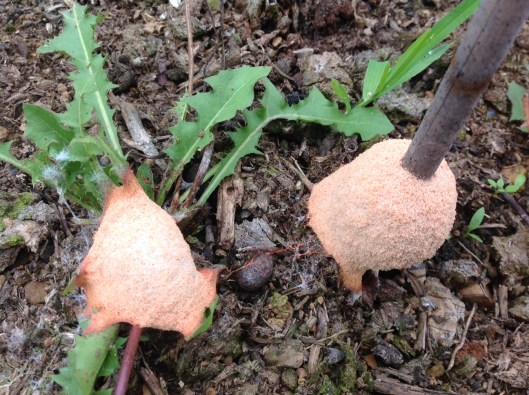
This morning the garden’s wonder is slime mould. One is puffball shaped, climbing a stake, while the other sprawls over a dandelion. Little tendrils appear to connect them, or show that they are the one … the one what? Creature? Plant? Are they one organism, or a collection?
They start the day a vibrant fluorescent yellow, but have now darkened to a peachy colour. Their powdery surface makes them look toxic, but various helpful websites tell us that they’re harmless, assisting in decomposition. They’re not fungi, but they use spores to reproduce. They can take many different forms – last time we had some it was like spilled paint tipped vibrantly over the soil. It appears that today’s are in their fruiting form. One type is attractively named the ‘dog vomit’ slime mould. Don’t blame the dog.