Tags
Seeking Sydney is a podcast that travels to the landscapes and landmarks of Sydney, adding the people and their stories. I will publish one episode every month for ten months. Episode 9 is now available in your podcast subscription, on the Spineless Wonders website, in Apple podcasts or Spotify or iHeart!
I call this episode ‘Time travel’ because we all time travel sometimes. We’re time travelling when we walk down a street and realise that a house that we’ve always looked at, is gone. We can still see every detail of it, but what is actually in front of us is a wire fence barricading off a piece of empty land.
Felicity Castagna sees how the streets and surrounds of Parramatta tell stories of their past and present inhabitants. She sees the migrant stories in the grand columns and staircases, and the stories of aspiration and hope in the fibro and red brick cottages.
Parramatta was established as part of the colony soon after the settlement at Sydney Cove. The soil at Parramatta was better than Sydney’s, and Governor Phillip was keen to make it the colony’s focus. But, as Naomi Parry Duncan says, the move out to Parramatta,
“was a military invasion. It wasn’t like Sydney Cove where it had been reasonably friendly, a beachhead settlement. Aboriginal people were like, oh yeah, these guys, well they don’t seem to be going very far. They don’t seem to know what they’re doing. So, yeah, it’s fine. We can hang around with them. We can enjoy their company. But once they went out to Parramatta and started to gobble up the land and push the people away from their lagoons and their rivers, and the places where they caught eel, the places of ceremony, the important places. Once they did that, then it was like, hang on a minute. And so war was the result. But they were outgunned. Literally.”
Naomi has been researching one of the people who fought in that war, the warrior Mousqueda [also Musquito], probably an Eora man, for 20 years. She tells his story vividly, giving us a sense of the people and dilemmas of that time. Mousqueda was arrested in 1805, but the war in the wider frontier beyond Parramatta continued. The Appin massacre of at least 14 Aboriginal men, women and children in April 1816, ordered by Governor Macquarie, marks the beginning of the final stage of that war.
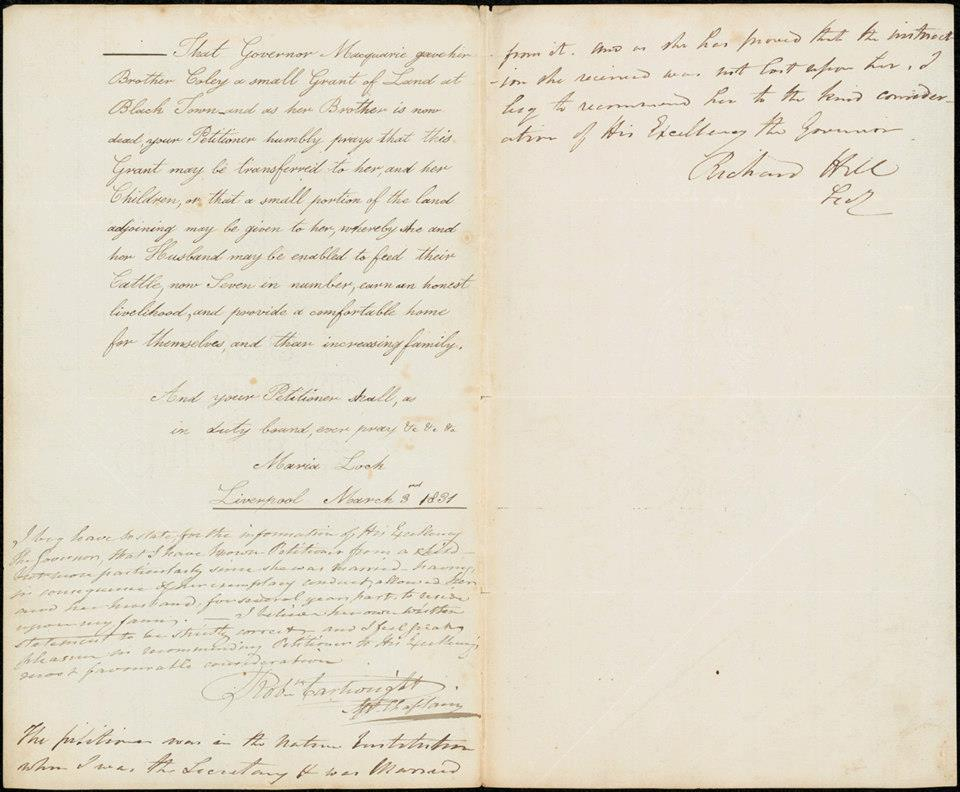
Macquarie arrived in the colony in 1810, not only determined to re-establish the rule of law after the military coup of 1808, but also determined to ‘civilise’ the Aboriginal people. He stated that he would do this through education – ‘in habits of industry and decency’ – and farming. He established the Native Institution in Parramatta, opened at the end of 1814 with four Aboriginal children. You can read its history here, and you can see the document that established it here. You can read an 1819 article about it from the Sydney Gazette here, including the report that the 14-year-old Aboriginal girl, Maria Lock, had won the overall prize for the schools in the colony. Maria Lock’s brother Colebee was granted 30 acres of land (with Nurragingy) in 1819, in the area now known as Blacktown. When both Colebee and Nurragingy died, Maria Lock petitioned Governor Darling for the land. You can see the petition here. She was eventually successful.
One of the saddest things about my research has been discovering, for so many institutions that I seek information about, ‘find and connect’ web pages, with their content warnings before you open the page:
This website contains material that is sometimes confronting and disturbing. Words or images can cause sadness or distress, or trigger traumatic memories for people, particularly survivors of past abuse, violence or childhood trauma.
There is one for the Parramatta Girls Home, established in 1887 in Fleet Street, North Parramatta. It operated under various names until 1975, with as many as 30,000 girls being placed in it over those years. Here is its ‘find and connect’ page.
Switching to the future, and a more hopeful aspect of life in the Parramatta area, is the Westmead Innovation District. John Richardson, a Consulting Partner with COX Architecture, has worked with the team developing this project. He outlined, in our interview, what an innovation district is and why Westmead was such a good choice for one.
There are obvious sustainability and social benefits of people living close to their work and high-class health facilities. Sydney – and the world – needs as much action on sustainability as we can get. Australia’s first National Climate Risk Assessment, finally released in September 2025, warns that the changing climate is likely to lead to more intense and extreme climate hazards – such as floods, cyclones, drought, fires and increased temperatures – in places where they haven’t been experienced before, more frequently and for longer periods.
But Penrith, on the northern edge of Western Sydney, has already been named the hottest place on Earth, with a temperature of 48.9 degrees recorded on January 4 2020. This was also the hottest day ever recorded in Greater Sydney.
Keeping with this episode’s theme of time travel, a 2023 article takes us travelling into the not-too-distant future. The first sentence of that article, ‘Impact of Accelerated Climate Change on Maximum Temperature Differences between Western and Coastal Sydney’ states:
“Increasing global emissions threaten to disproportionately impact the future of Greater Western Sydney (GWS), with some suburbs already experiencing temperatures 8 °C to 10.5 °C greater than the Sydney coastal region during heatwaves.”
And finally, going back to the past, Grace Karskens concludes episode 9 with the story of Nah Doong. You can hear, and read, a longer version of it here or here.
I hope you’ve been enjoying Seeking Sydney. Please share it, and listen out for Episode 10 – the last episode.
Acknowledgements
Interviewees for episode 9: my thanks to you all
Grace Karskens, Emeritus Professor of Australian History at the University of New South Wales. Her books include The Rocks: Life in Early Sydney (1997), The Colony: A History of Early Sydney (2009) and People of the River: Lost Worlds of Early Australia (2020).
Felicity Castagna, on Instagram under @Felicity Castagna
Naomi Parry Duncan, professional historian on Bluesky under @drnaomi
Paul Irish, historian and archaeologist, author of Hidden in Plain View
Deborah Lennis, Cultural Advisor Inner West Council
John Richardson, Sydney architect
Thanks also to:
Bronwyn Mehan, Spineless Wonders
Martin Gallagher, Echidna Audio: sound design
Zoe Hercus: publicity
Bettina Kaiser: logo & artwork
Peter Barley: extra voices
References
In this episode I referred to two books that are full of insights and different ways of looking at Australia’s past:
Billy Griffiths, Deep Time Dreaming, Black Inc (2018), p4 and p234.
Heather Goodall and Allison Cadzow. Rivers and resilience: Aboriginal people on Sydney’s Georges River. UNSW Press, 2009, p53.
 Kathy Prokhovnik